
Hello! Welcome back to your system design course.
In our last lesson, we delved into the fundamental trade-offs of distributed systems—Consistency, Availability, Latency, and Scalability. We established that you can't have everything at once and that designing a system involves making deliberate choices based on your application's needs. We discussed that these systems are composed of different services that need to communicate and coordinate.
Today, we'll focus on exactly how that communication happens.
Today's Goal
This lesson will teach you how to design API contracts for system components using REST or RPC patterns.
An API (Application Programming Interface) is the mechanism through which different software components interact. The "contract" is the formal agreement that defines the rules of that interaction.
Coming from a product design background, you can think of an API contract as a detailed technical specification for a part in a larger assembly. For a product to work, every component must adhere to its specifications—its dimensions, material, and connection points. An API contract serves the same purpose for software components, ensuring they can connect and work together seamlessly.
1. What is an API Contract?
An API contract is a formal, written agreement that specifies how a client should interact with a server or how two services should communicate with each other. It provides a single source of truth that development teams can rely on.
To understand why this is so important, let's look at a resource that breaks down the key components and benefits.
This article from GeeksforGeeks clearly defines what an API contract is and why it's a cornerstone of good system design.
Please read the sections titled 'Importance of API Contracts in System Design' and 'Key Components of an API Contract'. As you read, notice how these principles enable parallel development, much like how different teams can manufacture different parts of a product simultaneously if they all work from the same set of blueprints.
As the article highlights, a well-defined contract includes endpoints, methods, request/response formats, and authentication rules. This clarity prevents misunderstandings and allows frontend and backend teams to work independently.
Now, let's explore the two most common patterns for structuring these contracts: REST and RPC.
2. REST: The Language of the Web
REST (Representational State Transfer) is an architectural style that has become the de facto standard for building web APIs, especially for public-facing services and client-server communication (e.g., a mobile app talking to a backend).
REST is built on the principles of the web itself. It uses standard HTTP methods to perform actions on "resources."
To get a comprehensive overview, let's watch a video that explains API design from an interview perspective. It provides a clear, practical breakdown of REST.
API Design in System Design Interviews w/ Meta Staff Engineer
This video from Hello Interview, presented by a former Meta staff engineer, provides an excellent, practical guide to API design, starting with a deep dive into REST.
Please watch from the beginning until 12:39. This segment covers: What an API is (1:22 - 2:34) An overview of API protocols (2:34 - 3:59) A detailed breakdown of REST (3:59 - 12:39) Pay close attention to the core concepts of resources, HTTP methods (verbs), and the different types of input parameters (path, query, body).
Key Elements of a REST API Contract
As the video explained, designing a REST API involves defining the following:
- Resources: The "nouns" of your system. These are typically plural (e.g.,
/users,/products,/orders). - Endpoints: The specific URL that identifies a resource (e.g.,
/products/12345). - HTTP Methods: The "verbs" that define the action to be taken on a resource.
GET: Retrieve a resource.POST: Create a new resource.PUT/PATCH: Update an existing resource (fully or partially).DELETE: Remove a resource.
- Request/Response: The data formats for communication. This includes path parameters, query parameters, request bodies, and the structure of the JSON response.
- Status Codes: Standard codes to indicate the outcome (e.g.,
200 OK,201 Created,404 Not Found,500 Internal Server Error).
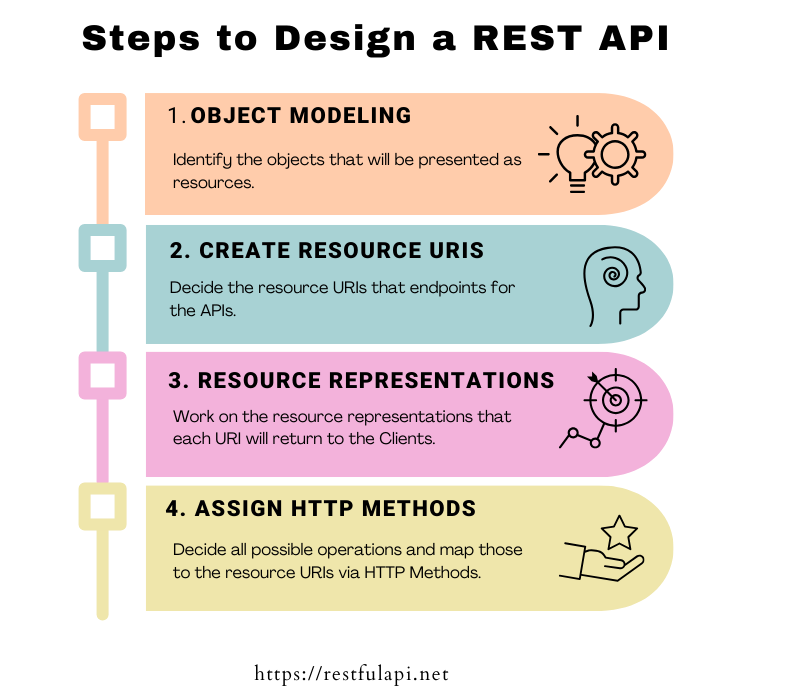
This entire process can be visualized as a clear, four-step design flow.
Example: A Simple Blogging API
Let's say we're designing an API for a blog. Here’s what a simple REST contract might look like:
- Create a new post:
POST /posts- Request Body:
{ "title": "My First Post", "content": "Hello, world!" } - Response:
201 Createdwith the full post object, including its new ID.
- Request Body:
- Get all posts:
GET /posts- Response:
200 OKwith a list of post objects.
- Response:
- Get a single post:
GET /posts/{postId}- Response:
200 OKwith the full post object.
- Response:
- Delete a post:
DELETE /posts/{postId}- Response:
204 No Content(indicating success with no data returned).
- Response:
This structure is intuitive and leverages the built-in features of HTTP, which is why it's so popular.
3. RPC: For High-Performance Internal Communication
While REST is great for public APIs, it's not always the best choice for communication between services inside a complex, distributed system (i.e., microservices). For this, we often turn to RPC (Remote Procedure Call).
The core idea of RPC is simple: make a function call on a remote server as if it were a local function in your own code. Instead of thinking about resources and HTTP verbs, you think about actions and methods.

Modern RPC frameworks like gRPC (developed by Google) are designed for high performance. They use efficient, binary data formats instead of human-readable text like JSON, and they operate over the high-performance HTTP/2 protocol.
Let's watch a short video that explains gRPC and its benefits.
What is RPC? gRPC Introduction.
This video from ByteByteGo gives a quick and clear animated explanation of what RPC and gRPC are, how they work, and when to use them.
Please watch from the beginning to 4:41, and then the final summary from 5:18 to 6:03. Focus on: How gRPC uses Protocol Buffers to define a strongly-typed contract. The performance benefits of binary encoding and HTTP/2. The typical use case: inter-service communication.
Key Elements of a gRPC API Contract
With gRPC, the contract is formally defined in a .proto file using Protocol Buffers. This file specifies:
- Services: A collection of related functions (e.g.,
TicketService). - Methods: The specific functions that can be called (e.g.,
GetEvent,CreateBooking). - Messages: The data structures for requests and responses (e.g.,
GetEventRequest,Event).
From this single .proto file, gRPC can automatically generate the client and server code in many different programming languages, ensuring the contract is strictly followed.
Example: RPC vs. REST
Let's see how a simple action compares in REST and RPC.
| Action | REST | RPC (Conceptual) |
|---|---|---|
| Get user details | GET /users/123 | usersService.getUser({ userId: 123 }) |
| Add a product | POST /products | productsService.addProduct({ name: "...", price: ... }) |
The RPC vs REST article from AWS provides a great table illustrating this difference. The RPC approach feels more like programming, while the REST approach feels more like manipulating data records.
4. Choosing the Right Pattern
So, when should you use REST versus RPC?
-
Use REST for:
- Public/External APIs: It's a web standard that any developer can easily understand and use without special tooling.
- Client-to-Server Communication: Perfect for web and mobile apps talking to your backend.
- Resource-centric services: When your API is primarily about CRUD (Create, Read, Update, Delete) operations on data objects.
-
Use RPC (like gRPC) for:
- Internal Microservice Communication: When you control both the client and the server, and performance is critical.
- Action-oriented services: When the API is more about triggering actions than managing data objects (e.g.,
paymentService.processPayment(...)). - Polyglot environments: When your microservices are written in different languages, gRPC's code generation is a huge benefit.
Conclusion
Today we've demystified API contracts and explored the two dominant patterns for designing them. You now have a framework for defining how the different parts of your system will communicate.
Key Takeaways:
- API contracts are the blueprints for communication in a distributed system, enabling clarity and parallel development.
- REST is a resource-oriented style using standard HTTP verbs. It's the default choice for public APIs and client-server interaction due to its simplicity and ubiquity.
- RPC is a function-oriented style focused on executing actions. Modern implementations like gRPC are optimized for high-performance, internal communication between microservices.
- The choice between REST and RPC is a classic design trade-off between standardization/simplicity (REST) and performance/type-safety (gRPC).
Preview of the Next Lesson:
We've now covered architectural patterns, fundamental trade-offs, and communication contracts. The final piece of the fundamentals puzzle is learning how to represent all of this visually. In the next lesson, we will learn how to create component diagrams that effectively communicate system architecture. This will allow you to take all the concepts we've discussed and present them in a clear, easy-to-understand blueprint.
Can't find a good explanation? Sign up and we'll make it for you
Sign up