
Hello. You now have a focused video question and a central mechanism—perhaps the block-and-tackle example: Why can several pulleys lift a heavy load with less pulling force? This lesson is where you protect that promising idea from becoming a polished but inaccurate animation.
For a 30–60 second explainer, you do not need to research everything about a machine. You need to verify the small set of statements on which your explanation depends, record the conditions that make those statements true, and translate them into wording that stays accurate when simplified. By the end, you will have a compact research packet ready to support your script.
Plan for about 40 minutes: a short source-evaluation video, one reading, and a focused fact-recording session.
Research claims, not topics
A search for “how pulleys work” can produce thousands of pages, diagrams, videos, product listings, and simplified explanations. That is too broad to evaluate efficiently. Instead, break your video’s mechanism into atomic claims: small statements that can each be checked.
For the block-and-tackle video, the claims might be:
| Claim type | Claim to verify | Why it matters in the video |
|---|---|---|
| Central mechanism | Several rope segments can support the moving load simultaneously. | This is the explanation’s main idea. |
| Force claim | In an ideal arrangement, more supporting rope segments reduce the required pulling force. | Prevents the animation from implying that pulleys create energy. |
| Tradeoff | The person must pull more rope to lift the load a given distance. | Gives the viewer the memorable “less force, more distance” conclusion. |
| Limitation | Friction and the weight of real components reduce the ideal advantage. | Stops the explanation from presenting an ideal model as a perfect real machine. |
| Terminology | “Fixed block,” “movable block,” “load,” “free end,” and “supporting rope segment.” | Helps you label the drawing consistently. |
Notice the boundary. You are not researching every crane, every rope material, or every pulley arrangement. You are collecting only what your script will claim.
A useful rule is:
If a viewer could reasonably repeat it as a fact after watching, verify it.
That includes visual statements. If your animation highlights four rope sections and labels the system “four times easier,” that is a factual claim even if the narration never says those words.
Use a source hierarchy, but match it to the claim
Not every reliable source serves the same purpose. A technical standard may be authoritative but unhelpful for a beginner-level explanation; a popular animation may be visually clear but too simplified to support a physics claim.
For a first engineering explainer, look for sources in roughly this order:
- Engineering textbooks, university course materials, and reputable educational institutions for established mechanisms and definitions.
- Peer-reviewed research or professional engineering organizations for contested, current, or technical claims.
- Government agencies and standards bodies for safety requirements, measurements, regulations, or public infrastructure facts.
- Manufacturer documentation for specifications of a particular product, while remembering that it may emphasize favorable performance.
- Popular articles and videos for understandable language, visual references, and search terms—not as your only evidence for the central claim.
A source is not automatically good merely because it looks professional. It must be good for the exact claim you want to make. A thirty-year-old mechanics textbook can be entirely suitable for explaining an ideal pulley. A thirty-year-old article about current battery performance, however, would need much more scrutiny.
The University of Denver Libraries offers a compact engineering-focused check called CUT: Current, Useful, and Trustworthy.
Evaluate your sources - A Guide to Engineering Research - Library Guides at University of Denver
Read the University of Denver Libraries guide to give yourself a practical standard before collecting facts. It is especially useful for distinguishing a source that is merely easy to understand from one that is appropriate evidence for an engineering script.
In the section “Evaluate your sources with the CUT test,” read the CUT checklist in full. For each criterion, imagine applying it to one source you may use for your chosen mechanism. Pay particular attention to whether the author is qualified for this specific topic and whether you can verify the claim elsewhere.
For your workflow, interpret CUT this way:
- Current: Is the date appropriate for this claim? Core mechanics may be stable; performance figures, regulations, materials, and safety claims may change.
- Useful: Does the source directly explain your mechanism, including its assumptions? A source that only mentions pulleys is not enough.
- Trustworthy: Can you identify the author or organization, their relevant expertise, and the evidence or references behind the explanation?
Check the path from headline to evidence
Online explanations often become less precise as they are repeated. A short video might summarize an article, which summarizes a report, which summarizes a study. Each retelling can discard conditions, uncertainty, or inconvenient limitations.
CrashCourse’s SIFT method gives you a practical way to pause before treating an appealing statement as a script fact.
Evaluating Sources & Fact Checking: Crash Course Scientific Thinking #6
Watch “Evaluating Sources & Fact Checking: Crash Course Scientific Thinking #6” from CrashCourse for a quick, practical fact-checking workflow. The method is useful when an online explanation gives you a satisfying sentence that may be too neat to be fully accurate.
In the segment on the SIFT method, watch the four checks. Focus on the difference between investigating the publisher, finding independent coverage, and tracing a claim back to its original context. Apply this particularly to claims that come from videos, infographics, search-result snippets, or social posts.
For an engineering creator, SIFT becomes a short routine:
- Stop. Do not write a claim into the script just because it produces a good hook or a clean visual.
- Investigate the source. Identify the organization, author, purpose, and relevant expertise.
- Find better coverage. Seek an independent source that explains the same mechanism.
- Trace the claim to its context. Find the original textbook section, paper, technical explanation, or documentation rather than relying on someone else’s summary.
“Independent” matters. Three websites that copied the same incorrect sentence are not three confirmations. The aim is to find another credible explanation that reaches the same conclusion through its own evidence.
For your first video, aim for two independent credible sources for the central mechanism and for any number you show on screen. One excellent source may establish a basic definition, but a second source is valuable because it reveals hidden assumptions.
Verify conditions, not just conclusions
Engineering statements are frequently true only under particular conditions. The most common research mistake in an explainer is finding a correct conclusion and removing the words that make it correct.
Consider the statement:
“A four-pulley system reduces the lifting force by four.”
This is too imprecise to use safely. The ideal mechanical advantage depends on the number of rope segments supporting the moving load, not simply on the number of visible pulleys. It also assumes an idealized system with negligible friction and a suitable rope arrangement.
For a block and tackle, the reasoning in an ideal model is:
Here, is the number of rope segments supporting the movable block, is the tension in each segment, and is the load’s weight. If the free end of the rope is pulled with approximately the same force as the tension, then:
That is why the number of supporting segments is the fact worth researching and animating.
But the force reduction comes with a distance tradeoff. If the load rises a distance , the person must pull roughly of rope in the ideal model:
You do not need to include equations in a 45-second video. You do need to preserve their meaning. A script-safe version might be:
“Each supporting rope section shares part of the load. You pull with less force, but you pull a longer length of rope.”
That wording is clear, visual, and accurate enough for a beginner audience. For real systems, add a brief limitation only if it fits your pacing:
“Real pulleys lose some of that advantage to friction.”
The key habit is this: record the assumptions beside the fact. Never store only the simplified conclusion.
Turn sources into a claim–evidence–reasoning record
Research becomes usable only when you can retrieve it during scripting. A pile of browser tabs is not a research system.
Use the Claim, Evidence, Reasoning framework as your notes structure. It forces you to separate what you want to say from what the source actually establishes, then explain the connection between them.
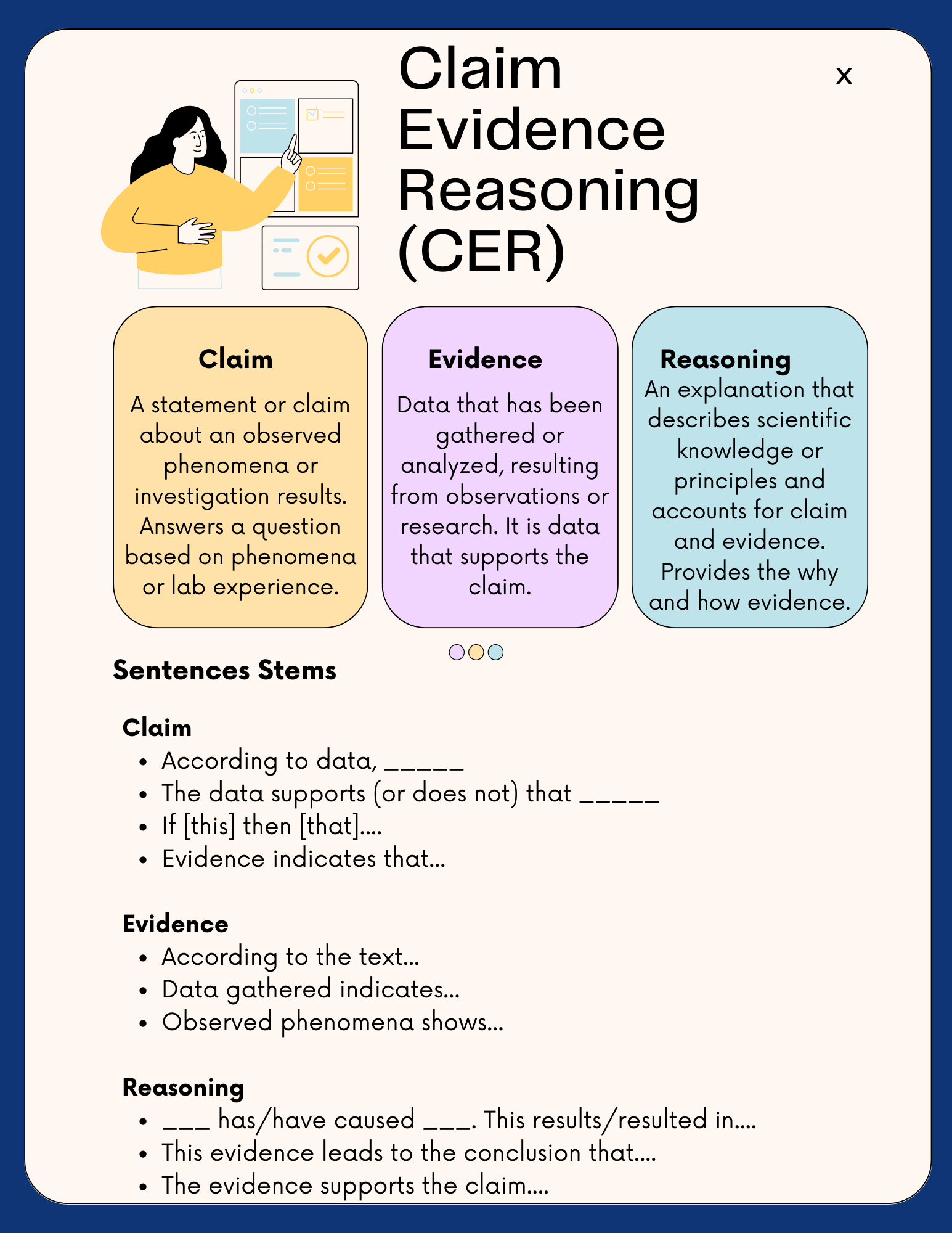
For every important script statement, create one short CER entry:
- Claim: The statement viewers will learn.
- Evidence: The precise source-backed fact, definition, diagram, measurement, or quotation.
- Reasoning: Why that evidence supports the claim, including conditions and limitations.
- Visual consequence: What the audience should see to understand the reasoning.
For the pulley topic, a completed entry could look like this:
Claim ID: M1

Draft claim:
Several rope sections can share the load on a movable pulley block.

Evidence:
[Record the author’s explanation or diagram showing the supporting segments.]
Source A: [title, author or organization, publication date, URL, section or page]
Source B: [same details]

Reasoning:
In an ideal system, each taut supporting segment pulls upward on the moving
block. More supporting segments mean the load is distributed among them.

Conditions:
Idealized model; the number of supporting rope segments matters; friction
reduces the real advantage.

Visual consequence:
Highlight each rope segment connected to the moving block, then show all
highlighted segments pulling upward as the crate rises.

Script-safe wording:
“Several taut rope sections share the load, so each one has less weight to
support.”
The evidence field should preserve enough detail to check later. Do not write “a website said so.” Capture:
| Record | What to save |
|---|---|
| Source identity | Title, author or organization, publication date, and URL |
| Exact location | Section heading, page number, figure number, or timestamp |
| Relevant passage | A short quotation or faithful paraphrase in your own words |
| Claim supported | The exact sentence or visual label in your planned video |
| Conditions | Ideal model, range, material, operating condition, or definition |
| Cross-check | A second source that agrees, disagrees, or adds a limitation |
| Script wording | The short, audience-friendly version you can responsibly say |
Keep this fact sheet in your phone notes app, a document, or a spreadsheet inside the video’s project folder. Give each claim an ID such as M1 for “main mechanism,” T1 for “tradeoff,” and L1 for “limitation.” When you later revise the script, you will know exactly which notes must be checked again.
Research like a careful explainer, at a smaller scale
Kurzgesagt’s visual style may be an inspiration, but its research habit is more important than any visual feature: begin with a question, build a baseline from literature, test the draft against stronger knowledge, and simplify without pretending that complexity has disappeared.
Can You Trust Kurzgesagt Videos?
Watch Kurzgesagt – In a Nutshell’s “Can You Trust Kurzgesagt Videos?” for its account of how research, fact-checking, concision, and source lists fit together. You are not expected to reproduce a studio-scale process; use it as a standard for the direction of your workflow.
Watch research and review to see why an initial script should be open to correction. Then watch concise conclusions for the tension between brevity and oversimplification. Focus on the principle: simplifying a mechanism is necessary, but removing essential conditions makes the simplified version misleading.
For a one-week production course and a first short video, your scaled-down verification pass can be completed in about 20 minutes:
- Write three to five atomic claims from your decision sheet.
- Search for each claim using technical terms, not only your planned title. For example, search phrases such as “block and tackle supporting rope segments,” “ideal mechanical advantage pulley,” and “pulley distance tradeoff.”
- Reject sources that do not identify an author or organization, do not explain their evidence, or only repeat a broad claim without conditions.
- Record one strong source for each claim and a second independent source for the main mechanism.
- Compare the two explanations. If they disagree, do not hide the difference. Identify whether they assume different pulley layouts, ideal conditions, or levels of detail.
- Write a script-safe version that includes the important qualifier without drowning the viewer in jargon.
Do not treat generated AI responses, search snippets, comments, or attractive infographics as evidence. They can help you discover vocabulary or locate questions worth checking, but your recorded evidence should come from sources whose authorship and context you can evaluate.
Avoid the four accuracy traps in short engineering videos
A short video has little space to repair a misleading first impression. Watch for these traps while drafting your fact sheet.
| Trap | Why it fails | Better production decision |
|---|---|---|
| Counting visible objects instead of the mechanism | Four pulleys do not automatically mean a fourfold force reduction. | Count and animate the rope segments supporting the moving load. |
| Turning an ideal model into reality | Friction, component weight, and geometry can change performance. | Use “ideally” in notes; add a compact friction caveat if needed. |
| Using a number without its unit or condition | “50% more efficient” is meaningless without a reference case. | Record what was measured, under what condition, and compared with what. |
| Treating a source as a script | Source wording may be too technical, incomplete, or aimed at another audience. | Preserve the source’s meaning, then rewrite it for your viewer. |
Accuracy does not mean packing every caveat into the narration. It means choosing a claim that remains true after simplification. Your scope boundary from the previous lesson is what makes that possible.
Key takeaways
A reliable engineering explainer begins with a claim list, not an unfocused search. Verify the central mechanism, every numerical or visual claim, the key tradeoff, and any limitation needed to avoid a false impression.
Use CUT to decide whether a source is current, useful, and trustworthy. Use SIFT to investigate its origin, seek independent coverage, and trace a claim back to its proper context. Then record each fact with its source, location, conditions, cross-check, and script-safe wording.
For your selected topic, finish this lesson with a small research packet containing:
- one verified central-mechanism claim;
- one verified tradeoff or consequence;
- one limitation or condition;
- two credible sources for the main claim; and
- a CER note connecting each claim to a planned visual action.
In the next lesson, you will use this packet to write a concise script with a hook, a clear causal explanation, and a memorable closing.
Can't find a good explanation? Sign up and we'll make it for you
Sign up