
Hello! Welcome to your next lesson in the "Building a High-Performance Marketing Organization" module.
In our last lesson, we focused on internal team dynamics, creating a framework to assess skill gaps and plan professional development. Building a capable team is the first step. The next, equally crucial step is ensuring that your team's valuable, data-driven work gains traction and influences decisions across the wider organization. This is where leadership moves from managing a team to driving business strategy.
Today, your learning outcome is to lead a process for aligning key stakeholders around a new data-driven initiative. Many great analytical projects fail not because the data is wrong, but because the key people weren't brought along on the journey. This lesson will provide you with a systematic process to manage these crucial relationships, secure buy-in, and turn your team's insights into impactful business action.
We will break this down into a four-step framework:
- Identify & Analyze: Who are your stakeholders and which ones matter most?
- Understand & Plan: What motivates them and how will you approach them?
- Engage & Communicate: How do you execute your plan and tailor your message?
- Manage & Collaborate: How do you handle resistance and foster true partnership?
1. The Foundation: Stakeholder Identification and Analysis
Before you can align anyone, you need a clear map of the landscape. A stakeholder analysis is a structured process to identify who has a stake in your project, understand their importance, and plan how to engage with them.
A simple yet powerful way to think about this is a three-step process: Identify, Prioritize, and Understand.
What is a Stakeholder Analysis? — Leading Successful Projects
To get a clear overview of this foundational process, please watch this short video from ProductPlan. It breaks down the core concepts of a stakeholder analysis.
Watch from 00:31 to 03:38. As you watch, focus on the three core steps: Identify: How to brainstorm who is affected by your project. Prioritize: How the Power-Interest grid helps you categorize stakeholders. Understand: The key questions to ask to learn about each stakeholder's motivations and perspective.
Step 1: Identify Your Stakeholders
As the video and your own experience suggest, a stakeholder is anyone professionally involved in or affected by your project. For a new data-driven marketing initiative (e.g., launching an incrementality testing program or adopting a new attribution model), this can be a wide-ranging group.
Stakeholder Management for Digital Marketers
The article 'Stakeholder Management for Digital Marketers' provides a helpful way to categorize these individuals. As you read, think about a recent project and who would fit into these groups.
Please read the sections 'Who counts as a stakeholder?' and 'Listing your stakeholders'. Notice the breakdown into Your Team, Internal Stakeholders, and External Stakeholders.
A good practice is to brainstorm this list with your team. Don't self-censor at this stage; get everyone down on paper. This could include:
- Your Team: The analysts and marketers running the initiative.
- Internal: The CMO, CFO, Head of Sales, product managers, the engineering team supporting your data infrastructure.
- External: Agency partners, technology vendors, and even customers.
Step 2: Prioritize Using a Stakeholder Map
Not all stakeholders are created equal. Trying to give everyone the same level of attention is inefficient and ineffective. The key is to prioritize based on their Power (or Influence) to affect the project and their Interest (or Impact) in its outcome.
This is typically visualized using a 2x2 matrix, often called a Power-Interest Grid or Stakeholder Map.
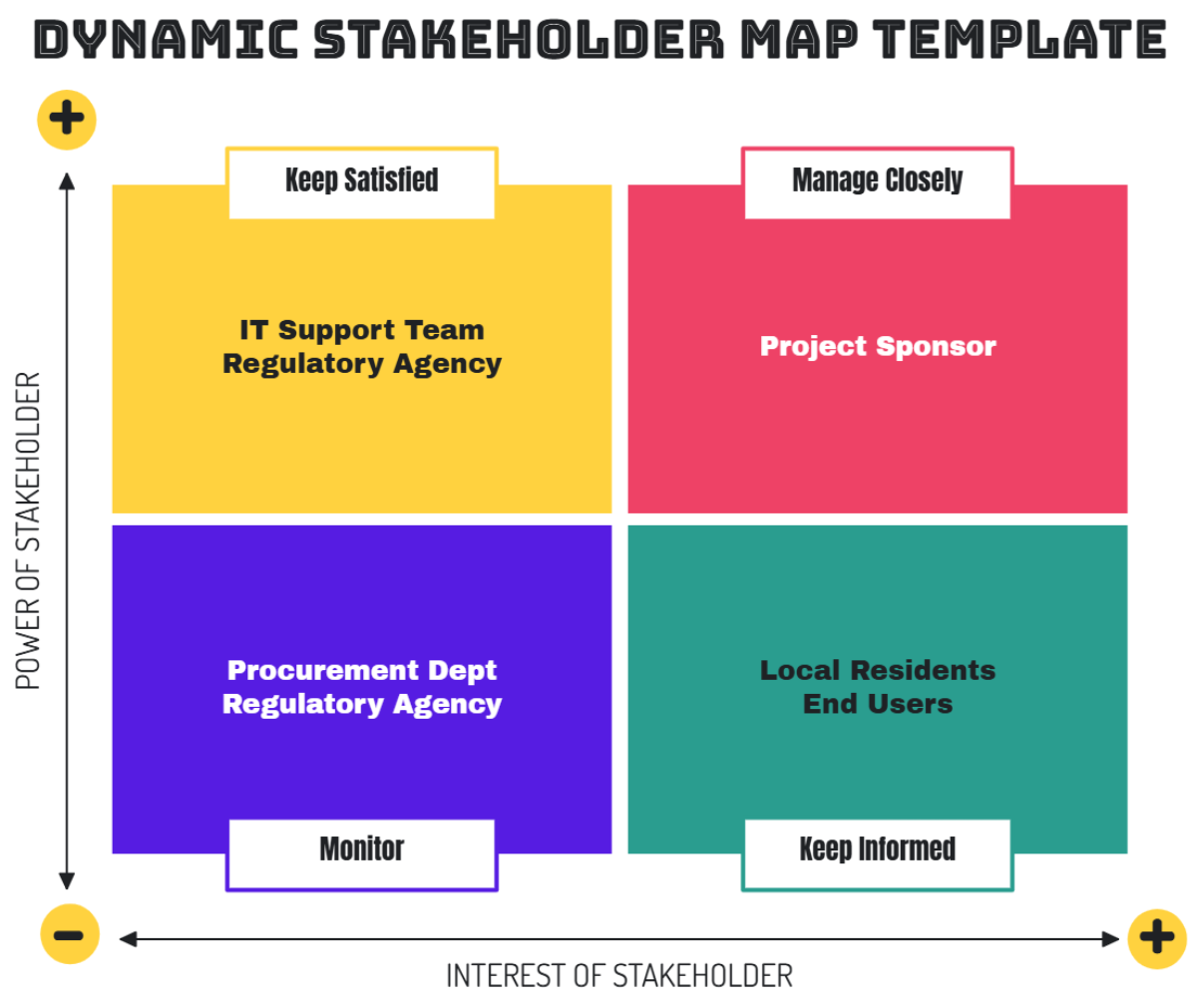
To apply this, you'll assess each stakeholder you identified:
- Power/Influence: How much authority do they have to block or enable your initiative? Do they control budgets, resources, or critical decisions?
- Interest/Impact: How much will this initiative affect their work, their team, their budget, or their own goals?
Plotting your stakeholders on this grid gives you a clear action plan:
- High Power / High Interest (Manage Closely): These are your key players (e.g., your CMO, the CFO). You must fully engage them and make the greatest efforts to satisfy their needs.
- High Power / Low Interest (Keep Satisfied): These stakeholders have power but aren't deeply involved in the details (e.g., Head of IT). Keep them satisfied, but don't overwhelm them with information.
- Low Power / High Interest (Keep Informed): This group is passionate and can be a great source of feedback, but they don't have final say (e.g., an analyst in another department, end-users of a report). Keep them adequately informed and ensure no major issues are arising.
- Low Power / Low Interest (Monitor): These stakeholders require minimal effort (e.g., procurement department for a small software purchase). Monitor them, but don't bother them with excessive communication.
2. Understanding Motivations and Planning Your Approach
With your stakeholders mapped, the next step is to go deeper than just power and interest. You need to understand their human motivations. This is the "Understand" step from the introductory video, but applied with strategic intent.
Stakeholder Management for Digital Marketers
This article from Target Internet explains how to move from mapping to planning by identifying who is likely to support or oppose your initiative.
Read the section 'Finding your advocates and detractors.' The key action here is to talk to people and listen. Your goal is to understand the 'why' behind their stance.
For each key stakeholder (especially those in the "Manage Closely" and "Keep Satisfied" quadrants), build a simple profile by asking:
- What are their primary goals and KPIs? How is their success measured? (e.g., The Head of Sales cares about lead quality and conversion rates, not just marketing spend efficiency).
- What are their pain points? What problems keep them up at night that your initiative could potentially solve?
- From their perspective, what are the pros and cons of your initiative? Be honest. Will it create more work for their team? Does it threaten a process they built?
- Are they an Advocate, a Detractor, or In-between? Based on the above, what is their likely initial position?
This process of understanding their world is the foundation for building trust and communicating effectively.
Building Strong Relationships with Business Stakeholders
The article 'Building Strong Relationships with Business Stakeholders' is written for data leaders and offers excellent advice on bridging the gap with non-technical partners.
Read the section 'Understanding Your Stakeholders.' Pay close attention to the concepts of identifying Line of Business (LOB) owners and 'Opening Up the Black Box.' This is about translating your data project into their business reality.
Test your understanding!
Imagine you are proposing a new, data-driven initiative to shift 20% of your Meta Ads budget from awareness campaigns to a new predictive LTV-based acquisition campaign.
- Identify a stakeholder you would place in the High Power / High Interest quadrant.
- Identify a stakeholder you would place in the High Power / Low Interest quadrant.
- For the "High Power / High Interest" stakeholder, what is one key question you would ask to understand their motivation and potential concerns?
Show answer
- High Power / High Interest: The Chief Financial Officer (CFO). They have high power over budget allocation and high interest in the financial return (ROAS, LTV/CAC) of marketing investments. The CMO is another excellent answer.
- High Power / Low Interest: The Head of Engineering. They have power because their team might be needed to provide data feeds or technical support for the pLTV model, but their day-to-day interest in the marketing campaign's strategy is low.
- Key Question for the CFO: A great question would be, "Beyond the top-line revenue impact, what are the key financial metrics you'll use to judge the success of this shift in the first six months? Are you more concerned with short-term payback period or long-term profitability?" This shows you're thinking in their language and aligning with their financial oversight goals.
3. Executing the Alignment: Communication and Persuasion
Your analysis and planning now culminate in targeted communication. The goal is to create personalized pitches that resonate with each stakeholder's unique motivations and concerns.
Tailoring Your Message
Generic, one-size-fits-all presentations don't work. You must frame your initiative in terms of what matters to your audience. This is often summarized as answering "What's In It For Me?" (WIIFM) for each stakeholder.
Building Strong Relationships with Business Stakeholders
The article 'Building Strong Relationships with Business Stakeholders' provides practical tactics for tailoring your communication.
Read the section 'Communicate Effectively.' Focus on the practical examples: 'Speak Their Language,' 'Results Over Processes,' and 'Keep It Simple.' This is the core of translating a data initiative into a business proposal.
For example:
- To the CFO: You don't talk about the machine learning model. You talk about improving the LTV/CAC ratio by 15% and shortening the new customer payback period.
- To the Head of Sales: You don't talk about ad impressions. You talk about how this new targeting will deliver higher-intent leads that are 20% more likely to convert.
- To the Engineering Team: You provide clear, concise technical requirements and explain the business impact their work will enable.
Structuring the Conversation
Having a clear structure for your pitch or presentation is critical. A logical flow helps your audience follow your reasoning and arrive at the same conclusion you did.
Share metrics and insights with stakeholders | Google Digital Marketing & E-commerce Certificate
This clip from a Google training video offers a simple but effective template for structuring a presentation to stakeholders, especially when you are asking for a change.
Watch from 26:16 to 29:26. Pay attention to the recommended flow: progress from general to specific, state insights upfront, use data to support the insights, and end with a clear call to action.
4. Managing Resistance and Fostering Collaboration
Even with the best plan, you will encounter skepticism and resistance. This is normal. Your role as a leader is not to bulldoze opposition but to understand and manage it constructively.
Start with your advocates to build momentum. Getting early "yeses" from influential supporters creates social proof that can help persuade those who are on the fence.
Stakeholder Management for Digital Marketers
Winning over skeptics is a critical leadership skill. This final reading provides strategies for dealing with detractors and some important tactics to avoid.
Read the sections 'Winning over detractors' and 'Tactics to avoid'. Key takeaways include understanding their motivations, offering them value, involving them in feedback, and avoiding group meetings that can turn negative.
Key strategies for managing detractors include:
- Listen First: Understand the root cause of their opposition. Is it based on a past failure? A resource constraint? A genuine disagreement on strategy?
- Find Common Ground: Connect the initiative back to a shared business goal you both care about.
- Involve Them: Ask for their feedback and genuinely incorporate it where possible. This can turn a detractor into a partner by giving them a sense of ownership.
- Know When to Escalate: If a detractor's opposition is insurmountable and they have the power to block the project, you may need to use the support of your own high-power advocates (like your manager or a project sponsor) to find a compromise or override the block.
Finally, true alignment comes from collaboration. Invite stakeholders into the process through workshops, regular check-ins, and establishing a shared language with common definitions and metrics.
Conclusion
Leading a stakeholder alignment process is a core function of any strategic marketing leader. It's how you ensure your team's analytical horsepower translates into real-world business momentum. By moving from ad-hoc conversations to a structured process, you dramatically increase your chances of success.
Key Takeaways:
- Start with a Map: Use a Power-Interest grid to identify, categorize, and prioritize your stakeholders.
- Understand the 'Why': Go beyond the map to understand the motivations, goals, and pain points of your key stakeholders. Classify them as advocates, detractors, or in-betweens.
- Speak Their Language: Tailor your communication to each stakeholder. Frame your data-driven initiative in terms of the business outcomes they care about, focusing on results over technical processes.
- Build a Coalition: Start with your advocates to build momentum, and use structured, empathetic strategies to listen to, involve, and win over skeptics.
- Manage the Process: Treat stakeholder alignment as a project in itself, with a clear plan, deliberate execution, and ongoing management.
Preview of Your Next Lesson:
Successfully aligning stakeholders on a major data-driven initiative will build confidence in your team and its capabilities. A natural consequence is that you'll start receiving more requests for data and analysis from across the business. To prevent your team from being overwhelmed by ad-hoc queries, you need a system. In our next lesson, we will focus on how to "Establish a governance process for managing and prioritizing analytical requests from across the business."