
Hello! Welcome to the next lesson in our final module, "Building a High-Performance Marketing Organization."
In our last lesson, we focused on organizational design, defining the core roles, responsibilities, and skillsets needed for a modern marketing analytics function. You now have a blueprint for the what—the competencies and functions your team needs to cover. Today, we'll build on that by tackling the how: how to find and hire the right people to bring that blueprint to life.
Your learning outcome for this lesson is to design a structured interview process and scorecard for hiring marketing analysts and specialists. As you transition into a more strategic leadership role, moving from managing a team to building one is a critical step. A well-designed, structured hiring process is your most powerful tool for reducing bias, making better decisions, and ensuring you bring on talent that will truly elevate your team's capabilities.
1. The Architecture of a Structured Hiring Process
Before diving into specific questions or scorecards, let's establish the overall structure. A haphazard process, where different candidates get different experiences, often leads to poor hiring decisions based on "gut feel." A structured process ensures fairness and consistency by defining clear stages, each with a specific purpose.
The journey from application to offer is a funnel designed to progressively assess different candidate attributes. The initial stages filter for baseline qualifications, while later stages allow for a deep dive into specific skills and competencies.
What are Hiring Managers Looking For? | Nail the Interview Process!
To understand this funnel, let's watch a segment from Alex The Analyst's video, 'What are Hiring Managers Looking For?'. He breaks down the initial stages of hiring from a manager's perspective, explaining the role of automated screening and recruiters.
Watch from 00:00:45 to 00:04:15. Pay attention to how candidates are filtered based on keywords and minimum qualifications before a hiring manager even sees their resume. This highlights the importance of having a clear job description and requirements from the start.
As the video explains, the process begins long before your first conversation. A typical structured hiring process includes these stages:
- Application & Resume Screen: Automated or manual check for minimum qualifications.
- Recruiter Screen: A brief call to verify experience, assess motivation, and check for alignment on basics like salary expectations and role scope.
- Hiring Manager Screen: Your first conversation to assess high-level fit, dive into their experience, and sell them on the opportunity.
- Technical / Skills Assessment: A practical test of hard skills (e.g., a case study, a work sample, a technical screen).
- Competency & Behavioral Interview: A deep dive into past experiences to assess soft skills, problem-solving approaches, and cultural fit.
- Final Round & Debrief: A final conversation, often with a senior leader or key cross-functional partner, followed by a meeting where the interview team consolidates feedback using their scorecards.
Your role as the hiring manager is to be the architect of this entire process.
2. Defining Your Target: The Ideal Candidate Profile
You can't find what you haven't defined. The first step in designing your process is to translate the job description into a concrete Ideal Candidate Profile. This internal document goes beyond a list of responsibilities and outlines the specific behavioral competencies and skills essential for success. This is where you connect back to the competencies we defined in the last lesson.
A fantastic resource for this is the "Example Interview Guide for Marketing Specialist" from Yardstick. It provides a complete template for a structured hiring process.
Example Interview Guide for Marketing Specialist
This guide from Yardstick offers a comprehensive template for a structured hiring process. We'll start by examining how it defines the ideal candidate.
Please read the section titled 'Ideal Candidate Profile (Internal)'. Focus on the 'Essential Behavioral Competencies' listed: Creativity, Data Analysis, Communication, Adaptability, and Collaboration. This is the core of what your interview process will be designed to measure.
These competencies—like Data Analysis and Communication—become the pillars of your interview process. Every question you ask and every assessment you design should map back to one of these predefined competencies.
3. Designing the Assessments: How to Test for What Matters
With a clear profile of who you're looking for, you can now design the interview stages to effectively assess those traits. The two most critical stages for an analyst or specialist role are the Behavioral Interview and the Skills Assessment.
The Behavioral Interview: Uncovering Past Performance
The principle behind behavioral interviewing is simple: past performance is the best predictor of future performance. Instead of asking hypothetical questions ("What would you do if...?"), you ask for specific examples from their past ("Tell me about a time when you...").
This method is crucial for reducing bias and getting a clearer signal on a candidate's actual capabilities.
Behavioral Interview Discussion with Ex-Meta Hiring Committee Member
This video, featuring an ex-Meta hiring committee member, explains exactly why behavioral interviews are so critical and what interviewers are looking for. It offers a senior-level perspective on evaluating candidates.
Watch the following clips: The 'Why' (01:19 - 05:29): Understand why behavioral interviews are especially important for senior roles and how they predict future success. The 'What' (06:50 - 09:38): Learn about the 'signals' interviewers assess, such as initiative, conflict resolution, and growth mindset. Reducing Bias (10:49 - 12:13): See how a structured approach helps create a more objective process. A Better Framework (16:24 - 20:03): Learn about the CARL (Context, Action, Result, Learnings) framework for structuring answers, which is a powerful tool for both candidates and interviewers.
The CARL framework is a valuable takeaway. When you interview candidates, listen for these four components:
- Context: What was the situation?
- Action: What did you specifically do? (This is the most important part).
- Result: What was the outcome? (Quantify it if possible).
- Learnings: What did you take away from the experience? What would you do differently?
The "Learnings" part is especially insightful for assessing a candidate's growth mindset and strategic thinking.
The Skills Assessment: Proving Practical Ability
While behavioral questions reveal a candidate's approach, a skills assessment tests their ability to execute. This can take several forms:
- For a Marketing Specialist: A take-home exercise or a live work sample is effective. This could involve creating a sample social media plan, writing ad copy, or outlining a content brief.
- For a Marketing Analyst: A case study is more appropriate. You present them with a business problem and a dataset (or a description of one) and ask them to outline their analytical approach, identify key metrics, and explain how they would derive insights.
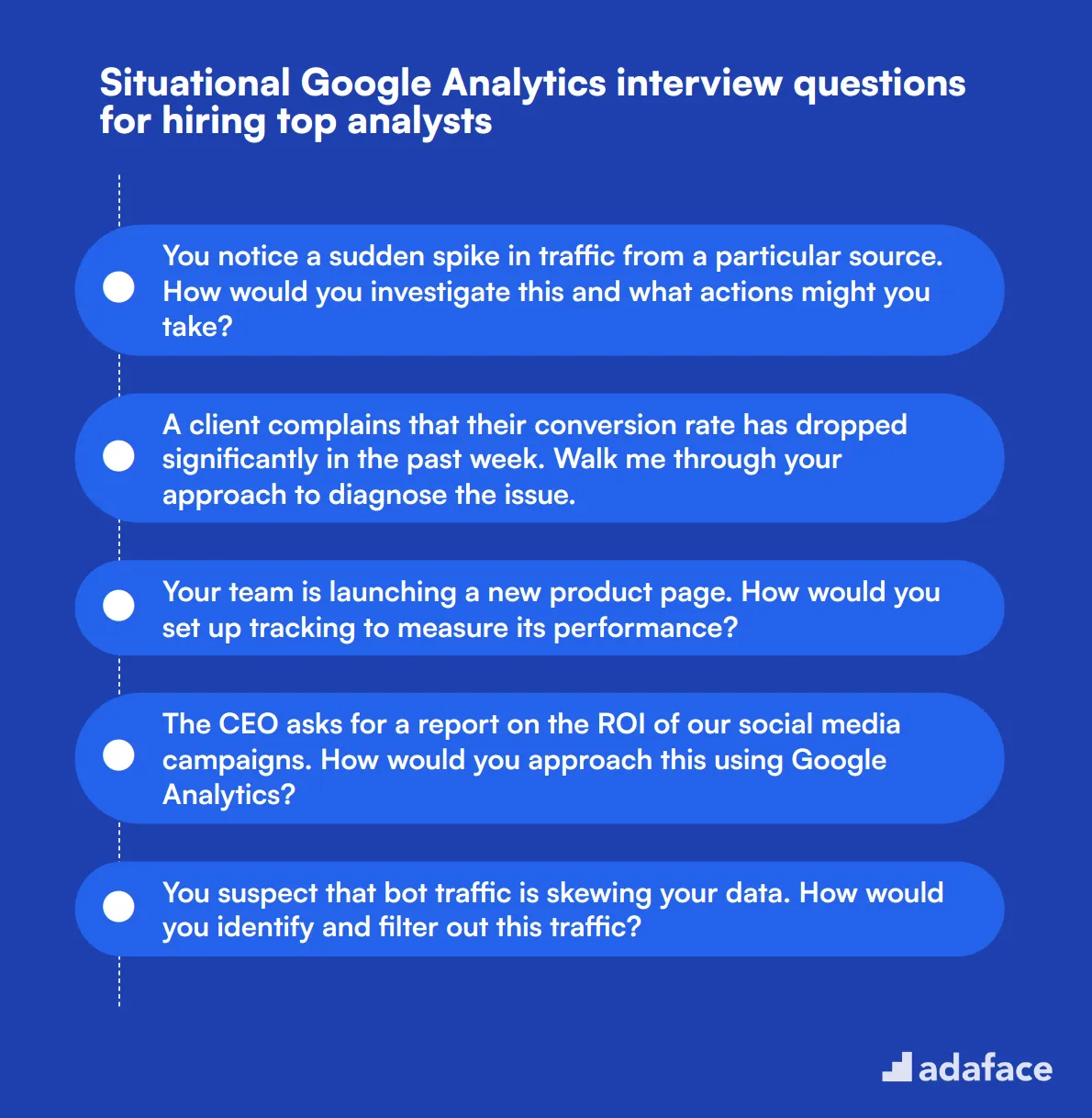
The Yardstick guide also provides an excellent template for a work sample exercise.
Example Interview Guide for Marketing Specialist
Let's return to the Yardstick guide to see how a skills assessment can be structured.
Read the section 'Marketing Skills Assessment.' Notice how it provides a clear task, defines the expected deliverables, and explains how the candidate will be evaluated. This structure ensures a fair and consistent assessment for all candidates.
4. The Scorecard: Your Tool for Objective Evaluation
The cornerstone of a structured interview process is the scorecard. It's a simple tool that forces the interview team to evaluate every candidate against the same predefined criteria, which should be the competencies from your Ideal Candidate Profile.
A scorecard prevents "halo/horn effects" (where a good/bad first impression colors all other judgments) and reduces the influence of unconscious bias. Instead of leaving an interview with a vague "I liked them," each interviewer must justify their ratings with specific evidence.

Key components of a good scorecard:
- Competencies/Criteria: The 3-5 most critical skills from your Ideal Candidate Profile (e.g., "Analytical Thinking," "Communication," "Collaboration").
- Rating Scale: A simple, clearly defined scale (e.g., 1-4, where 1 = Does Not Meet Bar, 4 = Exceeds Bar).
- Comments/Evidence: The most crucial section. Interviewers should note specific examples from the candidate's answers that justify their rating.
- Recommendation: A final decision (e.g., Strong Hire, Hire, No Hire) based on the evidence.
The Yardstick guide (LINK) provides excellent examples of scorecards integrated into each interview stage. Notice how the criteria in its "Competency Interview Scorecard" directly match the "Essential Behavioral Competencies" defined earlier. This alignment is key.
5. Making the Decision: The Debrief Meeting
After all interviews are complete, the hiring team comes together for a debrief meeting. This is not a session to debate opinions; it's a structured meeting to review the scorecard data.
Each interviewer shares their ratings and, more importantly, the evidence they collected. This process often reveals patterns. If three out of four interviewers rated a candidate low on "Collaboration" and can provide concrete examples, that's a strong signal. The discussion should be centered on the competencies and the evidence, not on subjective feelings.
The "Debrief Meeting" and "Reference Checks" sections in the Yardstick guide (LINK) provide a great framework for running this final part of the process.
Test your understanding!
You are hiring a Marketing Data Analyst for your team. Using the scorecard template as a guide and drawing on the competencies discussed, define four key criteria you would include in your scorecard. For each criterion, write one sample behavioral question you could use to assess it.
Show answer
Here's a sample scorecard structure for a Marketing Data Analyst role:
Criterion 1: Analytical & Problem-Solving Skills
- Sample Question: "Tell me about a time you encountered a surprising or ambiguous trend in your data (e.g., a sudden drop in conversion rate). Walk me through the steps you took to investigate the root cause and what you discovered."
Criterion 2: Technical Proficiency (in practice)
- Sample Question: "Describe the most complex analysis you've performed using SQL and a data visualization tool. What was the business question, how did you structure your query, and how did you present the findings visually?"
Criterion 3: Business Acumen & Impact
- Sample Question: "Give me an example of an analysis you conducted that led to a specific change in marketing strategy or budget allocation. How did you connect your data findings to a business recommendation, and what was the result?"
Criterion 4: Communication & Stakeholder Influence
- Sample Question: "Tell me about a time you had to present complex analytical findings to a non-technical audience (like the marketing or sales team). How did you tailor your communication, and what challenges did you face in getting them to understand and act on your insights?"
Conclusion
As a leader, designing a robust hiring process is one of the highest-leverage activities you can undertake. It's an investment that pays dividends by ensuring you build a team of high-performers who are truly equipped to drive the business forward.
Key Takeaways:
- Structure is Strategy: A structured hiring process with defined stages, competencies, and scorecards is essential for reducing bias and making effective hires.
- Define Before You Design: Start by creating an "Ideal Candidate Profile" that outlines the core competencies you're hiring for.
- Assess Holistically: Use a mix of behavioral questions (to understand their approach) and skills assessments (to verify their abilities).
- Use Scorecards for Objectivity: Evaluate every candidate against the same predefined criteria and demand evidence to back up ratings.
- Debrief with Data: Base your final hiring decision on the consolidated evidence from the scorecards, not on subjective "gut feelings."
Preview of Your Next Lesson:
Hiring the right person is the first step. The next is ensuring they grow and thrive on your team. In our upcoming lesson, you will learn how to "Create a framework for assessing skill gaps and planning professional development for your team." This will equip you to not only hire A-players but also to develop them into the future leaders of your organization.