Hello! Let's dive back into game theory.
In our last session, we focused on how to communicate with your customers. We saw that actions like setting a premium price and investing in high-quality marketing act as credible signals of the superior quality you intend to offer.
Today, we shift our focus from customers to competitors. The question is no longer just "How do I signal quality?" but "How much of my strategy should I reveal?" Your goal for this lesson is to learn how to evaluate when to reveal versus conceal information about your business plans. For a new business entering a market, this is a critical decision. Announcing your plans could either scare off competition or invite a devastating response. Keeping silent could protect a key advantage or cause you to miss an opportunity to shape the market in your favor.
1. The Default Stance: Conceal Your Hand
In most competitive situations, information is a valuable asset. Your unique plans, knowledge, and capabilities give you an edge. The natural starting point, therefore, is to protect that information.
Think of it like a game of poker. You wouldn't show your opponents your hand. Similarly, if you're developing a more efficient production process using your CNC machine or have identified an underserved niche market, broadcasting that information would erase your advantage. It gives competitors time to copy your idea, prepare a counter-strategy, or pre-empt your move entirely.
To begin, let's read a short, clear explanation of this core principle.
The article 'Game Theory' from Econlib provides a concise summary of the strategic logic behind both concealing and revealing information.
Please read the short section titled 'Concealing and revealing information.' It's near the end of the article. Focus on the fundamental difference it draws between situations where you want to hide information and those where you want to credibly reveal it.
As the article states, the general principle is that "actions speak louder than words." Concealment is the default when the information itself is your advantage. But as we're about to see, sometimes the action of revealing information can be a powerful strategic move in itself.
2. Strategic Revelation: When to Show Your Cards
While concealment is the default, there are specific situations where openly—and credibly—revealing your plans can be highly advantageous. This is not just "cheap talk"; it involves backing up your announcement with an action that influences your competitors' decisions.
Let's explore a few key scenarios using a practical resource on game theory applications. The following reading contains several examples that we can adapt directly to your woodworking business.
Chapter 7. Game Theory Applications – The Economics of ...
The chapter 'Game Theory Applications' from The Economics of Food and Agriculture provides clear, tangible examples of sequential games where revealing information and moving first can create a significant advantage.
You don't need to read this entire chapter now. I will guide you to the specific examples as we go. For now, just know that this resource will be our guide for the next section.
Scenario 1: Pre-empting the Market to Deter Entry
If a market can only support one new player, being the first to commit can scare competitors away. By making a public, irreversible move, you signal that you are entering and that any other new entrant will face a money-losing battle.
The 'Pre-Emptive Strike' example (Section 7.2.3) in the resource you just opened illustrates this perfectly with Walmart and Target.
Application to your business:
Imagine there's a nearby affluent town with general contractors but no dedicated premium cabinet maker. The market might be big enough for one specialist, but not two. If you make a public and costly commitment—like signing a multi-year lease on a workshop in that town and publicizing your new CNC machine delivery—you are signaling to any other potential woodworker considering that market: "I'm here, and the market is now full." A rational competitor would likely look for a different opportunity rather than enter a fight where both are likely to lose money.
Your announcement isn't about your product quality; it's a signal to deter a specific competitive action (entry).
Scenario 2: Claiming a High-Profit Niche (First-Mover Advantage)
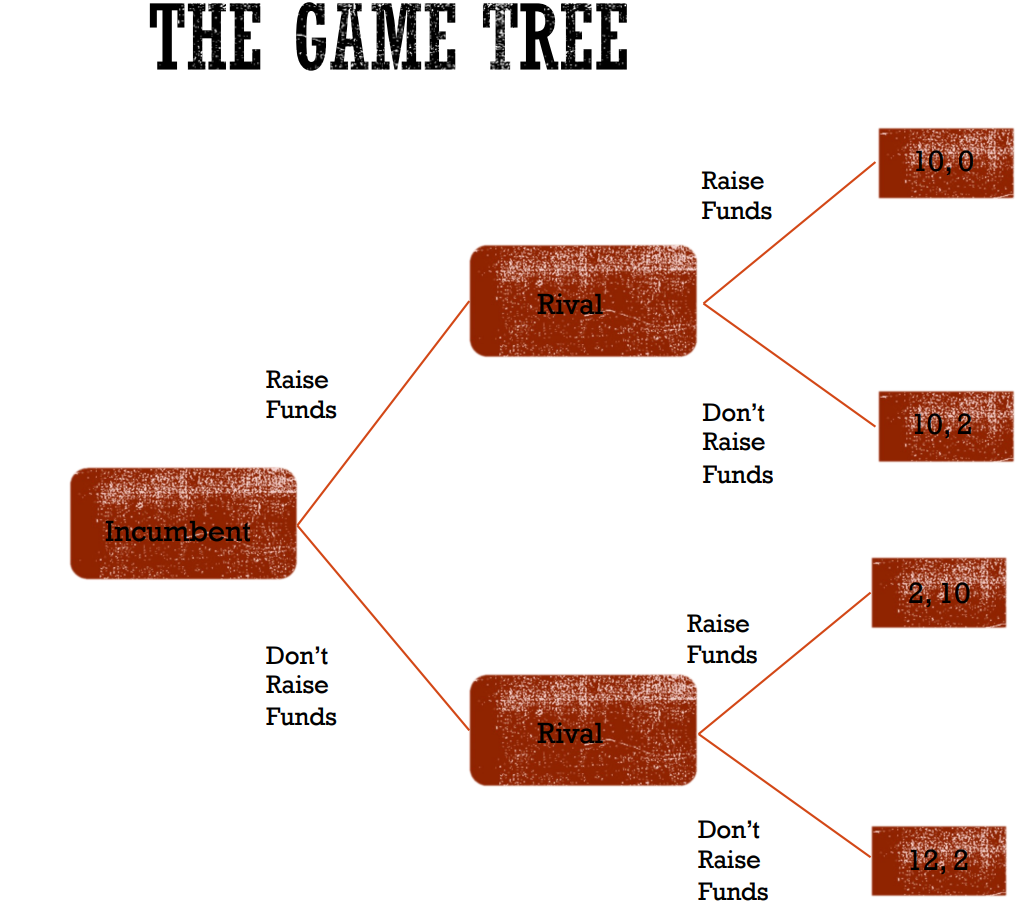
Sometimes, a market has multiple segments with different levels of profitability. By moving first into the most lucrative segment, you can force later entrants into less attractive positions.
The 'Product Choice Game Two' (Section 7.1.4) in the resource demonstrates this. In the example, both cereal companies want to enter the more profitable 'Oat' market. The one that moves first gets it, and the other is left with the less profitable 'Wheat' market.
Application to your business:
Let's assume the market for custom, high-end front doors is more profitable (higher margins, less competition) than the market for kitchen cabinets. Both you and a potential competitor know this. By publicly investing in specialized door-making equipment (e.g., a wide-belt sander or oversized joinery machine) and marketing yourself as a "Custom Entryway Specialist," you are making the first move. Your competitor, seeing the premium door market is now occupied, may decide their best response is to focus on cabinets to avoid direct competition. You've used strategic revelation to claim the more profitable niche.
Test your understanding!
Suppose you learn that a local competitor is also planning to upgrade to a CNC machine. You want to focus on highly intricate, carved cabinet doors, which is a small but very profitable niche. Your competitor seems to be focused on general-purpose cabinetry.
Based on the First-Mover Advantage concept, what is one action you could take to signal your intention and "claim" the intricate carving niche?
Show answer
You could, for example, publicly announce that you've invested in advanced 5-axis CNC technology and specialized software specifically for complex 3D carving. You could post videos of the machine being installed or test-carving intricate patterns on your company's social media. This is a credible signal because it's a costly investment. It tells your competitor you are serious about dominating that specific niche, potentially leading them to cede it to you and focus on their general-purpose offerings.
Scenario 3: Making Your Intentions Credible
Sometimes you want to reveal your plan to make a threat or promise credible, thereby shaping a competitor's behavior. An announcement alone is "cheap talk." A credible signal requires a commitment that would be costly to reverse.
The 'Commitment and Credibility' example with the beef producers (Section 7.2.4) is a powerful illustration. By selling off their low-quality herd, the producers make it impossible for them to choose the 'LOW' strategy, which forces the packers to play 'HIGH'.
Application to your business:
Imagine an established competitor offers both high-end and low-end cabinets. You want to enter the market focusing only on the premium segment. You worry they will drop their prices to drive you out. You could make a public commitment to exclusively using premium materials like solid hardwood and high-end German hardware. You could even write a blog post titled "Why We'll Never Use Particleboard."
This is a credible signal. By publicly disavowing the cheaper materials your competitor uses for their low-end line, you make it clear you cannot and will not compete on price in that segment. This makes the threat of a price war less likely, as you are positioning yourself in a different class. You have effectively revealed your plan to limit your own options, which in turn can limit your competitor's aggressive responses.
3. A Decision Framework: To Reveal or To Conceal?
So, how do you decide? Before making your plans public, ask yourself the following questions:
- What Is My Strategic Goal? Am I trying to deter a competitor from entering? Am I trying to claim a specific market segment? Am I trying to encourage cooperation or avoid a price war?
- What Action Do I Want My Competitor to Take (or Not Take)? I want them to stay out, focus on a different product, or maintain their current prices.
- Will Revealing My Plan Make This Outcome More Likely? Does knowing my plan guide them to a decision that benefits me?
- How Can I Make My Revelation Credible? Can I back it up with a costly, visible, and irreversible action (e.g., buying a machine, signing a lease, launching a marketing campaign)? If not, it's just cheap talk and will likely be ignored.
- What's the Downside Risk? What if I'm wrong? If I announce my entry, what if the incumbent decides to fight viciously instead of retreating? Are my finances prepared for that possibility?
You should default to CONCEALMENT if:
- The information itself is your primary advantage (e.g., a secret, efficient technique).
- Revealing your plan gives a competitor valuable time to prepare a counter-move.
- You are not yet ready or able to make a credible, costly commitment to back up your words.
Conclusion
Today we've moved beyond signaling to customers and into the strategic game of information management with competitors. The decision to reveal or conceal your plans is not arbitrary; it's a calculated move with specific goals.
Key Takeaways:
- Concealment is the Default: Protect information that is the source of your competitive advantage.
- Strategic Revelation Influences Competitors: Use public, credible announcements to deter entry (pre-emption), claim profitable niches (first-mover advantage), and shape competitor behavior.
- Credibility is Non-Negotiable: Your revealed plans will only be effective if they are backed by costly, irreversible commitments. Actions always speak louder than words.
- Use a Framework: Before revealing anything, analyze your goal, the desired competitor reaction, the credibility of your signal, and the potential risks.
Preview of the Next Lesson:
We've just spent this lesson thinking about how you send signals to your competitors. In our next lesson, we will flip the script. We will focus on how to interpret competitors' actions (e.g., a major capacity expansion) as potential signals about their strategy, allowing you to better anticipate their moves and react effectively.