Hello! Welcome back to your course on game theory for entrepreneurs.
In our last lesson, we focused on how you can send signals to your competitors by strategically revealing or concealing your business plans. We established that making your intentions credible through costly, irreversible actions is key to shaping your competitors' behavior.
Today, we're going to flip the coin. Instead of sending signals, you'll be on the receiving end, learning how to read the strategic moves of other players in your market. Your goal for this lesson is to learn how to interpret competitors' actions (e.g., a major capacity expansion) as potential signals about their strategy. This skill is vital for anticipating threats and opportunities as you launch your woodworking business.
1. Actions Speak Louder Than Words
Just as your actions signal your intent, so do your competitors'. A key part of business strategy is moving beyond simply observing what competitors do and starting to ask why they are doing it. In game theory, we assume competitors are rational actors making moves to maximize their own payoffs. An action, especially a costly one, is a piece of information about their view of the market and their plans for it.
The most powerful and unambiguous signals are often related to a company's physical and operational capacity. For your woodworking business, capacity could mean:
- The number of cabinets you can produce per month.
- The size of your workshop.
- The number and type of CNC machines you operate.
A change in capacity is rarely just an internal operational adjustment; it's a strategic move that sends a message to the entire market.
2. Decoding a Capacity Expansion
Imagine you're about to launch your business, and you discover that an established local cabinet maker has just purchased a second large CNC machine, effectively doubling their production capacity. Is this good news or bad news? How should you interpret this?
A capacity expansion is a strong signal because it is a costly and irreversible commitment. A CNC machine is a major capital investment; it can't be easily sold off without a significant loss. This commitment makes the signal credible.
To understand what this signal means, let's explore the strategic role of capacity decisions.
Capacity Decisions and Commitment | Game Theory ...
The following article explains why capacity decisions are so important from a game theory perspective. It will help us understand what a competitor might be trying to achieve with a major expansion.
Please read the sections titled 'Strategic importance of capacity decisions' and 'Role of commitment in capacity'. As you read, focus on how increasing capacity can be used to deter potential entrants and how irreversible investments serve as a credible threat.
As the reading highlights, a competitor's capacity expansion is a signal with several potential meanings:
- A Deterrent to Entry: By increasing capacity, the incumbent is signaling that they can flood the market with products. This excess capacity allows them to engage in aggressive price competition if a new player (like you) enters. They are essentially saying, "This market isn't big enough for both of us, and I have the resources to fight and win a price war." The goal is to make market entry look unprofitable for you.
- A Statement of Confidence: The expansion signals that the competitor sees strong future demand in the market. They are investing to capture that future growth. This could be good news (the market is growing) but also challenging (they plan to dominate it).
- A Path to Lower Costs: With your mechanical engineering background, you know that higher production volume can lead to economies of scale, lowering the per-unit cost. By expanding, the competitor signals they are preparing to compete more aggressively on price in the long run.
Let's visualize this. The game below shows a simplified interaction between you (Firm 1) and an incumbent competitor (Firm 2). 'Expand' means buying a new CNC machine.
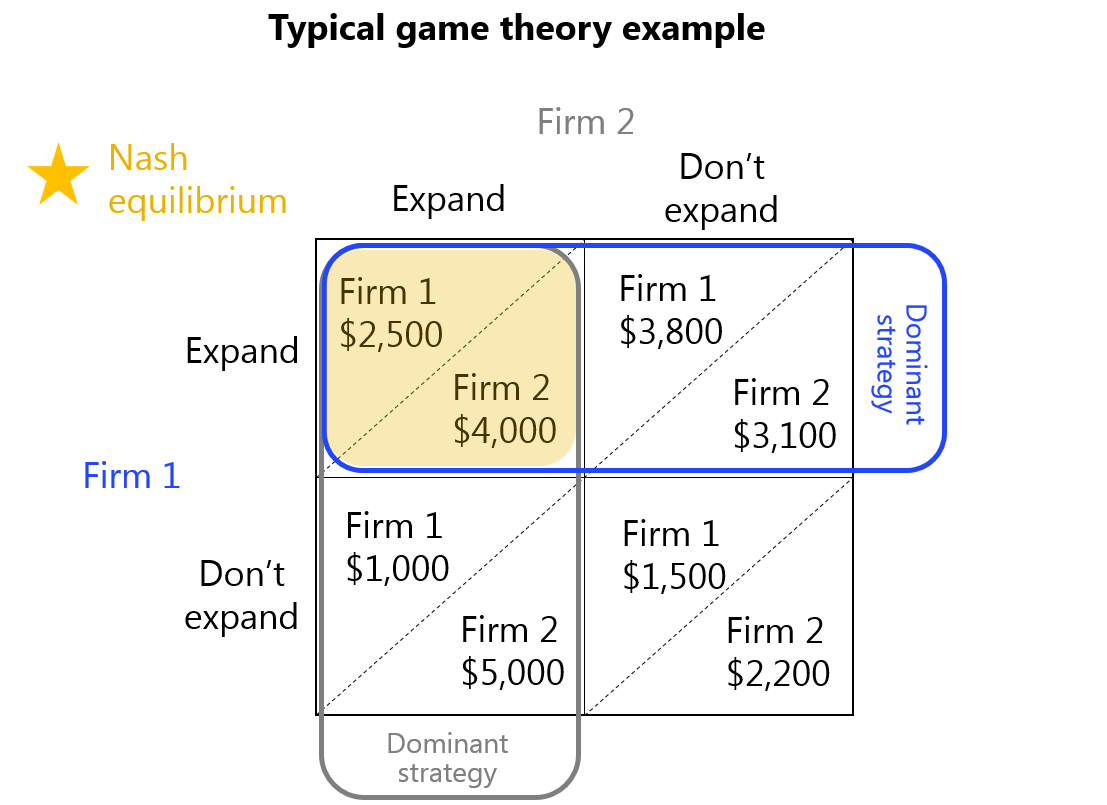
In this example, Firm 2 (the incumbent) does better by expanding regardless of your choice. This signals their intent to be aggressive. Their best possible outcome ($5,000) occurs if they expand and you don't. This suggests their expansion may be a move designed to convince you that staying small or not entering at all is your best option.
3. Reading Between the Lines: Other Competitor Signals
Capacity is a big, obvious signal, but competitors communicate their strategies through many other actions. Using what we learned in the last lesson about sending signals, we can now interpret them as a receiver.
Signal: Product Line Changes
Let's revisit the 'Product Choice Game' from the resource "Chapter 7. Game Theory Applications – The Economics of Food and Agriculture," which you looked at in the last lesson. If you see a competitor suddenly launch a line of "premium, custom-designed front doors" (your intended niche), you can interpret this as a pre-emptive strike. They are signaling their intent to occupy that niche before you can, forcing you to compete directly or find a different market segment.
Signal: Strategic Threats
Imagine a large competitor who builds mid-range cabinets threatens to launch a high-end bespoke line to compete with you directly. Is this threat credible? To find out, you need to assess if it's an "empty threat."
Chapter 7. Game Theory Applications – The Economics of ...
Not all announced moves are genuine threats. It's crucial to distinguish a real strategic signal from bluster. Let's look at an example of an 'empty threat' from the resource we used previously.
Please read the short section '7.2.2 Empty Threat'. Focus on why Monsanto's threat to set a low price is not believable given the payoffs and their business model.
To determine if your competitor's threat is empty, ask yourself:
- Would this move be profitable for them? Launching a low-volume, high-skill bespoke line might conflict with their high-volume, lower-margin business model.
- Would it hurt them more than it would hurt me? The investment in new artisans and marketing might cost them more than the potential profit they'd take from you.
- Does it align with their known capabilities? Are they known for craftsmanship or for mass production?
If the move seems irrational or self-damaging for them, it's likely an empty threat designed to scare you off.
Test your understanding!
You notice a small, high-end competitor who specializes in custom furniture has just started a major advertising campaign specifically highlighting their "quick-ship" standardized kitchen cabinets. What might this action signal about their strategy, and how might it affect you?
Show answer
This action likely signals a strategic pivot. The competitor may be finding the high-end custom market too slow or competitive and is moving into a higher-volume, lower-margin segment. This could be an opportunity for you, as it might mean they are de-emphasizing the premium custom space, leaving a gap for your business to fill. It signals that a key competitor in the premium niche is now focusing its resources elsewhere.
4. An Analyst's Framework for Competitor Actions
To systematically interpret what your competitors are doing, you can use a simple framework. When you observe a significant competitor action, work through these questions:
- The Action: What did they do? Be specific. (e.g., "They leased a second workshop space," not "They're getting bigger.")
- The Credibility: Is it a real commitment? How costly and irreversible is this action? A press release is cheap talk. A signed multi-year lease or a non-refundable deposit on a machine is a credible commitment.
- The Capability: What can they do now that they couldn't do before? (e.g., "They can now produce 50% more cabinets per month," or "They can now service customers in the north side of the city.")
- The Strategic Intent: What are they trying to achieve? Look at the market context. Are they trying to deter your entry? Pre-empt a niche? Signal their long-term dominance? Respond to a move you made?
- Your Response: What is your best move now? Based on their likely intent, should you ignore the signal, pivot your strategy, accelerate your plans, or accommodate their move?
Using this framework will help you move from simply seeing competitor actions to understanding their strategic implications.
Conclusion
Today, you've learned to be a codebreaker for your competitors' strategies. By viewing their actions through the lens of game theory, you can better anticipate their intentions and make smarter decisions for your own business.
Key Takeaways:
- Competitors' actions, especially costly and irreversible ones, are credible signals about their strategic intentions.
- A capacity expansion is a powerful signal of commitment, often intended to deter new entrants by threatening aggressive price competition.
- Always evaluate the credibility of a competitor's move. Distinguish between genuine, costly commitments and cheap talk or "empty threats."
- Use a structured framework (Action, Credibility, Capability, Intent) to analyze competitor moves and inform your own strategy.
Preview of the Next Lesson:
We've spent this module on the cat-and-mouse game of signaling and interpretation between individual firms. In our next module, "Navigating Competitive Dynamics," we will zoom out. Our first lesson will focus on how to analyze how market structure changes as competitors enter, exit, or consolidate, giving you a broader, long-term view of the competitive landscape you are operating in.