Hello! Welcome to your next lesson.
In our last session, you built your first automated email flow: the welcome series. We briefly touched on the idea of making it "smarter" by not sending a first-purchase discount to someone who had already bought from you. That was your first taste of segmentation.
Today, we're going to master that concept. Sending the same email to every single person on your list is inefficient. The key to high-revenue email marketing is sending the right message to the right person at the right time. This lesson is dedicated to exactly that.
You will learn how to segment a customer email list based on their interests or purchase behavior to send highly targeted promotions. We'll move beyond simple welcome flows and explore how to group your audience into strategic segments that you can use to personalize your marketing, increase sales, and build a stronger brand connection.
1. What is Segmentation and Why Does It Matter?
Before we jump into the "how," let's quickly cover the "why." Sending targeted emails isn't just a nice-to-have; it's a financial necessity in e-commerce. Generic email blasts often lead to low open rates, high unsubscribe rates, and can even damage your sender reputation, causing your emails to land in spam folders.
Segmentation is the practice of dividing your email list into smaller groups—or segments—based on specific criteria. These segments are dynamic, meaning they automatically update as customer data changes. Someone can enter or leave a segment without you manually moving them.
To understand the core strategies, this article from Referral Candy provides an excellent overview.
Klaviyo Segmentation Strategies: The Complete Guide
Read this article to understand the fundamental types of segmentation that are essential for any e-commerce store. It explains the 'why' behind this powerful strategy.
Read the sections 'Why Klaviyo Segmentation Strategies Matter for Ecommerce Success' and 'Essential Klaviyo Segmentation Strategies Every Ecommerce Brand Should Use' (up to 'Product Affinity Segmentation'). Focus on understanding the difference between Engagement-Based and Purchase Behavior segmentation.
As the article highlights, segmentation allows you to tailor your messaging precisely, leading to significantly higher revenue and customer engagement.

2. How to Create Segments in Klaviyo
Now for the practical part. Let's see how to build a segment inside Klaviyo. The logic is consistent across most platforms: you define a set of conditions, and the platform gathers everyone who meets them.
The following video demonstrates creating a segment for users who abandoned their checkout. While the example is specific, the process he shows is universal for creating any segment.
2024 Klaviyo Email Marketing FREE Course: New Tutorial for Shopify (Step By Step)
In this clip, Max Sturtevant walks through the mechanics of creating a segment in Klaviyo. Pay close attention to the logic he uses to combine different conditions.
Watch from 24:27 to 26:59. Focus on how he navigates to the 'Lists & Segments' area and uses the definition builder to add conditions like 'What someone has done...' and combines them with 'AND'. This is the core skill for building all segments.
3. Key Segments to Build Today
Let's apply that knowledge to create a few essential segments for your business.
a) Engagement-Based Segments
This is about how people interact with your emails. It's crucial for maintaining good deliverability and focusing your efforts on an interested audience.
- Engaged (30 Days): This will be your primary audience for most campaigns.
- Definition:
Has opened OR clicked an email at least once in the last 30 days.
- Definition:
- Unengaged (90+ Days): This group is at risk of churning. You should not send them regular campaigns. Instead, you'd target them with a special "win-back" campaign.
- Definition:
Has opened email zero times in the last 90 days AND has clicked email zero times in the last 90 days.
- Definition:
b) Purchase-Behavior Segments
This is about how people shop with you. It's one of the most profitable ways to segment.
-
VIP Customers: These are your best customers. They deserve special treatment like early access to sales or exclusive offers.
- Definition:
Placed Order at least 3 times over all timeANDHas a total order value of more than $200 over all time. (You can adjust these values based on your products and average order value).
- Definition:
-
First-Time Customers: They've trusted you once. Your goal is to encourage a second purchase.
- Definition:
Placed Order exactly 1 time over all time.
- Definition:
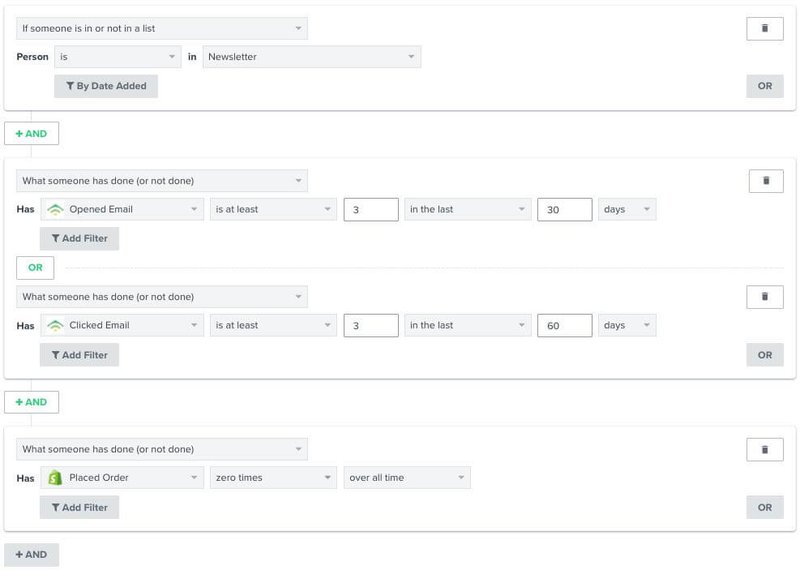
Test your understanding!
You want to run a "We miss you!" promotion with a strong discount. Which segment would be the most appropriate target, and why would you exclude your "Engaged (30 Days)" segment from this campaign?
Show answer
The most appropriate target would be a segment of one-time purchasers who bought a while ago (e.g., Placed Order exactly 1 time over all time AND Last Order date was more than 90 days ago).
You would exclude your "Engaged (30 Days)" segment because offering a deep discount to your most active and loyal customers can train them to wait for deals and devalue your brand. The strong discount is a specific tool to win back customers who have become inactive.
4. Proactive Segmentation: Capturing Customer Interests
So far, we've segmented based on actions people have already taken (reacting to their behavior). A more advanced strategy is to proactively ask customers what they're interested in from the moment they subscribe.
A "quiz pop-up" is a brilliant way to do this. Instead of just asking for an email, you ask a simple question first. This not only increases sign-up rates due to commitment bias but also gives you invaluable data for segmentation.
Klaviyo Pop Up Form Tutorial for Ecommerce Brands
This video introduces the concept of a 'quiz pop-up'. It's a highly effective, practical method for gathering preference data upfront.
Watch from 01:11 to 05:53. The presenter compares different pop-up types and explains why the quiz pop-up is so effective for collecting data you can use for personalization.
Now, how do you actually capture that information? You use a feature called "hidden fields" to add a "profile property" to the subscriber's profile.
Klaviyo Pop Up Form Tutorial for Ecommerce Brands
This is the most critical part. Let's see how to tag a subscriber with their preference when they answer your pop-up quiz.
Watch from 18:17 to 19:36. Focus on how he clicks a button in the form editor and configures the 'Submit hidden fields' option. He creates a profile property (e.g., 'gender_interest') and assigns a value ('men's'). This action is what makes interest-based segmentation possible.
Once a subscriber is tagged with a property like Interest = 'Skincare', you can easily create a segment for all skincare enthusiasts and send them targeted promotions about new serums or moisturizers, while excluding them from promotions for makeup.
5. Using Your Segments for Targeted Promotions
Creating segments is only half the battle. Now you need to use them. When you create a one-time promotional Campaign, instead of sending it to your entire list, you will select one of your new, highly-targeted segments.
This video shows you exactly where to do that in the campaign setup process.
2024 Klaviyo Email Marketing FREE Course: New Tutorial for Shopify (Step By Step)
This final clip shows you how to put your new segments to use when sending an email campaign.
Watch from 53:35 to 55:02. The presenter demonstrates how to select a specific segment (in his case, 'Engaged 30 days') as the recipient list for a campaign. This ensures your message only goes to the intended group.
By sending campaigns only to your engaged segments, you ensure your message is relevant, your metrics stay healthy, and you maximize your return on investment.
Conclusion
You have now moved from basic email automation to strategic, data-driven marketing. By segmenting your audience, you can create personalized experiences that resonate with customers, build loyalty, and directly increase your store's revenue.
Key Takeaways:
- Segmentation involves creating dynamic groups of customers based on criteria like engagement, purchase history, or declared interests.
- Key behavioral segments include engaged/unengaged users, VIPs, and first-time buyers.
- You can proactively gather data for interest-based segmentation using tools like quiz pop-ups that tag users with profile properties.
- When sending promotional campaigns, you should target specific segments rather than your entire list to maximize relevance and profitability.
Next Up:
In the next module, we shift our focus from marketing foundations to the core of e-commerce: your products. We'll start by learning how to define the criteria for a profitable product based on demand, competition, margin, and logistics, setting the stage for effective product research.