
Welcome. You have now completed the first orienting module’s essential distinctions: Steiner’s works appear in different genres and settings; later anthroposophical traditions should not be silently attributed to Steiner; and personal artistic experience belongs in study without being confused with textual evidence or clinical knowledge.
This final lesson gathers those distinctions into an initial concept map. Its purpose is not to reduce anthroposophy to a neat diagram, nor to settle whether its spiritual-scientific claims are true. Rather, it gives you a stable way to locate what you encounter: philosophical argument, spiritual-scientific method, pictures of the human being, artistic practice, and therapeutic application. You will be able to add detail and revise connections as the course unfolds.
Plan for about 40 minutes: 15 minutes of focused reading, 15 minutes constructing the map, and 10 minutes refining it through one artistic example and a boundary check.
A concept map is a map of relationships, not a statement of proof
A map is useful when a field contains closely related ideas that are easily blended together. Anthroposophy often creates this difficulty because its philosophical, esoteric, artistic, educational, and medical dimensions share vocabulary about the human being while serving different purposes.
For this course, keep five regions distinct:
-
Steiner’s philosophical writings ask publicly discussable questions about knowing, thinking, freedom, and ethical action. Their arguments can be read, reconstructed, and criticized philosophically.
-
Spiritual science is Steiner’s name for a proposed extension of cognition beyond ordinary sensory knowledge. It includes a claimed disciplined path of inner development and a body of supersensible findings.
-
The picture of the human being is the conceptual account that Steiner develops through this spiritual-scientific framework: bodily, soul, spiritual, and functional distinctions. Later lessons will examine its fourfold, threefold, and soul-spiritual descriptions carefully.
-
Artistic work includes Steiner’s artistic indications, architecture, sculpture, eurythmy, colour work, and later artistic lineages. In this framework, art is not merely decoration or private self-expression; it may be approached as a way of making formative qualities perceptible.
-
Practical applications include Waldorf education, anthroposophic medicine, and later anthroposophically informed art-therapy traditions. These are fields of practice with their own historical development, responsibilities, and standards.
The central discipline is to avoid turning a relationship into a shortcut. For example:
- Philosophy does not deductively prove every later spiritual-scientific claim.
- A fourfold picture of the human being is not equivalent to accepted anatomy or clinical diagnosis.
- An artistic experience is not by itself therapeutic evidence.
- An art-based wellbeing activity is not automatically art therapy.
- A tradition’s use of a Steiner concept does not establish that Steiner himself taught that specific method.
Two primary-source views of the whole
Steiner’s 1921 lecture “Anthroposophy and Spiritual Science” presents anthroposophy as a proposed spiritual science that seeks both to value natural science and to move beyond what it regards as the limits of sensory inquiry. Later in the lecture, he connects this claimed knowledge with accounts of the human being, education, medicine, and art.
Read selected passages from Rudolf Steiner’s lecture to see how he himself connects method, human knowledge, art, education, and medicine. Read it as a primary source: it presents Steiner’s own claims and rationale, rather than independently established conclusions.
In the opening numbered paragraphs [1] through [9], read Steiner's opening orientation. Focus on the double claim: anthroposophy seeks supersensible knowledge, yet says that it should emulate the discipline and objectivity of natural science. Then move to paragraphs [45] through [47]. Read the human and practical claims. Notice that Steiner presents medicine and Waldorf education as applications informed by a claimed knowledge of the whole human being. Finally, read paragraphs [49] through [51], beginning the account of art. Mark the difference between an artistic claim about how art can disclose formative laws and a claim about a particular artistic technique or therapeutic intervention.
A second lecture supplies two especially useful distinctions. First, Steiner differentiates anthroposophy from ordinary anthropology. Second, he presents the physical, etheric, astral, and further dimensions not as separate objects one finds in ordinary anatomy, but as differentiated aspects of a whole human being as he claims spiritual research encounters it.
This short selection from another Steiner lecture helps you label two parts of your map precisely: “spiritual science” as Steiner uses the term, and the anthroposophical picture of the human being.
In the opening untitled passage, read the definition of anthroposophy. Note that Steiner uses “spiritual science” in a particular sense: he claims that spirit is real and knowable, not simply an abstract category in history, sociology, or philosophy. Then find the later brief passage beginning “All that I have now brought before you.” Read the prism comparison. It will help you remember that the fourfold account is an anthroposophical analytic model of the human being, not a list of ordinary physical structures.
As you read, use your source-journal discipline. A helpful note might read:
Source claim: In this lecture, Steiner presents spiritual science as a disciplined route to knowledge beyond the sensory world.
My paraphrase: He argues that natural-scientific habits of rigor should be retained while new inner capacities are developed.
Boundary note: This is Steiner’s methodological claim. Its status differs from a conclusion supported by publicly replicable empirical research.
The five regions of your initial map
Start with Anthroposophy in the centre, but do not treat it as a single undifferentiated doctrine. Place the five regions around it.
The bracketed labels are a simple claim-status legend:
| Label | What it marks | What to keep in mind |
|---|---|---|
| [P] | Philosophical argument | Ask whether the reasoning is coherent and whether you agree with its premises and conclusions. |
| [SS] | Steiner’s spiritual-scientific claim | Record the stated method, distinguish it from fantasy or private association, and do not mistake it for mainstream empirical evidence. |
| [H] | Anthroposophical human model | Treat it as a framework with internal relationships, not as anatomy, diagnosis, or a personality classification. |
| [A] | Artistic indication, practice, or lineage | Separate what is visibly present in the work from symbolic, pedagogical, or therapeutic interpretations. |
| [C] | Contemporary practical or clinical claim | Ask about training, scope, consent, supervision, evidence, ethics, and institutional responsibility. |
1. Philosophical writings: the question of cognition and freedom
For now, keep this node concise:
Steiner’s philosophical writings: An inquiry into how human beings know, how thinking may be understood, and how free ethical action may be possible.
This node will become richer in the next module, especially through The Philosophy of Freedom. For present purposes, it establishes that anthroposophy did not begin merely as a collection of esoteric assertions. Steiner’s earlier work engaged questions of epistemology, thinking, and moral freedom through philosophical argument.
The connection between philosophy and spiritual science should be marked carefully:
Map connection: Steiner presents spiritual science as continuous with a transformed and disciplined activity of knowing.
Boundary: A philosophical account of cognition does not, by itself, demonstrate the later supersensible findings claimed in spiritual-scientific lectures.
2. Spiritual science: a claimed method and a claimed field of knowledge
Write this node in two lines:
Method claim: Inner exercises cultivate capacities for Imagination, Inspiration, and Intuition.
Content claim: These capacities can disclose supersensible realities, including dimensions of human existence before birth and after death.
You need not decide whether you accept these claims in order to map them accurately. The important distinction is between:
- what Steiner claims the method is;
- what he claims it can disclose;
- what experiences a learner actually has during a practice;
- what a person can responsibly claim to know in a public, professional, or clinical setting.
Your future inner-practice module will treat the exercises with clear duration limits, grounding, and no expectation of unusual experiences. In the present map, simply record that spiritual science is both a proposed method of inquiry and a body of resulting claims.
3. Picture of the human being: a framework, not a diagnosis
At the centre of many anthroposophical practical fields is a layered picture of the human being. In later modules, you will distinguish:
- the physical, etheric, astral, and “I” organizations;
- the sentient, intellectual or mind, and consciousness soul;
- the nerve-sense, rhythmic, and metabolic-limb organizations.
For now, write a deliberately modest map note:
Anthroposophical picture of the human being: A set of interrelated bodily, soul, spiritual, and functional descriptions that Steiner presents as arising from spiritual-scientific inquiry.
The language of “organizations” and “members” can tempt one to imagine invisible physical organs. Do not assume this. Within the anthroposophical framework, these terms name differentiated principles or dimensions of a whole human being. Outside that framework, they are not standard anatomical entities.
This matters in therapeutic contexts. A practitioner may find the framework meaningful as a way to form questions about rhythm, embodiment, attention, or biography. But it must never become a substitute for medical assessment, psychiatric diagnosis, or the client’s own account of their life.
4. Artistic work: making experience perceptible
In the sources you read, Steiner associates art with the manifestation of formative laws in nature and human experience. His own architectural and artistic work sought, in his account, to embody forms and colour harmonies rather than attach a fixed symbolic code to each feature.
That distinction helps with painting practice. A colour study may make a quality of density, movement, warmth, opacity, radiance, or boundary vividly present. It does not follow that the colour is a fixed symbol or that it reveals a maker’s personality.
Write this node in three layers:
Artistic work: Practices of painting, drawing, form, movement, architecture, sculpture, and eurythmy that Steiner and later anthroposophical artists connect with human and natural formative qualities.
Direct observation: What is materially and visibly present in a work.
Interpretive layer: Possible artistic, pedagogical, spiritual, or personal meanings that must be identified as interpretations.
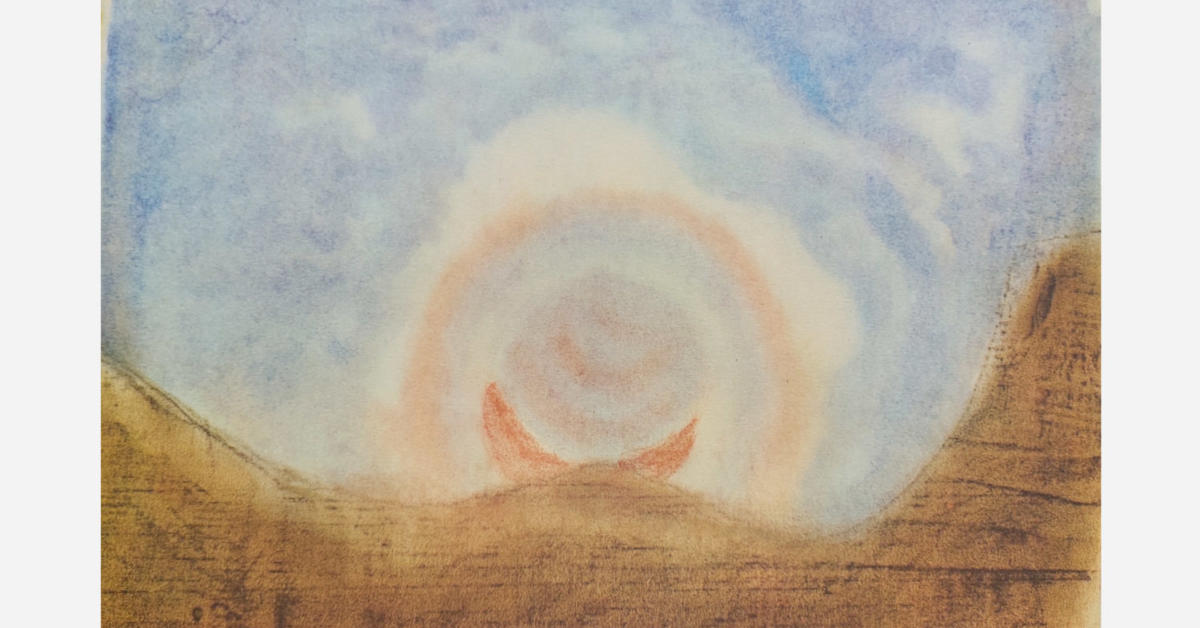
The watercolor image can be described without psychological interpretation: a pale luminous disc; a warm red-orange crescent beneath it; blue surrounding space; brown rising forms at the sides; blended edges; a strong contrast between cool and warm regions. These are observations. Statements about the artist’s inner condition, cosmic realities, or a viewer’s diagnosis would require a different level of evidence and should not be placed in the observation layer.
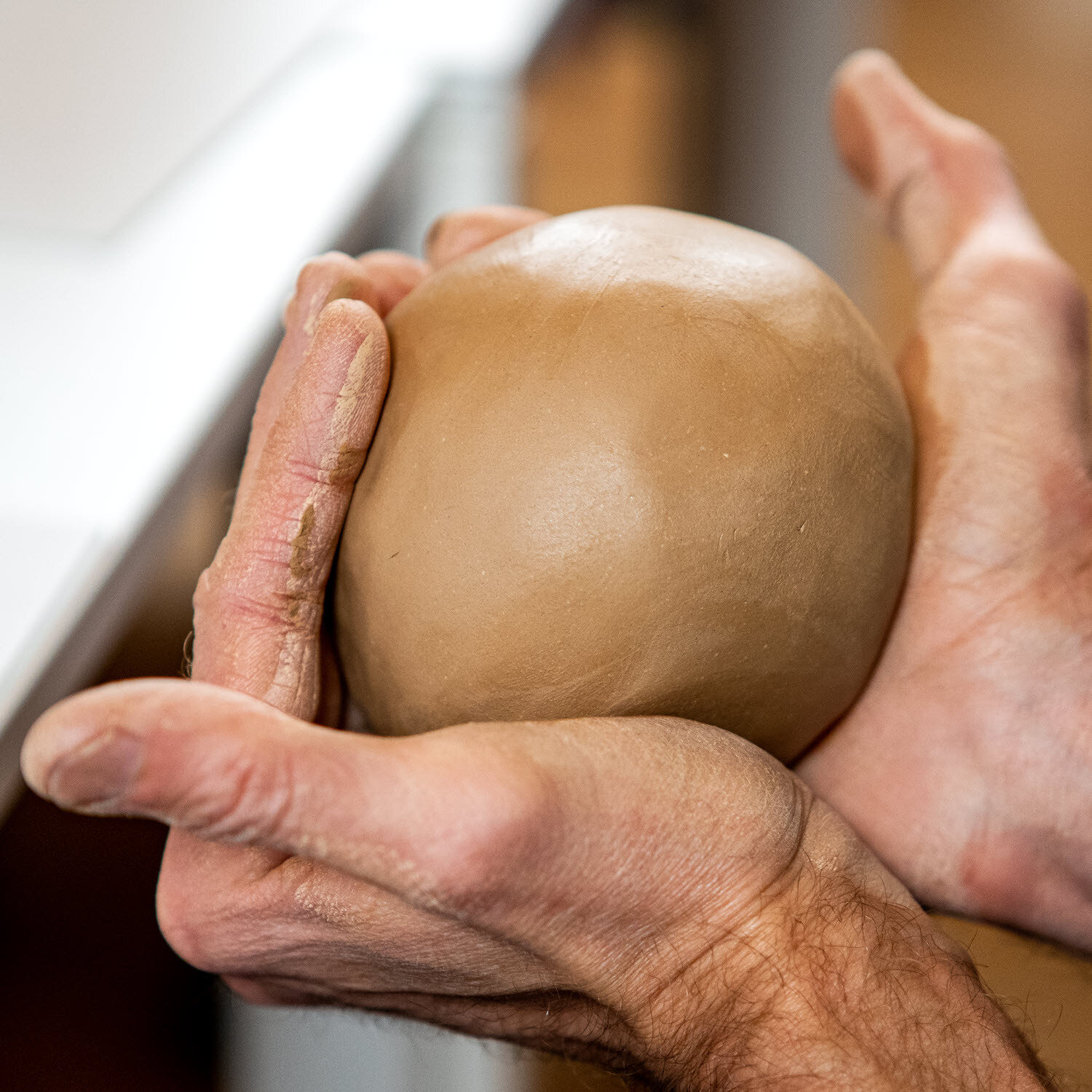
Art is also materially grounded. Colour, pressure, resistance, surface, tempo, and the relation between hand and material all matter before any theory is applied.
5. Practical fields: related applications with different responsibilities
Place three smaller circles or labels beneath “Practical fields”:
- Waldorf education
- Anthroposophic medicine
- Anthroposophically informed art-therapy traditions
They share historical and conceptual connections to anthroposophy, but they are not interchangeable.
| Field | Primary purpose | Essential boundary |
|---|---|---|
| Waldorf education | Education and development within a class and school setting | A class exercise is not individualized treatment. |
| Anthroposophic medicine | Medical care informed by an anthroposophical human picture | Medical diagnosis, treatment, prescribing, and risk management require appropriately qualified clinicians. |
| Anthroposophically informed art therapy | Therapeutic use of artistic processes within a professional relationship | It requires clinical competence, ethical practice, supervision, consent, safeguarding, and attention to evidence. |
For your own developing professional direction, the last boundary is especially important. An anthroposophical idea about colour, rhythm, or human development may inform a practitioner’s questions. It cannot justify interpreting a client’s painting as a diagnosis, imposing a spiritual explanation, or working beyond one’s training and approved role.
In a hospital, wellbeing, rehabilitation, or supportive arts activity must be clearly named as such unless it is delivered within an authorized therapeutic service by a suitably trained and supervised practitioner.
Build your first version
Use a double-page journal spread, a large sheet of paper, or a digital canvas. Keep it provisional: leave generous blank space around every node.
Pass 1: Place the five regions
Write Anthroposophy in the centre. Around it, place:
- Philosophical writings
- Spiritual science
- Picture of the human being
- Artistic work
- Practical fields
Add the five bracket labels, , , , , and , beside the relevant regions.
Pass 2: Add one disciplined connection statement per line
Do not use vague connections such as “everything is related.” Write a short statement that identifies the type and status of the relationship.
You may use these initial formulations:
- [P] and [SS]: Steiner presents later spiritual science as extending a disciplined activity of knowing; this is a claim of continuity, not a proof.
- [SS] and [H]: Steiner presents his picture of the human being as arising from supersensible research.
- [SS] and [A]: Steiner connects artistic creation with making formative qualities perceptible.
- [H] and [C]: Anthroposophical practical fields use aspects of this human picture as a framework.
- [A] and [C]: Some later therapeutic traditions use artistic media, but artistic activity alone is not therapy.
If you encounter a connection you cannot yet state clearly, leave a question mark rather than filling the space with a conclusion.
Pass 3: Attach sources and contexts
Beside each node, add at least one source or source type:
| Map region | First source note |
|---|---|
| Philosophical writings | The Philosophy of Freedom; philosophical work; public argument |
| Spiritual science | A Steiner lecture or esoteric book; intended audience and date matter |
| Picture of the human being | A Steiner spiritual-scientific text; model and terminology need careful definition |
| Artistic work | Artistic indication, Goethean source, Steiner work, or later lineage; identify which |
| Practical fields | Institutional practice, training tradition, professional guideline, or clinical literature; do not assume Steiner is the direct source |
This source layer prevents a common difficulty in anthroposophical study: a later training phrase may feel deeply “Steinerian,” yet have a different origin, a different purpose, or a much later therapeutic interpretation.
Pass 4: Add a boundary strip at the bottom
At the bottom of the map, write:
A relationship is not an equivalence. A spiritual claim is not automatically a clinical fact. An artistic experience is not a diagnostic sign. A respectful therapeutic practice protects the client’s freedom, meaning, and safety.
This is not a rejection of anthroposophy from outside. It is a discipline that lets each part of the map retain its proper integrity.
Key takeaways
Your initial map has five distinct but connected regions:
- Philosophical writings address cognition, thinking, freedom, and ethical action through argument.
- Spiritual science is Steiner’s claimed method of supersensible inquiry and the body of claims associated with it.
- The picture of the human being is an anthroposophical framework of bodily, soul, spiritual, and functional dimensions.
- Artistic work is approached as a way of making perceptible qualities of form, colour, movement, and life, without reducing art to fixed symbolism.
- Practical fields draw on anthroposophical ideas in different ways, while retaining distinct educational, medical, ethical, and clinical responsibilities.
Keep this map accessible. It will become a working document rather than a finished diagram: each later module will add definitions, sources, practices, artistic studies, and carefully marked questions.
In the next module, you will return to the philosophical region of the map and examine the basic problem of knowledge in Steiner’s early work: how percepts, concepts, and thinking are related.
Can't find a good explanation? Sign up and we'll make it for you
Sign up