
Introduction
Welcome to your first lesson on Aristotle. In our last discussion, we saw Plato's magnificent Theory of Forms encounter a serious internal challenge with the Third Man Argument. This problem, which Plato himself raised, suggested that the theory might lead to an infinite regress, undermining its ability to explain reality. This philosophical impasse created the perfect opportunity for a new approach.
That new approach came from Plato's most famous student, Aristotle. While deeply influenced by Plato, Aristotle took a radically different path. Instead of locating ultimate reality in a separate, transcendent world of Forms, Aristotle sought to understand the reality of the concrete, individual things we encounter every day through our senses.
To do this, he needed a new toolkit for explanation. This lesson introduces the cornerstone of his entire philosophical system: the doctrine of the Four Causes. Your learning outcome is to explain these four causes using examples, as Aristotle himself does in Book II of his work, the Physics. Understanding this framework is the first and most crucial step in grasping Aristotle's metaphysics and his response to Plato.
What Does Aristotle Mean by "Cause"?
Before we dive in, we must address the word "cause" itself. For modern ears, "cause" usually means an event that brings about another event (an effect). This corresponds to only one of Aristotle's four causes. The Greek word Aristotle used, aition (plural aitia), is much broader. It is better translated as "explanation," "reason," or "explanatory factor."
When Aristotle asks for the causes of a thing, he is asking for the different ways we can answer the question, "Why is this thing the way it is?" To have complete knowledge of something, Aristotle believes, we must be able to answer this "why" question in all four of the ways he identifies.
To explore this crucial distinction, please read the short introductory section of the following university lecture notes.
These notes from S. Marc Cohen's course on Ancient Philosophy explain why 'explanation' is a better translation for Aristotle's 'aition' than 'cause'.
Please read the first section, 'What are there four of?'. Focus on why our modern, Humean notion of cause-and-effect is too narrow to capture Aristotle's meaning.
The Four Causes: An Overview
Aristotle argues that there are four fundamental types of explanation we can give for any object or phenomenon. These are traditionally called:
- The Material Cause
- The Formal Cause
- The Efficient Cause
- The Final Cause
To get a quick, clear overview of these four concepts, let's watch a short video that illustrates them using a single, intuitive example: an apple.
Aristotle's Four Causes | Highlights Ep.43
This video from Hillsdale College provides a concise introduction to the four causes, using the example of an apple to make each one clear.
Watch the full video (it's short). Pay attention to how each 'cause' answers a different kind of 'why' question about the apple.
Unpacking the Causes: The Bronze Statue
As the video showed, the four causes provide a comprehensive framework for analysis. Let's now explore them in more detail using an example that Aristotle himself frequently used: the creation of a bronze statue. This example from artistic production makes the distinctions very clear.
The following reading from the Stanford Encyclopedia of Philosophy provides a rigorous breakdown.
Aristotle on Causality - Stanford Encyclopedia of Philosophy
This excerpt from the article 'Aristotle on Causality' offers a detailed analysis of the four causes using the classic example of a bronze statue.
Please read section 2, 'The Four Causes'. As you read, try to identify how each cause contributes to the explanation of the statue's existence.
Based on that reading, let's summarize the four causes as they apply to the statue:
-
The Material Cause: This is the "that out of which" a thing comes to be. It's the matter or substrate that persists through a change.
- Example: The bronze is the material cause of the statue.
-
The Formal Cause: This is the form, pattern, or essence of the thing. It's the "what it is to be" that thing, its definition or structure.
- Example: The sculptor's design or plan—the shape and structure that makes the bronze a statue rather than just a lump of metal.
-
The Efficient Cause: This is the primary source of the change or motion. It's the agent that brings something into being or initiates a change.
- Example: The sculptor is an efficient cause. More precisely, Aristotle would say the art of bronze-casting within the sculptor is the most accurate efficient cause, as it is the knowledge that guides the production.
-
The Final Cause: This is the end, goal, or purpose—the "for the sake of which" a thing is done. The Greek word for this is telos.
- Example: The statue's purpose could be to honor a god, commemorate a hero, or to be sold for profit. This purpose is the reason the entire process was undertaken.
This diagram offers another clear, visual example using a simple table.
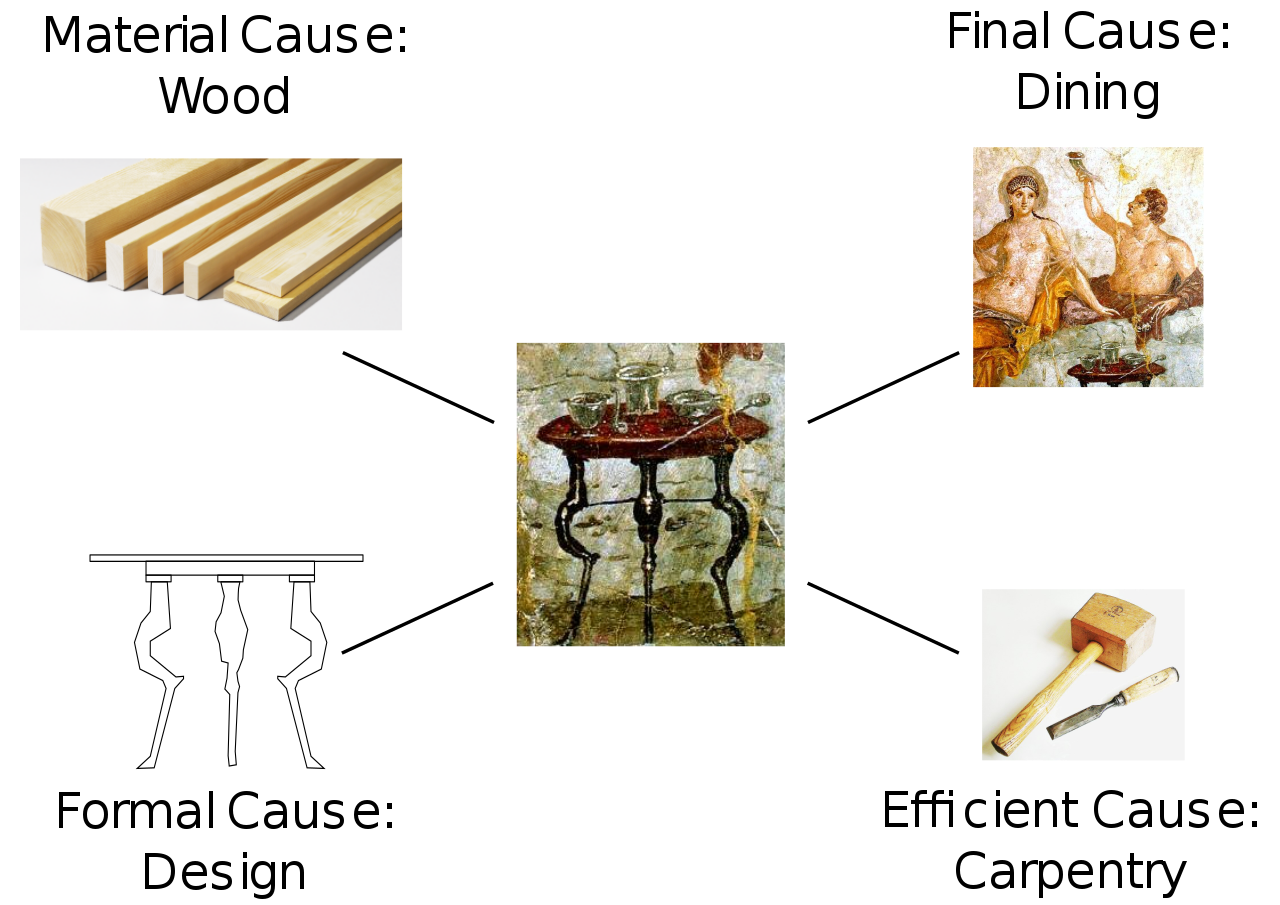
The Causes in Nature: From Artifacts to Organisms
Applying the four causes to man-made artifacts is fairly straightforward. But Aristotle's real innovation—and the main subject of Physics Book II—was to apply this same explanatory framework to nature.
This is where his philosophy most profoundly departs from modern science. While we might talk about material and efficient causes in nature, Aristotle insists that natural objects and processes also have formal and, most controversially, final causes.
Let's read how Aristotle makes this move and defends the idea of final causes (telos) in nature.
Aristotle on Causality - Stanford Encyclopedia of Philosophy
These sections from the Stanford Encyclopedia of Philosophy article explain how Aristotle applies his causal framework to natural phenomena and defends the controversial idea of final causality in nature.
Please read Section 3, 'The Four Causes and the Study of Nature,' and Section 4, 'Final Causes Defended.' Focus on: How the causes apply to a natural process, like the generation of a human being. Aristotle's argument against those who claim natural outcomes (like the growth of teeth) happen by chance or necessity alone.
As the readings explain, a final cause in nature is not a conscious plan or purpose held in a mind (like a sculptor's plan or a divine creator's). Instead, for Aristotle, the telos of a natural object is an internal principle of development. It is the end-state that the organism strives to reach by its own nature.
Let's apply the four causes to a natural object, like an acorn developing into an oak tree:
- Material Cause: The cells and organic matter that constitute the acorn.
- Formal Cause: The "oak-ness" or the structure and essence of a fully-formed oak tree. This is the blueprint that guides its development.
- Efficient Cause: The parent oak tree that produced the acorn. This reflects Aristotle's principle that "it takes a human being to generate a human being"—the agent of generation is a mature member of the same species.
- Final Cause (Telos): The goal of the acorn is to become a mature oak tree. In natural organisms, Aristotle notes that the formal cause and the final cause often coincide. The goal (telos) is to realize the complete form.
This idea that natural things have an intrinsic end is known as teleology. For Aristotle, you cannot fully explain why an acorn grows the way it does without reference to the oak tree it is striving to become. This regularity in nature, he argues, cannot be a mere coincidence.
Synthesis and Review
To bring all these ideas together, let's turn to a comprehensive video explanation that walks through each of the four causes with clear definitions and multiple examples, both from artifacts and nature.
Aristotle, Metaphysics, bk. 1 | Metaphysics and the Four Causes | Philosophy Core Concepts
Dr. Gregory Sadler provides a detailed walkthrough of Aristotle's Four Causes, covering the key terminology and examples that are central to his metaphysics.
Please watch from 03:52 to 14:43. You can watch it in segments: Formal Cause: 03:52 - 06:50 Material Cause: 06:50 - 09:55 Efficient Cause: 09:55 - 12:09 Final Cause: 12:09 - 14:43 Notice how the explanation for each cause answers a different kind of 'why' question.
Conclusion
In this lesson, we have unpacked the essential toolkit for understanding Aristotle's philosophy. By replacing Plato's transcendent Forms with an analysis of the world we experience, Aristotle provided a powerful new framework for scientific and philosophical inquiry.
Here are your key takeaways:
- Aristotle's term aition is broader than our modern "cause" and is better understood as an explanation or answer to a "why" question.
- The Four Causes are the Material (what it's made of), Formal (its structure or essence), Efficient (what brought it about), and Final (its purpose or telos).
- While easy to see in artifacts (like a statue), Aristotle controversially argued that all four causes, including final causes, operate in nature.
- A final cause in nature is not an external, conscious purpose but an internal principle of development toward a mature state. This is Aristotle's principle of teleology.
With this framework for explaining why things are the way they are, Aristotle next turned his attention to a more fundamental question: What kinds of things are there in the first place? In our next lesson, we will explore his answer in the Categories, where he introduces the crucial distinction between substance and accident—the difference between a thing and its properties.
Can't find a good explanation? Sign up and we'll make it for you
Sign up