
Introduction
In our previous lesson, we explored Aristotle's framework of the Four Causes, which provides a comprehensive way to answer the question, "Why is this thing the way it is?" We saw that for Aristotle, a full explanation involves understanding a thing's material, form, efficient cause, and its purpose or telos.
Now, we move from the question of why things are to the more fundamental question of what they are. To do this, Aristotle undertook a groundbreaking project: to classify the basic kinds of things that exist in the world and the ways we can describe them. This project is detailed in his work, the Categories.
In this lesson, you will learn to distinguish between substance and accident in Aristotle's Categories. This is one of the most foundational distinctions in all of Western philosophy. Grasping it is essential for understanding Aristotle's metaphysics, his critique of Plato, and much of the philosophical thought that followed for the next two millennia.
The Ten Categories of Being
Aristotle begins by observing the way we use language. He assumes that the basic structures of our language reflect the basic structures of reality itself. When we describe something—say, a particular person like Socrates—we can say many different kinds of things about him. We can say what he is (a man), his quality (wise), his quantity (5 feet tall), his relation to someone else (taller than Plato), a place (in the marketplace), a time (yesterday), and so on.
Aristotle identified ten ultimate categories of predication. These represent the ten fundamental ways that something can be.
To get an overview of these categories and the philosophical project behind them, please watch the first part of this video.
Professor Daniel Bonevac introduces Aristotle's 'Categories' and explains his method of using the structure of language to understand the structure of the world. He then lists the ten categories with examples.
Please watch from the beginning to 08:10. Focus on the list of ten categories and the core idea that these are categories of 'being'—different ways of answering the question of what something 'is'.
As the video explains, the ten categories are:
- Substance (e.g., a man, a horse)
- Quantity (e.g., two feet long)
- Quality (e.g., white, grammatical)
- Relation (e.g., double, half)
- Place (e.g., in the Lyceum)
- Time (e.g., yesterday)
- Position (e.g., is-lying, is-sitting)
- State or Having (e.g., has-shoes-on)
- Action (e.g., cutting)
- Affection or Passion (e.g., being-cut)
The Primacy of Substance
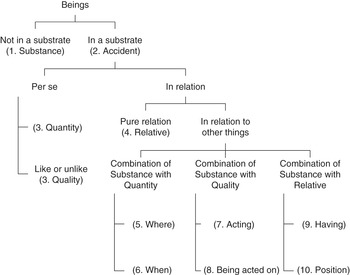
While there are ten categories, they are not all on equal footing. Aristotle argues that one category is primary and fundamental: Substance. All the other nine categories—which are collectively known as accidents—depend on substance.
What does this mean? You can have a substance, like a horse, exist on its own. But you cannot have "whiteness" (a quality), "two hundred kilograms" (a quantity), or "running" (an action) exist independently. They must always be the quality, quantity, or action of a substance. Whiteness must be in a body; running must be done by a living thing.
Substance is the fundamental reality because it is the underlying subject that has all the other properties. The other nine categories are the accidents that belong to substances.
Let's continue with the video to see why substance is the "focal meaning" of being.
This segment explains why substance is the primary category of being. All other categories relate to and depend on substance for their very existence.
Watch from 10:06 to 13:20. Pay close attention to the idea that substance answers the question 'What is it?' in the most fundamental way, while accidents describe its various attributes.
This hierarchical relationship is captured in the following diagram, which shows how all "Beings" are first divided into either Substance or Accident.
The Technical Distinction: "Said Of" vs. "In" a Subject
To make the distinction between substance and accident more precise, Aristotle introduces two technical relations. Understanding these is the key to mastering his system in the Categories. Since you prefer a rigorous, text-driven approach, we'll work through this with a detailed set of lecture notes, followed by a look at the primary text itself.
The two key relations are:
- "Said of a subject": This is a relation of classification between a universal kind and a particular thing that falls under it. For example, the species man is "said of" the individual Socrates. The genus animal is "said of" the species man. This relation tells you what a thing is.
- "In a subject": This describes a property or attribute that resides in something else and cannot exist separately from it. For example, a particular shade of white is "in" a body; knowledge of grammar is "in" a soul. This relation describes a property that a thing has.
Please read the following sections from a university lecture on the Categories that breaks down this crucial distinction.
Lecture on Categories - University of Washington
These notes from Prof. S. Marc Cohen provide a very clear, structured explanation of the 'said of' and 'in' relations, which form the basis for the substance-accident distinction.
Please read the sections titled '6. Two fundamental relations: SAID OF and IN a subject' and '8. The fourfold division'. These sections explain the two relations and how they create a four-part classification of all existing things.
The Four-Fold Division of Beings
As the reading explains, the combination of these two relations ("said of" / not "said of"; "in" / not "in") yields a four-fold classification of all existing things:
-
Universal Substance: Said of a subject, but not in a subject.
- Example: The species man or the genus animal. These are universal concepts that classify substances.
-
Particular Accident: In a subject, but not said of a subject.
- Example: The specific paleness in Socrates's face at a particular moment. It is an individual property.
-
Universal Accident: Both said of a subject and in a subject.
- Example: The general quality of whiteness. It is in bodies (substances) and is also said of particular instances of white.
-
Particular Substance: Neither said of a subject nor in a subject.
- Example: This individual man (Socrates), this particular horse. Aristotle calls these primary substances.
This four-fold division is the core of Aristotle's ontology in the Categories. Primary substances are the fundamental building blocks of reality. Everything else either classifies them (secondary substances) or is a property that exists within them (accidents).
This diagram provides a clear visualization of the four categories using "Peter" as the primary substance.

Primary vs. Secondary Substance
Now, let's turn to the primary source. Reading Aristotle's own words, especially from Chapter 5 of the Categories, will solidify your understanding of these distinctions.
[PDF] Aristotle's Categories (Chapters 1-5)
This is a direct translation of chapters 1-5 of Aristotle's 'Categories'. Reading the original text allows you to see precisely how he defines primary and secondary substances and distinguishes them from accidents.
Please read Chapter 5 (which begins on page 2 with the heading 'Chapter 5'). Focus on these key passages: 2a13-2a19: Aristotle's definition of primary and secondary substance. 2a35-2b7: His argument for why primary substances are fundamental—if they didn't exist, nothing else could. 3b32-4a10: His claim that substance does not admit of more or less, and its unique ability to receive contraries (e.g., a man can become pale from being tan while remaining the same man).
To complement the primary text, Dr. Gregory Sadler offers a detailed video explanation of the distinction between primary and secondary substances.
Aristotle, The Categories | Primary and Secondary Substance | Philosophy Core Concepts
Dr. Sadler provides a focused analysis of the distinction between primary substances (individuals) and secondary substances (species and genera), explaining their hierarchical relationship.
Watch the following segments: 00:50 - 07:43: Introduction to primary vs. secondary substances, with examples. 12:32 - 15:01: Explanation of why primary substances are ontologically fundamental—everything else depends on them. Focus on why species (like 'man') are considered 'more substance' than genera (like 'animal').
Conclusion
In this lesson, we have moved from Aristotle's theory of explanation (the Four Causes) to his theory of being (the Categories). By analyzing the structure of predication, Aristotle created a powerful map of reality, with individual substances at its center.
Here are the key takeaways:
- Substance vs. Accident: The fundamental distinction is between a substance (what a thing is, e.g., Socrates, a horse) and its accidents (the properties it has, e.g., his height, his color, his location).
- Ontological Dependence: Accidents are ontologically dependent on substances. They cannot exist on their own; they must be in a substance.
- The Four-Fold Division: Using the relations "said of" and "in a subject," Aristotle classifies all beings into four types: primary (particular) substance, secondary (universal) substance, particular accident, and universal accident.
- Primary Substance: Individual entities like "this man" or "this horse" are the ultimate subjects of reality. They are neither "in" nor "said of" anything else in the same way. If they did not exist, nothing else could.
- Secondary Substance: The species and genera (like man and animal) that classify primary substances. They are what we say a primary substance is.
You are now equipped with two of Aristotle's most powerful analytical tools: the Four Causes and the distinction between substance and accident. In our next lesson, we will see how Aristotle uses this new metaphysical framework to launch a direct and influential critique of Plato's Theory of Forms.
Can't find a good explanation? Sign up and we'll make it for you
Sign up