Hello! Welcome to the fifth lesson in our module on Core Models for Competitive Analysis.
In our last lesson, you learned how to model a simultaneous business decision, like pricing, using a payoff matrix. We built a matrix for your new woodworking business and started to analyze it by asking, "What is my best response to my competitor's potential actions?"
Today, we will formalize that analysis to achieve today's learning outcome: to identify a Nash Equilibrium as a stable outcome where no player wishes to unilaterally change their strategy. This is one of the most fundamental concepts in game theory, and mastering it will give you a powerful tool for predicting how your competitors are likely to act.
What is a Nash Equilibrium?
At its core, a Nash Equilibrium represents a stable outcome of a game. It's a situation where every player has chosen their best possible strategy, given the strategies chosen by all other players. In this state, no single player can get a better payoff by changing their strategy on their own. It's a point of "no regrets" for everyone involved.
To get a solid grasp of this concept and its importance in business, let's start with a short reading.
What Is Nash Equilibrium and Why It Is Important?
The article 'What Is Nash Equilibrium and Why It Is Important?' from Franchise Times provides a clear, business-focused definition. It uses an excellent real-world example of gas stations clustering together to make the idea intuitive.
Please read the first three sections: 'Understanding Nash Equilibrium', 'Real-World Example: The Gas Station Conundrum', and 'Why Nash Equilibrium Matters for Businesses'. Focus on the definition and how it applies to real business decisions.
As the article highlights, the power of this concept is in prediction. If you can analyze a situation and identify the likely Nash Equilibrium, you can anticipate the outcome of a competitive interaction, whether it's a price war, a marketing battle, or a product launch.
Finding the Nash Equilibrium: The Best Response Method
Now that you understand what a Nash Equilibrium is, let's learn how to find it. We'll use a systematic approach called best response analysis, which you got a preview of in our last lesson.
The key idea is to look at the game from each player's perspective, one at a time. For each possible move your competitor can make, you figure out your single best response. A Nash Equilibrium exists where each player's action is the best response to the other's.
The following video demonstrates this method very clearly. It also introduces the related concept of a dominant strategy—a strategy that is best for a player regardless of what the other player does.
Nash Equilibrium|Dominant Strategy|Game Theory|Explained with example|Economics for Beginner|Masters
This video from Eco Inclined by Pooja Jain provides a step-by-step walkthrough of finding the Nash Equilibrium. It first shows a game with dominant strategies and then a game without, which is a useful distinction.
Please watch from 00:42 to 10:06. The first part (until 06:32) covers a game with dominant strategies. The second part (from 06:32 onwards) shows how to find the Nash Equilibrium using best response analysis when a dominant strategy doesn't exist.
The method shown in the video can be summarized as:
- Assume you are the row player. For each column (your competitor's choice), find your highest payoff and circle it.
- Assume you are the column player. For each row (the other player's choice), find your highest payoff and circle it.
- Identify the Nash Equilibrium. Any cell where both payoffs are circled is a Nash Equilibrium. This is the stable outcome because both players are playing their best response simultaneously.
Application: Solving Your Pricing Game
Let's apply this method to the pricing game matrix we created in the last lesson for your woodworking business versus "Artisan Cabinets".
| You \ Artisan | Premium |
Competitive |
|---|---|---|
Premium |
(3, 3) | (1, 4) |
Competitive |
(4, 1) | (2, 2) |
| (Payoffs: (Your Payoff, Artisan's Payoff), where 4=Best, 1=Worst) |
Step 1: Find Your Best Response
- If Artisan prices
Premium(left column), your best response is to priceCompetitive, as your payoff of 4 is better than 3. Let's circle 4. - If Artisan prices
Competitive(right column), your best response is to priceCompetitive, as your payoff of 2 is better than 1. Let's circle 2.
| You \ Artisan | Premium |
Competitive |
|---|---|---|
Premium |
(3, 3) | (1, 4) |
Competitive |
(4, 1) | (2, 2) |
Notice that Competitive is your best move no matter what Artisan does. This means Competitive is your dominant strategy.
Step 2: Find Artisan's Best Response
- If you price
Premium(top row), Artisan's best response is to priceCompetitive, as their payoff of 4 is better than 3. Let's circle 4. - If you price
Competitive(bottom row), Artisan's best response is to priceCompetitive, as their payoff of 2 is better than 1. Let's circle 2.
| You \ Artisan | Premium |
Competitive |
|---|---|---|
Premium |
(3, 3) | (1, 4) |
Competitive |
(4, 1) | (2, 2) |
Step 3: Identify the Nash Equilibrium
Now, let's combine our circles onto one matrix:
| You \ Artisan | Premium |
Competitive |
|---|---|---|
Premium |
(3, 3) | (1, 4) |
Competitive |
(4, 1) | (2, 2) |
The cell where both payoffs are circled is (Competitive, Competitive). This is the Nash Equilibrium of the game.
What does this mean for your business? It predicts that despite both of you being better off if you both priced Premium (payoff 3 each), the strategic incentives will likely drive both you and your competitor to price competitively, leading to a less profitable outcome (payoff 2 each). This is a powerful, if sobering, insight.
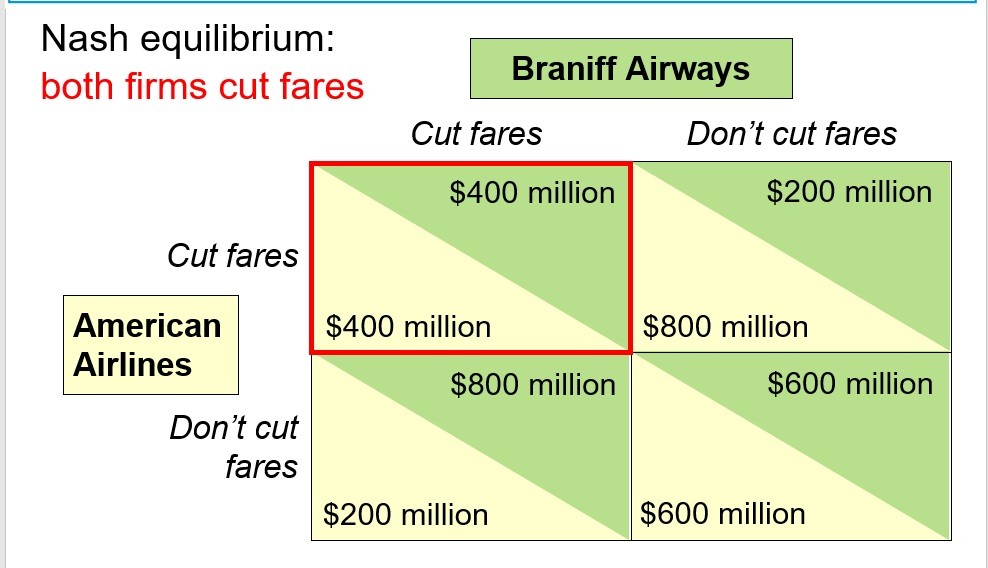
Here are a couple of other real-world examples in matrix form. Notice the highlighted cell in each case represents the Nash Equilibrium.

Test your understanding!
Let's imagine you and Artisan Cabinets are deciding on your marketing focus for the next quarter. You can either run Online Ads or focus on Local Fairs. Your payoffs are ranked from 4 (best) to 1 (worst).
| You \ Artisan | Online Ads |
Local Fairs |
|---|---|---|
Online Ads |
(2, 2) | (4, 1) |
Local Fairs |
(1, 4) | (3, 3) |
| (Payoffs: (You, Artisan)) |
Using the best response method, what is the Nash Equilibrium of this game? Are there any?
Show answer
Let's find the best responses.
- If Artisan chooses
Online Ads, your best move isOnline Ads(2 > 1). - If Artisan chooses
Local Fairs, your best move isOnline Ads(4 > 3). - If you choose
Online Ads, Artisan's best move isLocal Fairs(4 > 2). - If you choose
Local Fairs, Artisan's best move isLocal Fairs(3 > 1).
The matrix with circled best responses looks like this:
| You \ Artisan | Online Ads |
Local Fairs |
|---|---|---|
Online Ads |
(2, 2) | (4, 4) |
Local Fairs |
(1, 4) | (3, 3) |
There are actually two Nash Equilibria:
- You choose
Online Adsand Artisan choosesLocal Fairs. - You choose
Local Fairsand Artisan choosesOnline Ads.
This is a different type of game, called a "Coordination Game." The stable outcomes are those where you and your competitor avoid direct competition and specialize in different marketing channels. The strategic challenge here would be signaling your intent or figuring out which equilibrium you'll land on.
Conclusion
Today you've learned to identify the most likely, stable outcome of a competitive situation. The Nash Equilibrium is a cornerstone of strategic thinking because it forces you to move beyond what you want to happen and predict what is likely to happen based on the rational choices of all players.
Key Takeaways:
- A Nash Equilibrium is a stable outcome where no player can benefit by unilaterally changing their strategy. It represents a "no regrets" point for all players.
- You can find the Nash Equilibrium by performing a best response analysis: for each player, you circle their best payoff for every possible choice the other player can make.
- A cell where all payoffs are circled is a Nash Equilibrium. A game can have one, multiple, or sometimes no Nash Equilibria (in pure strategies).
- Identifying the equilibrium allows you to anticipate competitor behavior and make more informed strategic decisions about pricing, marketing, and product offerings.
Preview of the Next Lesson:
In our pricing game, we found that the Nash Equilibrium was an outcome where both you and your competitor were worse off than if you had both cooperated. This specific, and very common, type of situation is known as the Prisoner's Dilemma. In our next lesson, we will dive deep into this famous model to understand why mutually beneficial cooperation can be so hard to maintain and what strategies businesses can use to overcome this challenge.