Hello! Welcome to the final lesson in our module on Core Models for Competitive Analysis.
In our last lesson, we explored the concept of Nash Equilibrium and found that in your pricing game against "Artisan Cabinets," the most likely outcome was for both of you to price competitively, leading to lower profits for both. This might have felt counterintuitive: if both of you would be better off cooperating with premium prices, why does the logic point to a price war?
Today, we'll dive into the formal model that explains this exact puzzle. Our learning outcome is to use the Prisoner's Dilemma model to understand why mutually beneficial cooperation can be difficult to achieve. This is one of the most famous and powerful concepts in game theory, and you'll find it explains a vast range of situations you'll encounter as a business owner.
What is a Prisoner's Dilemma?
The Prisoner's Dilemma is a specific type of game where individual self-interest leads to a worse outcome for everyone involved than if they had cooperated. The name comes from a story about two suspects being interrogated in separate rooms, but the underlying structure appears everywhere from global politics to business pricing.
To get a clear and concise definition of the model's key characteristics, let's watch a short video.
Prisoners Dilemma Examples: Oligopoly, Carbon Emission & Dating
The video 'Prisoners Dilemma Examples' by Ashley Hodgson does an excellent job of skipping the classic story to focus directly on the two essential characteristics that define a Prisoner's Dilemma. This will give you a clear framework for identifying these situations in the wild.
Please watch from 01:07 to 05:49. Pay close attention to the two characteristics she outlines: 1) Both players have a dominant strategy, and 2) Both players would prefer the outcome where they both played their dominated (cooperative) strategy.
To summarize the key takeaways from the video:
A situation is a Prisoner's Dilemma if it meets these two conditions:
- Each player has a dominant strategy to "defect" (e.g., cut prices), meaning it's their best move regardless of what the other player does.
- The outcome from mutual defection is worse for both players than the outcome of mutual cooperation (e.g., both keeping prices high).
This creates the "dilemma": rational, self-interested choices pull everyone toward a result that nobody wants.
The Prisoner's Dilemma in Your Market: The Pricing Trap
This model is most famous in business for explaining why price wars are so common and so destructive. Let's ground this in your woodworking business.
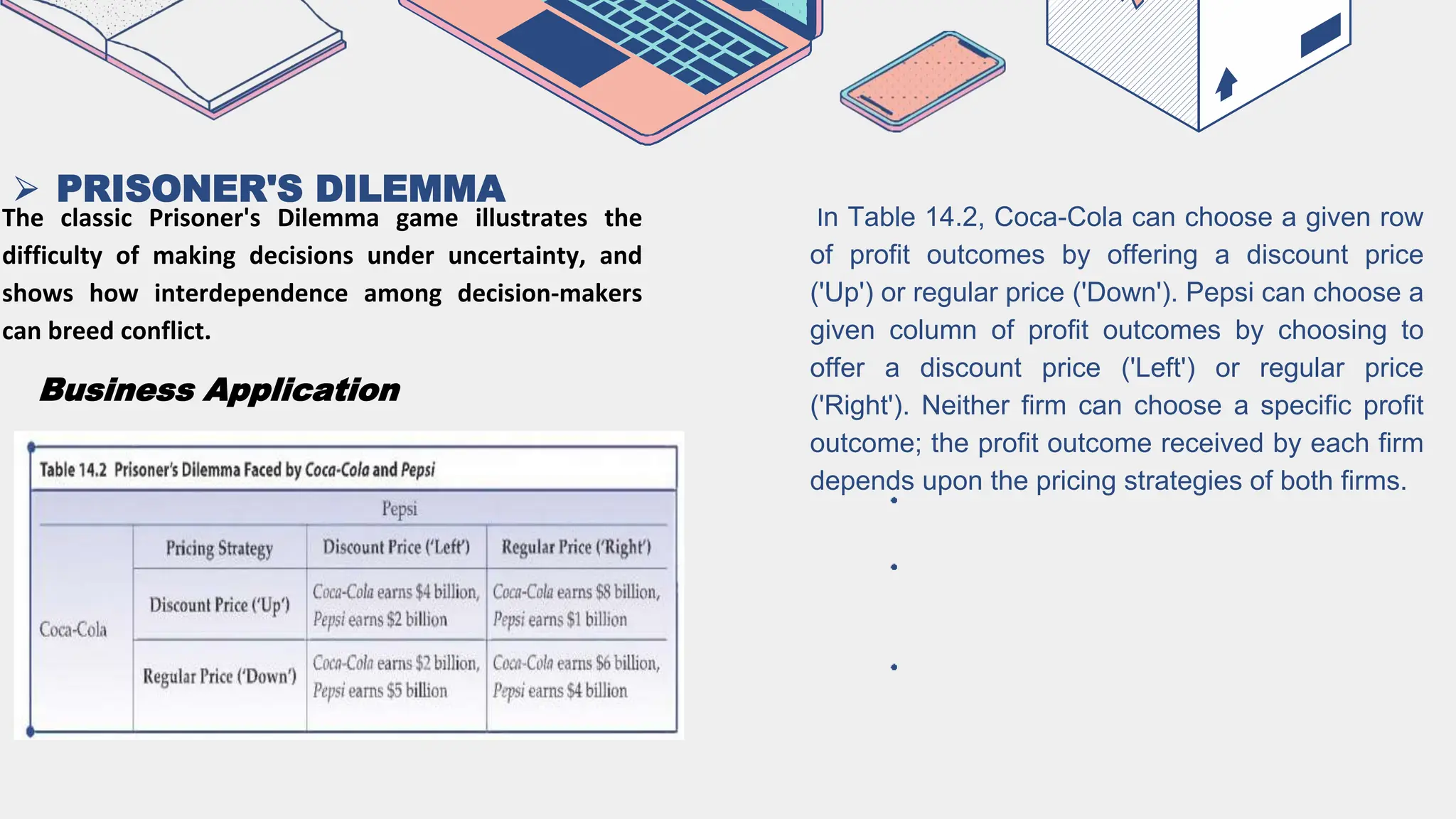
Imagine you and a key competitor, "Local Joinery," are the two main providers of premium, custom-sized cabinet doors in your area. You both have a choice: maintain a High Price (cooperate to keep margins healthy) or offer a Low Price (defect to try and steal market share).
Let's map out the potential weekly profits in a payoff matrix:
| You \ Local Joinery | High Price (Cooperate) | Low Price (Defect) |
|---|---|---|
| High Price (Cooperate) | ($10k, $10k) | ($2k, $15k) |
| Low Price (Defect) | ($15k, $2k) | ($5k, $5k) |
(Payoffs: (Your Profit, Local Joinery's Profit))
Let's analyze this using the best response method from our last lesson:
-
Your perspective:
- If Local Joinery prices High, your best move is to price Low ($15k > $10k).
- If Local Joinery prices Low, your best move is still to price Low ($5k > $2k).
- Pricing Low is your dominant strategy.
-
Local Joinery's perspective:
- If you price High, their best move is to price Low ($15k > $10k).
- If you price Low, their best move is still to price Low ($5k > $2k).
- Pricing Low is also their dominant strategy.
The Nash Equilibrium is where you both play your dominant strategy: (Low Price, Low Price). You both end up making $5k in profit. But look at the top-left cell: if you had both cooperated and kept prices high, you could have each made $10k!
You are both drawn into a price war, even though it makes you both worse off. This is the Prisoner's Dilemma in action.
The Price War "Death Spiral"
For a new premium business like yours, falling into this trap is particularly dangerous. Competing on price is the opposite of building a premium brand. It can trigger a "death spiral" that is hard to escape.
Prisoner's Dilemma: Why Price Competition Is a Game You Cannot Win
The article 'Prisoner's Dilemma: Why Price Competition Is a Game You Cannot Win' from PricePerfect lays out the devastating consequences of unchecked price competition.
Please read the section titled 'The Price War Death Spiral.' As you read, think about what this would mean for your business. To compete on ever-lower prices, you might be forced to use lower-quality wood, cheaper hinges, or rush your finishing process—all of which would destroy the premium reputation you want to build.
Test your understanding!
You're considering offering a free, high-end installation service with your cabinets. This is costly for you. Your main competitor, "Artisan Cabinets," faces the same choice.
- If you both Don't Offer it, you both make a good profit of $8k.
- If you both Offer it, the cost eats into your profits, and you both make $4k.
- If you Offer it and they Don't, you attract many customers and make $12k, while they lose out and make $1k.
- If they Offer it and you Don't, they attract the customers and make $12k, while you make $1k.
Is this situation a Prisoner's Dilemma? Why or why not?
Show answer
Yes, this is a classic Prisoner's Dilemma.
- Each player has a dominant strategy: Your best move is always to Offer the service, regardless of what Artisan does. (If they don't offer, you get $12k vs $8k. If they do offer, you get $4k vs $1k). The same logic applies to Artisan.
- The mutual defection outcome is worse than mutual cooperation: If you both follow your dominant strategy and Offer the service, you each end up with $4k. This is worse for both of you than if you had both cooperated and not offered the service, in which case you would have both made $8k.
Escaping the Dilemma: Repeated Games and Tit-for-Tat
So, is cooperation hopeless? Not necessarily. The classic Prisoner's Dilemma assumes a one-time interaction. Most business relationships, however, are repeated games. You'll be setting prices next month, and the month after that. You and your competitors remember each other's past actions.
This possibility of future reward and punishment completely changes the game. It allows for strategies that build trust and sustain cooperation. The most famous of these is called "Tit for Tat."
The following video brilliantly explains this through the story of a computer tournament designed to find the best strategy for a repeated Prisoner's Dilemma.
This game theory problem will change the way you see the world
This video from Veritasium, 'This game theory problem will change the way you see the world,' is a fantastic exploration of how the Prisoner's Dilemma changes when it's played over and over. It introduces the concept of the 'Iterated Prisoner's Dilemma' and the elegant 'Tit for Tat' strategy.
Please watch from 04:39 to 15:57. This is the longest resource in the lesson, but it's highly engaging. Focus on understanding why 'Tit for Tat' was so successful and the four qualities of winning strategies that Robert Axelrod identified: being nice, retaliatory, forgiving, and clear.
The insights from Axelrod's tournament give you a powerful mental model for long-term strategic interaction:
- Be Nice: Don't be the first to start a price war. Start by cooperating (e.g., setting a fair, sustainable premium price).
- Be Retaliatory: Don't be a pushover. If a competitor undercuts you, you must respond. This signals that aggressive behavior will not be profitable for them. This might mean matching their price cut, even if it hurts you both in the short term.
- Be Forgiving: If the competitor returns to a cooperative price, you should too. Don't hold a grudge. The goal is to restore the mutually profitable equilibrium, not to punish them indefinitely.
- Be Clear: Your pricing strategy shouldn't be erratic. Your competitors should be able to understand your behavior. A clear "Tit-for-Tat" strategy is easy for competitors to recognize, making cooperation more likely.
Conclusion
Today, we've unpacked one of game theory's most important models. The Prisoner's Dilemma provides a stark warning about the dangers of unchecked, self-interested competition.
Key Takeaways:
- The Prisoner's Dilemma occurs when rational individual choices lead to a collectively irrational and suboptimal outcome.
- It's defined by two features: each player has a dominant strategy to "defect," and the resulting equilibrium is worse for all than if they had cooperated.
- In business, this dynamic frequently leads to destructive price wars and can trigger a "death spiral" of declining quality and margins—a major threat to a premium brand.
- In repeated games, cooperation can be sustained. Strategies like Tit for Tat (cooperate on the first move, then copy your opponent's last move) are highly effective.
- Successful long-term strategies are often nice, retaliatory, forgiving, and clear.
Preview of the Next Lesson:
We are now concluding our module on core models for competitive analysis. We've looked at simultaneous-move games where you and your competitors act at the same time.
But what about decisions where timing matters? In the next module, "Market Entry and Positioning," we will shift our focus to sequential-move games. Our first lesson will be: Apply a game tree and backward induction to analyze your market entry decision. This will give you a new tool to map out decisions that unfold over time, such as deciding whether to enter a market before or after a competitor.