Hello! Welcome to the second lesson in our module on Core Models for Competitive Analysis.
In our last lesson, we established the crucial difference between simultaneous-move games (where players act without knowing their opponents' current moves) and sequential-move games (where players move in order, observing prior actions). We noted that your decision to enter the market is a classic sequential game.
Today, we will build on that foundation. The learning outcome for this lesson is to represent a sequential decision, such as your market entry, using a game tree. This will give you a visual map to chart out the potential paths your business journey can take, based on your actions and your competitors' likely reactions. Think of it as creating a schematic for a strategic decision, which should resonate with your engineering background.
What is a Game Tree?
A sequential game is best represented in what's called extensive form, which we visualize using a game tree. A game tree is a diagram that shows every possible sequence of moves in the game. It has three key components:
- Nodes: These are the points where a player makes a decision. We label each node with the player whose turn it is to move.
- Branches: These represent the actions a player can take at a decision node. Each branch leads to a new state of the game.
- Payoffs: These are listed at the very end of each path (at the terminal nodes). They represent the outcome for each player for that specific sequence of moves. By convention, the first number in the payoff pair is for the first player, and the second number is for the second player.
Let's look at a classic example: a new firm entering a market dominated by a monopoly.

Constructing a Game Tree for Your Woodworking Business
Now, let's apply this directly to your situation. You are considering entering the premium custom cabinet market, where there's already an established local player. Let's call them "Incumbent Cabinets."
Step 1: Identify the Players and the Sequence
- Player 1: You (the Entrant)
- Player 2: Incumbent Cabinets (the Incumbent)
- Sequence: You move first by deciding whether to launch your business. The Incumbent observes your choice and then decides how to react.
Step 2: Map Your Initial Decision (The First Node)
The game starts with your decision. Your node has two branches:
- Enter: You invest in the CNC machinery, set up your workshop, and start marketing your premium cabinets.
- Stay Out: You decide not to enter this specific market.
Step 3: Map the Competitor's Reaction (The Second Node)
- If you choose Stay Out, the game ends. The incumbent continues as before.
- If you choose Enter, the game moves to the Incumbent's decision node. They have to decide how to respond to your entry. Let's say their main options are:
- Accommodate: They maintain their current pricing and accept that they will now have to share the market with you.
- Fight: They launch a price war, drastically cutting their prices to try and drive you out of business before you can get established.
Step 4: Assign Payoffs (The Terminal Nodes)
Now we assign hypothetical profits to each of the three possible outcomes. The exact numbers aren't as important as their relative values. Let's measure payoffs in thousands of dollars of potential annual profit.
- You
Stay Out: You make no investment and earn no profit from this venture. The incumbent keeps all their monopoly profit.- Payoff: (You: $0, Incumbent: $100k)
- You
Enter, IncumbentFights: A price war is costly for everyone. The incumbent loses profit, and you might even lose money in your first year.- Payoff: (You: -$20k, Incumbent: $30k)
- You
Enter, IncumbentAccommodates: You both capture a piece of the market and make a healthy profit, though the incumbent now makes less than they did as a monopolist.- Payoff: (You: $50k, Incumbent: $70k)
Putting it all together, the game tree for your market entry decision looks like this:
This game tree models your decision to enter the premium cabinet market. You move first, and Incumbent Cabinets reacts. The payoffs represent potential annual profits and show the consequences of each path.
This visual map makes the strategic landscape much clearer. To reinforce this structure, the following reading provides a great explanation of how to construct these games.
17 Sequential Games - Profit Analytics for Entrepreneurs
The article '17 Sequential Games' from Profit Analytics for Entrepreneurs provides a clear, business-focused explanation of how to build and interpret game trees in extensive form.
Please read the section titled '17.4 Constructing Sequential Games in Extensive Form'. Focus on how it visually represents the monopolist-entrant game. We will cover the method for 'solving' the game in our next lesson, so for now, just focus on the structure of the tree.
Expanding the Tree: More Complex Decisions
Your decisions won't always be a simple binary choice. For instance, your initial investment in CNC machinery could be large or small. A large investment might produce cabinets more efficiently but costs more, while a smaller, more versatile machine might be less of a commitment.
This initial choice can influence how your competitor reacts. A large investment might signal you are serious and have lower production costs, making a price war more dangerous for them.
The game tree below illustrates a similar scenario between Wal-Mart and Target. Wal-Mart's initial decision isn't just to enter, but how to enter (with a large or small store).
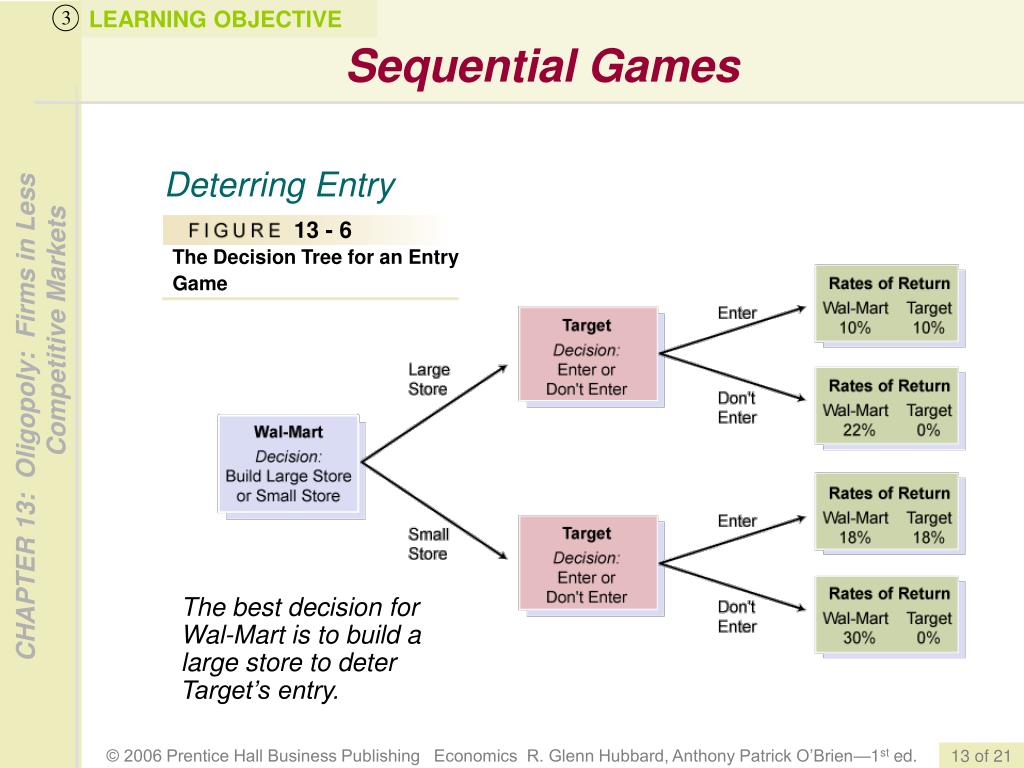
This shows how game trees can capture more nuanced strategic decisions, like what kind of equipment to buy or what scale to launch your business at.
Test your understanding!
Let's think about another key decision: your product line. You could focus on a Niche market (e.g., only complex, high-end custom doors) or a Broader market (e.g., doors and standard-sized kitchen cabinets).
An established competitor currently specializes in standard cabinets.
- If you choose Niche, you don't compete with them directly, so they might Ignore you.
- If you choose Broad, you are now a direct competitor in their main market, and they might Cut Prices to defend their turf.
Try to sketch out the game tree for this decision. What are the nodes, branches, and terminal outcomes?
Show answer
Here's how the game tree would be structured:
-
Player 1 (You) Node:
- Branch 1:
Niche (Doors Only) - Branch 2:
Broad (Doors & Cabinets)
- Branch 1:
-
Path 1: You choose
Niche- This leads to the Competitor's node. Since you aren't a direct threat, their likely action is to Ignore you.
- Terminal Node 1: You carve out a new niche, they keep their market. Both do well.
-
Path 2: You choose
Broad- This leads to the Competitor's node. Now you are a direct threat.
- Competitor Node:
- Branch 2a:
Cut Prices - Branch 2b:
Do Nothing
- Branch 2a:
- Terminal Node 2a (Cut Prices): You both compete on price, and profits are lower for both.
- Terminal Node 2b (Do Nothing): You enter their market, and you both share it, but they did not react with a price cut.
This exercise shows how a game tree can help you think through not just market entry, but also your product positioning strategy.
Conclusion
Today, we've translated the abstract idea of a sequential game into a concrete, practical tool: the game tree. By mapping out decisions and their consequences, you can bring structure and clarity to complex strategic problems.
Key Takeaways:
- A game tree is the visual representation of a sequential game.
- It is built from nodes (decision points), branches (actions), and payoffs (outcomes at the terminal nodes).
- Constructing a game tree forces you to explicitly consider who the players are, the sequence of moves, the available actions, and the potential outcomes.
- This tool is powerful for modeling key entrepreneurial decisions like market entry, investment scale, and product line choices.
Preview of the Next Lesson:
We've successfully created the map. In the next lesson, we'll learn how to use it to find the best path forward. You will learn to use backward induction on a game tree to find the optimal sequence of moves. This powerful technique of "looking ahead and reasoning back" is one of the most fundamental and useful concepts in all of game theory.