Hello! Welcome back.
In our last lesson, we explored the concept of 'best response' and saw how it helps predict a competitor's actions. We used a payoff matrix to analyze a simultaneous pricing decision and referenced a game tree for a sequential market entry decision. You might have noticed that the timing and information available in those two scenarios were different.
Today, we'll formalize that difference. This lesson is the first step in building our core toolkit for competitive analysis. Our goal is to distinguish between simultaneous-move and sequential-move games. Understanding this distinction is crucial because it tells you which analytical tool to use for a given strategic problem, ensuring you're looking at the situation in the right way.
For your business, this distinction is immediately practical. Deciding whether to buy a unique CNC machine that your competitors will see is a sequential game. Deciding what price to quote on a project when you know a competitor is also submitting a sealed bid is a simultaneous game. Let's dive in.
Two Kinds of Strategic Time: Simultaneous vs. Sequential
In game theory, the timing of decisions fundamentally changes the nature of the interaction. The key factor is not whether players act at the exact same millisecond, but what they know when they make their choice.
1. Simultaneous-Move Games
In a simultaneous-move game, players make their choices without knowing the current decisions of their opponents. Think of it as making a move in the dark about what others are doing right now.
To get a quick overview of this concept, please watch the first part of this video.
Game Theory Simultaneous Moves
This short clip from a video by Ashley Hodgson introduces the core idea of a simultaneous-move game, where players' choices are revealed at the same time.
Watch the video from the beginning until the 0:43 mark. Focus on the definition provided and the idea that payoffs are determined after all decisions are revealed together.
As the video explains, the choices are effectively made in parallel. This type of game is also sometimes called a static game.
A classic business example is two companies submitting sealed bids for a contract. Neither knows the other's bid when making their own. The pricing game we analyzed in the previous lesson, where you and your competitor set prices for the month without knowing each other's choice until the prices are public, is another perfect example. We typically use a payoff matrix to analyze these games.
2. Sequential-Move Games
In a sequential-move game, players act in a defined order. Crucially, players who move later have information about the choices made by players who moved earlier.
This video provides a clear visual introduction to how sequential games work.
Game Theory: Sequential Move Games
This clip from Economics in Many Lessons illustrates a sequential-move game using a diagram called a game tree, which we've briefly seen before.
Watch from the start until 1:13. Notice how Player 1 moves first, and Player 2's decision depends on which path Player 1 chose. This visualizes the flow of information.
These are also known as dynamic games. Your decision to enter the woodworking market is a sequential game: you move first by setting up your business, and then existing furniture makers react. In these games, the key is to "look ahead and reason back." We typically use a game tree to map out the decisions.
Reading the Definitions
For a concise, text-based summary of these concepts, the following resource is very helpful.
Understanding Game Theory and Its Impact on Decision Making
This article from Intelligent Machines provides clear, side-by-side definitions of static (simultaneous) and dynamic (sequential) games.
Please read the short section titled '3. Static (Simultaneous) vs Dynamic (Sequential) Games'. It will reinforce the distinction we've just discussed.
To solidify your understanding, here is a summary table:
| Feature | Simultaneous-Move Game | Sequential-Move Game |
|---|---|---|
| Timing | Players make their choices concurrently. | Players make their choices in a specific order. |
| Information | Players do not know the other players' current moves. | Later players observe the moves of earlier players. |
| Key Mindset | "What will my rival do now?" | "If I do X, how will my rival react then?" |
| Primary Tool | Payoff Matrix | Game Tree |
| Woodworking Example | Setting monthly prices at the same time as a competitor. | Deciding to enter the market; competitors react after entry. |
Test your understanding!
For each of the following scenarios related to your woodworking business, decide whether it is a simultaneous-move or a sequential-move game.
- You are considering offering a 5-year warranty on your custom cabinets, a move that would be very public. Your main competitor would then have to decide whether to match your warranty or not.
- You and one other local CNC woodworker are both asked to submit final, sealed price quotes to a general contractor for a large batch of custom doors.
- You're deciding on your advertising budget for the year. Your competitor is doing the same. You won't know their budget until their ads start appearing, and they won't know yours.
Show answer
- Sequential. You move first by announcing the warranty. Your competitor observes your move and then decides how to react.
- Simultaneous. The bids are "sealed," meaning you make your decision without knowing your competitor's choice. Both decisions are revealed at the same time.
- Simultaneous. You are both deciding in parallel without knowledge of the other's immediate choice.
Combining Game Types: A Hybrid Scenario
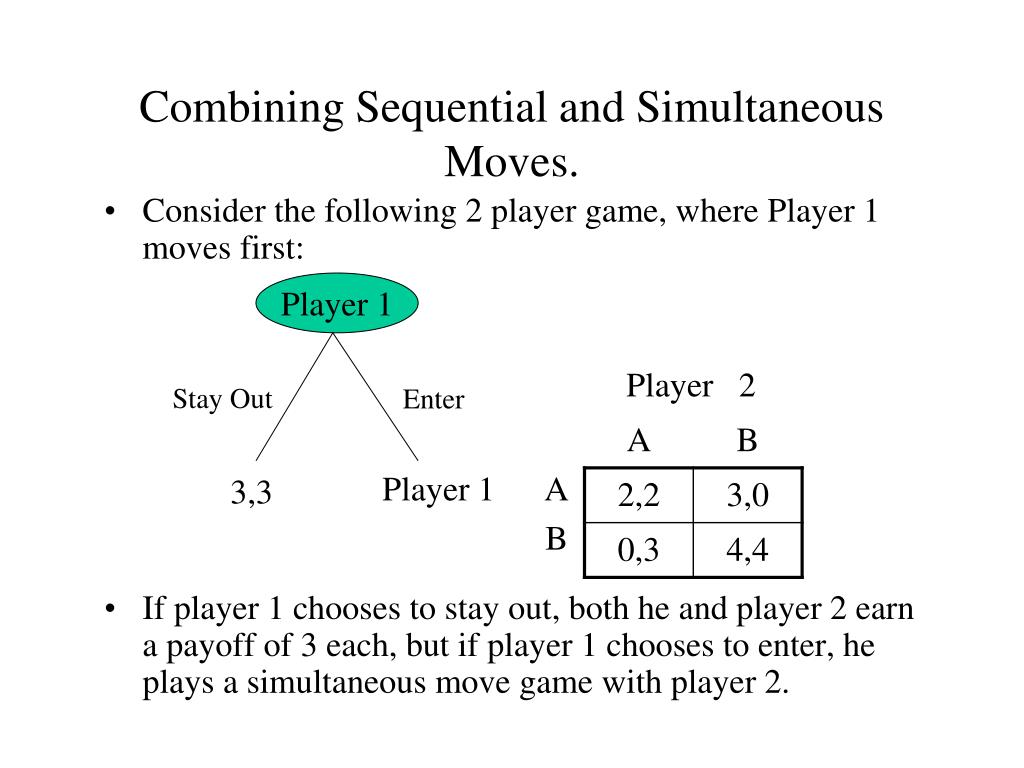
In the real world, strategic interactions are often multi-layered. A game might start sequentially and then lead into a simultaneous game.
Consider your market entry.
- Step 1 (Sequential): You decide whether to Enter the premium cabinet market or Stay Out.
- Step 2 (Simultaneous): If you enter, you and the incumbent now face a new reality. Each month, you both have to set your prices. This becomes a simultaneous game, repeated over and over.
The image below illustrates exactly this kind of hybrid game. Player 1 first makes a sequential choice to "Enter" or "Stay Out." If Player 1 enters, it triggers a simultaneous game where both players must choose their next move (A or B) at the same time.
Conclusion
Today we've drawn a clear line between two fundamental types of strategic interactions. This distinction is the first and most important step in analyzing any competitive situation.
Key Takeaways:
- Simultaneous-move games involve players choosing their actions at the same time, without knowledge of what their opponents are doing. The key question is "What will they do now?"
- Sequential-move games involve players taking turns, with later players being aware of earlier players' actions. The key question is "If I do this, what will they do then?"
- The type of game determines the right analytical tool: payoff matrices for simultaneous games and game trees for sequential games.
- Many real-world business strategies, like market entry, are hybrid games where an initial sequential move sets the stage for future simultaneous interactions.
Preview of the Next Lesson:
Now that you can identify a sequential game, our next lesson will focus on how to formally analyze one. We will dive deep into representing a sequential decision, such as your market entry, using a game tree. This will give you a powerful visual tool for planning your first major strategic moves.