Introduction
Welcome back! In our last lesson, you learned to ask the single most important question for finding a plan in a quiet middlegame: "Which is my least active piece?" By identifying your "unemployed" pieces, you've mastered the critical first step of strategic improvement.
Today, we take the logical next step: moving from diagnosis to action. This lesson is all about answering the follow-up question: "Now that I've found my worst piece, what do I do with it?" Our goal is to learn how to formulate a simple plan to improve the position of a passive piece.
Just as in marketing you might reallocate budget from a non-performing channel to one with higher potential, in chess, you must reroute your non-performing pieces to where they can have the most impact. This skill of gradually improving your position is what separates good players from great ones, and it's a key part of your journey to 1500 ELO.
1. From Identification to a Plan: The Three-Question Framework
Once you've identified your least active piece, creating a plan for it involves a simple, structured thought process. Grandmasters often do this intuitively, but we can make it explicit with three questions.
Let's hear GM Sam Shankland introduce this framework.
Finding the best Squares for your Pieces with Maneuvering | Chess Middlegame | GM Sam Shankland
In this clip, GM Sam Shankland outlines the three crucial questions to ask when you are maneuvering your pieces to better squares.
Watch from the beginning until 01:29. Pay close attention to the three questions he proposes. We will be using them as our guide for the rest of this lesson.
Here is the framework for your planning process:
- Which is my least effective piece? (This is what we covered last lesson).
- Where are my opponent's weaknesses? Your improved piece needs a target or a purpose. This could be a weak pawn, an exposed king, or a key square to control.
- What is my opponent's idea? Sometimes, you need to improve a piece for defensive reasons—to counter a threat or shore up your own weaknesses.
Let's see how this works in a simple, concrete example.
Finding the best Squares for your Pieces with Maneuvering | Chess Middlegame | GM Sam Shankland
Now, watch how GM Shankland applies this framework to improve a passive rook in a game by former World Champion Anatoly Karpov.
Watch the segment from 03:43 to 04:23.
Let's break down Karpov's plan using the framework:
- Worst Piece: The rook on
a1. It's doing absolutely nothing. - Opponent's Weakness: The pawn on
f7, which is a classic target near the king. - The Plan: A simple, one-move plan: play Rook f1. This brings the "unemployed" piece directly into the game to pressure a known weakness.
This is the essence of piece improvement: finding a better job for your least active piece.
2. The Art of the Reroute
Sometimes, a piece is so poorly placed that it can't be improved in a single move. This is especially true for knights, which can't move long distances quickly. In these cases, you need to formulate a multi-step plan called a maneuver or reroute.
The idea is to spend a few moves walking the piece to a much better square. This may feel slow, but as we'll see, the payoff is huge.
The Most Important Skill in Chess: Improving Your Worst Piece
This blog post from Chess.com reinforces the importance of these slow, patient improvements.
Read the sections 'How Strong Players Use This Concept' and 'Common Examples'. Notice the key advice: for a knight on the rim, the plan is to 'reroute it, even if it takes three moves'.
Now, let's watch a masterful example of a knight reroute from the same Karpov game.
Finding the best Squares for your Pieces with Maneuvering | Chess Middlegame | GM Sam Shankland
A few moves later, Karpov identifies a new worst piece—the knight on c3. Watch the brilliant, non-obvious plan he conceives to improve it.
Watch from 04:58 to 07:44. Focus on why the knight on c3 is considered passive and the logic behind the surprising move Nb1.
Karpov's plan for his knight is a perfect illustration of the rerouting principle:
- Worst Piece: The knight on
c3. It looks developed, but it has no future. It can't move forward to any useful squares. - Opponent's Weaknesses: The pawns on the queenside, especially
a5, and the strong opposing knight onb4. - The Plan (Reroute):
- Play
Nb1. This move looks like a step backward, but it's the start of the maneuver. - The idea is to then play
c3to kick the strong black knight away. - Finally, the white knight can re-emerge on a much better square like
b3orc4, where it attacks the weaka5pawn and controls more of the board.
- Play
This patient, multi-move plan completely transformed the position in White's favor.
3. Plans for Different Pieces
While the three-question framework is universal, the types of plans often depend on the piece you are trying to improve.
Improving a "Bad" Bishop
A "bad bishop" is one that is blocked by its own pawns. A great plan for a bad bishop is often to trade it for your opponent's "good" bishop.
This Is Your Worst Piece | Chess Middlegame Strategy
This video provides a very clear example of formulating a plan to trade a bad bishop for a good one.
Watch from 03:41 to 06:05. The player with the Black pieces identifies their light-squared bishop as an 'unhelpful piece' and creates a plan to exchange it for White's powerful light-squared bishop.
Improving a Blocked Rook
As the article we read mentioned, a common plan for a rook blocked by a pawn is to prepare a pawn push or file opening. This involves using your pawns to dynamite open a file, giving your rook a highway into the opponent's position. This is a longer-term plan we will revisit when we discuss pawn structures.
Simple Bishop Improvement
Sometimes, the plan is much simpler. Look at the position below.

4. Practice Problem
Now it's your turn to formulate a plan. Look at the position below. It's White's turn to move, but we are going to focus on Black's position.
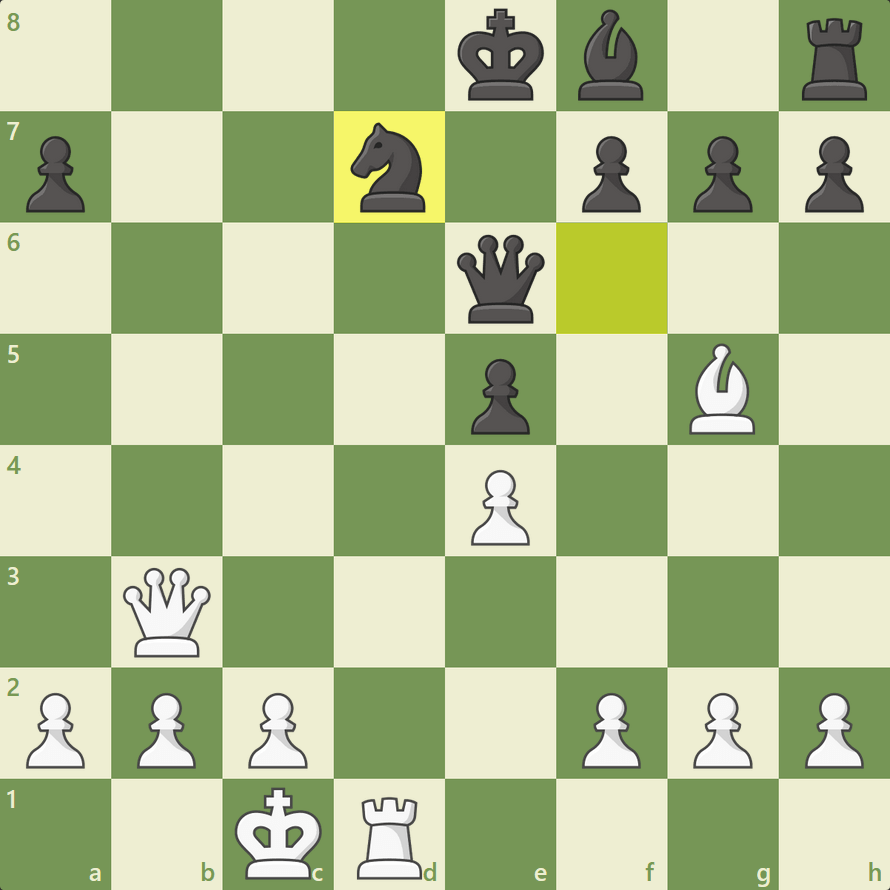
Your Task:
Imagine it's Black's turn. Using the principles we've discussed, formulate a simple, two-move rerouting plan to improve the knight on d7.
- Where does the knight want to go to be more active?
- What two moves get it there?
.
.
.
Solution
- Destination Square: The knight on
d7would be much more active onf6. Fromf6, it would control the center (d5,e4) and help defend the kingside. - The Plan: A common and effective reroute is
...Ne8followed by...Nf6.
This Ne8-f6 maneuver is a fundamental pattern in many openings. It takes a passive piece and repositions it on one of the best squares on the board.
Conclusion
You've now moved from simply identifying problems to actively solving them. This is a massive step forward in your strategic understanding.
Key Takeaways:
- Use the Three-Question Framework: To formulate a plan for your worst piece, ask: 1. Which piece is worst? 2. Where are the opponent's weaknesses? 3. What is their plan?
- Master the Reroute: Don't be afraid to take multiple moves to maneuver a piece (especially a knight) to a superior square. A step back is often the first step forward.
- Have Piece-Specific Plans: Remember common ideas like trading your bad bishop for their good one or preparing pawn breaks to open files for your rooks.
By consistently applying this thinking process—identify the worst piece, then formulate a plan to improve it—you will build a powerful new habit that will steadily improve your positions and lead to more victories.
Preview of the Next Lesson:
We saw how powerful well-placed knights can be. In our next lesson, we will dive deeper into this by focusing on one of the most important concepts in chess strategy: recognizing knight outpost squares and maneuvering a knight to occupy one. You'll learn what makes an outpost a knight's dream home and how to secure one in your own games.