
Welcome back. In the last lesson, you diagnosed whether a venture category was in neglect, discovery, acceleration, euphoria, reversal, or capitulation. That diagnosis tells you what kind of feedback regime you are facing. It does not yet tell you whether acting against the prevailing view is intelligent.
This lesson supplies that second step. A category in capitulation may contain an unusually attractive opportunity — or it may be avoided for very good reasons. The aim is to distinguish the two by combining an outside view of base rates, a test of structural constraints, and explicit rival explanations for the observed neglect. Plan for roughly 40–45 minutes including the selected material.
Contrarianism is a claim about a causal error, not a preference for unpopular assets
“Everybody dislikes it” is an observation. It is not an investment thesis.
A genuine contrarian opportunity exists when the market’s negative conclusion is materially wrong, incomplete, or applied too broadly. A justified avoidance exists when the negative conclusion reflects a binding constraint that has not changed: weak willingness to pay, irreducible technical risk, bad unit economics, an unfinanceable development path, or a structurally unattractive competitive position.
For VC purposes, separate three cases that are too often collapsed into one:
| Case | What is actually true? | Implication for a VC investor |
|---|---|---|
| Bad company or broken category | The underlying economics do not support an attractive outcome. | Avoidance is justified. |
| Good company, but not a venture case | The business may be viable, but its growth, capital needs, or return shape do not fit VC. | It may be a good business and still not be a contrarian VC opportunity. |
| Good venture case outside the market’s current search space | The company can plausibly generate a venture-scale outcome, but is neglected because the market has misread the evidence or has stopped looking. | This is the relevant contrarian setup. |
This distinction matters particularly at pre-seed and Series A. At those stages, the market is not merely estimating future cash flows; it is also judging whether there will be later investors, credible hiring pools, customer references, and a viable route through uncertainty. A company can be technically impressive and commercially real, yet remain a poor venture investment if the financing path required to prove its case is not available.
A contrarian therefore has a double burden:
- Explain why the consensus is negative.
- Show why that explanation does not establish that the company or category is unattractive.
The second burden is the harder one.
Gate one: begin with the outside view
The inside view starts with the distinctive details of a company: an exceptional founder, a novel technology, a reference customer, an apparently enormous market. Those details matter, but they are exactly where a compelling narrative can overpower judgment.
The outside view asks a prior question:
Among businesses facing materially similar conditions, how often do the required outcomes actually occur?
In Bayesian terms, a company-specific observation should update rather than replace the prior:
The practical message is simpler: an unusually persuasive story needs unusually strong evidence when it sits in a reference class with poor historical outcomes.
Build the right reference class
The main failure in applying base rates is choosing a class that is either too broad or selectively flattering. “AI,” “climate,” “biotech,” or “Europe” are rarely useful reference classes by themselves. They mix businesses with radically different development cycles and economic constraints.
A useful reference class combines the features that causally determine the outcome:
| Dimension | Weak comparison | More useful comparison |
|---|---|---|
| Category | “Lab automation” | Laboratory workflow software with regulated-biopharma buyers |
| Stage | “Early-stage companies” | European pre-seed and Series A companies before repeatable deployments |
| Business model | “SaaS” | Software sold through a long validation process to a small set of enterprise buyers |
| Capital intensity | “Deep tech” | Businesses requiring hardware integration before paid deployment |
| Financing environment | “VC-backed firms” | Companies that need a priced institutional round before a defined technical or commercial milestone |
| Geography | “European startups” | Companies dependent on a specific local buyer, hiring, regulatory, and follow-on financing ecosystem |
The point is not to find a statistically perfect twin. In venture capital, that is often impossible. The point is to identify the forces that make a seemingly similar company fail or succeed, then avoid treating a category label as though it were causal.
Practical Lessons from Michael Mauboussin | Multiples, Base Rates and Expectations Investing
Watch Practical Lessons from Michael Mauboussin | Multiples, Base Rates and Expectations Investing from Excess Returns. Mauboussin’s framework is designed for public equities, but its central discipline transfers well to VC: distinguish what the market already assumes from what you have independent reason to believe.
First watch embedded expectations. Translate “price” into the private-market setting: pre-money valuation, terms, implied follow-on availability, and the operating milestones required to justify the next round all embody expectations. Then skip to the outside view. Focus on the idea of placing a specific case inside a broader reference class. In venture work, the reference class should concern the mechanism of success or failure, not merely the fashionable sector label.
In private markets, you cannot reverse-engineer a share price with the precision of a public-market discounted-cash-flow model. But you can still ask what must be true for today’s terms to make sense. For example:
- What paid adoption level must be reached before the next round?
- How many buyers must convert, and at what sales-cycle length?
- What technical or regulatory proof is assumed?
- How much dilution, capital, and elapsed time does that path imply?
- How many comparable companies have actually reached that combination?
This turns “the company seems cheap after the reset” into a testable proposition: cheap relative to what operating path, and how frequently does that path work?
Use base rates as discipline, not as a veto
The base rate is not a mechanical exclusion rule. If it were, VC would never fund companies that break an established pattern. Its role is to make the exceptional claim explicit.
For example, a low base rate for capital-intensive laboratory businesses may be overcome by genuine evidence that a key bottleneck has changed: a large decline in instrument cost, a regulatory pathway that has become clearer, or customer data showing that deployment is now repeatable. It is not overcome by saying that the team is impressive or that “the market has not understood the potential.”
The relevant question is:
What changed the base rate, or why is this company not actually part of the reference class whose base rate worries us?
Venture Capital Start-up Selection
Read the NBER working paper Venture Capital Start-up Selection. It provides a useful empirical antidote to narrative overconfidence: early-stage screening improves the odds, but the underlying distribution remains highly uncertain, and a pass can reflect mandate or valuation rather than business quality.
In the paper’s sample discussion, locate the paragraph beginning “potential early-stage companies the VC considered investing in from 2015 to 2021.” Read the reported unconditional and screened-sample outcomes. Focus on the distinction between the broad sourced population and firms that survived an initial screening process. Then go to Section 3.10, “Reasons for Passing.” Read the section beginning with the discussion of reasons for passing and ending with the conclusion on valuation-based passes. In particular, examine the pass-reason evidence. Notice that a fund declining to invest can communicate very different things: a concern about business quality, a geography or mandate constraint, an early stage mismatch, or a valuation disagreement.
The paper’s sourced-company figures are a useful calibration device, not a universal venture base rate. In its particular Midwest early-stage sample, roughly 30% of sourced companies later raised at least $1 million in VC financing, while roughly 10% raised at least $10 million. Even after intensive screening, uncertainty remained substantial.
Equally important, “VC passed” is not an outcome variable. A pass because of geography, fund stage, ownership requirement, or valuation can be entirely rational for that fund while revealing little about the company’s underlying quality. Conversely, passes based on business model, competition, market, or a finding that the company was uninteresting were associated with materially weaker subsequent outcomes in that sample. A contrarian should therefore disaggregate the observed rejection rather than treating it as either folly or proof.
Gate two: test whether the constraint is structural
Base rates tell you how much skepticism is warranted. They do not tell you why an opportunity is difficult. That requires a structural test.
A structural constraint is one that cannot be wished away by more enthusiasm, a better deck, or another financing round. It may be solvable, but only through a specific mechanism, on a realistic timeline, with identifiable resources.
The central question is:
If the category received more attention and more capital tomorrow, would the core obstacle become easier to solve — or merely more expensive to live with?
Consider five common constraints.
| Constraint | A potentially contrarian interpretation | Evidence of justified avoidance |
|---|---|---|
| Technical feasibility | A former limitation has been relaxed through a reproducible technical advance. | Results remain dependent on demonstrations, narrow conditions, or heroic founder intervention. |
| Customer willingness to pay | The market has confused failure of a prior workflow with absence of the underlying customer problem. | Customers acknowledge the pain but will not change behaviour, budget, or procurement process. |
| Unit economics | A cost curve, automation gain, or distribution change alters the economics at scale. | Each incremental customer requires more subsidisation, services, hardware, or scarce labour than the prior one. |
| Competitive structure | Incumbents are poorly positioned because the new approach changes the basis of competition. | Incumbents own the distribution, data, regulation, or integration layer and can neutralise differentiation cheaply. |
| Financing dependency | The next proof point can be reached with existing capital and a credible buffer. | The company needs several optimistic rounds before any milestone that a new investor would finance. |
The last row is particularly important in a cold market. A company may be fundamentally promising, but its path may require a financing environment that no longer exists. That does not prove that the technology is bad. It may, however, justify avoiding the investment now.
Do not substitute founder quality for business quality
The investor-priorities chart below records a survey of institutional VCs. Management teams are frequently cited as important and are far more often named the single most important factor than business model, product, or market.
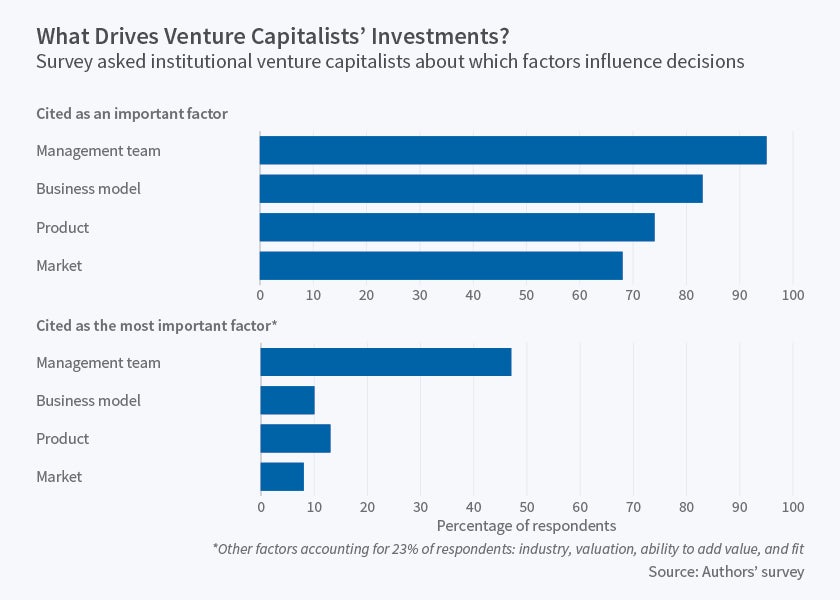
That emphasis is understandable at seed stage: the team is observable before the business has produced much hard evidence, and a strong team can adapt. But it also creates a recurring contrarian error. A well-regarded team can make a structurally weak company appear like an overlooked gem, especially when the market’s current neglect feels unfair.
The NBER study offers a useful corrective. In its sample, team assessments were more associated with early financing, while product and market assessments were more informative about later financing and survival. This is not an argument to discount teams. It is an argument to ask whether founder quality is being used as evidence that an unresolved market, product, or cost constraint will somehow disappear.
Buy the Dip? The Allure and Dangers of Contrarian Investing
Watch Buy the Dip? The Allure and Dangers of Contrarian Investing by Aswath Damodaran. The setting is public-market investing, but the segment supplies a valuable principle for venture work: contrarianism needs a quality screen that can distinguish a temporarily unpopular asset from a value trap.
Watch quality screens. Focus on the logic rather than on public-market valuation ratios. For an early-stage company, “quality” must be translated into evidence about customer behaviour, product performance, unit economics, and the feasibility of the path to the next proof point.
A useful discipline is to write each suspected constraint as a sentence with four parts:
Constraint: What blocks success?
Mechanism: Why does it block success?
Resolution: What specifically could relax it?
Proof: What observable evidence would show that the resolution is real?
If you cannot articulate the resolution and the proof, you are not looking at a contrarian opportunity yet. You are looking at a hope that the consensus is too pessimistic.
Gate three: force the thesis to compete with alternative explanations
The most seductive contrarian error is treating a visible failure as a mispricing without considering that the failure may be diagnostic.
Suppose a category has become unpopular after several companies shut down. There are at least four distinct explanations:
| Rival explanation | What it says | Evidence that would discriminate |
|---|---|---|
| Category stigma | Investors generalised too much from failures concentrated in one flawed model. | Surviving companies show demand and retention after removing the specific flaw. |
| No real demand | Buyers liked pilots and demonstrations but do not pay, renew, or change workflow. | Paid conversion, renewal, and budget ownership remain weak even after product improvements. |
| Economics never worked | Growth required subsidies, services, or capital costs that cannot scale. | Contribution economics worsen or fail to improve as deployments expand. |
| VC search-space failure | The company is overlooked because of geography, founder network, or category unfamiliarity. | Comparable-quality companies perform through alternative capital, customer-funded growth, or later discovery by specialists. |
| Financing-path failure | The business could work eventually, but cannot reach the necessary proof point before capital runs out. | Development and sales milestones remain too distant relative to realistic financing availability. |
Notice that these explanations are not mutually exclusive. A category may be stigmatised and have a real demand problem. It may have strong customer pull and be unsuited to venture financing because the time to proof is too long. The task is not to find the most flattering explanation; it is to identify which explanation best predicts the facts you should see next.
This is where selection effects matter. VCs tend to fund firms that already look unusually promising on observable dimensions. Therefore, the success of VC-backed companies does not prove that VC capital alone created their quality — and the absence of VC funding does not prove the reverse.
[PDF] Hidden in Plain Sight: Venture Growth with or without Venture Capital
Read the NBER paper Hidden in Plain Sight: Venture Growth with or without Venture Capital. It separates two ideas that are often conflated: venture capitalists may select firms that already have unusually strong observable characteristics, and VC funding may still add value after that selection.
In Section V, “What the Process of Selection into Venture Capital Reveals About the Process of Growth in the Absence of Venture Capital,” find the discussion of growth among firms that never received VC. Read from the paragraph beginning “To begin testing the relationship between growth within the non-VC-backed firm sample” through the top-end results. Focus on the finding that some firms with characteristics associated with VC selection achieve growth without receiving VC. Then read the matching discussion in Section VI, beginning with the explanation that VC-funded firms differ from random firms, through the discussion of the matched estimate. Focus on how controlling for observable characteristics sharply reduces the apparent difference between VC-backed and non-VC-backed firms.
The implication is subtle but important. A high-quality company outside the current VC market may indeed be neglected. But it may also be pursuing an alternative route to growth that does not require, or cannot efficiently absorb, venture capital. That distinction separates a potentially attractive company from an attractive VC investment.
A worked diagnosis: a cold laboratory-automation category
Consider a stylised case: several venture-backed laboratory-automation businesses failed after burning heavily on custom hardware, long integrations, and subsidised pilots. Investors now treat “lab automation” as an unfundable category. A pre-seed company offers workflow software that sits above existing instruments and claims that it can reduce experiment setup time substantially.
A superficial contrarian thesis would be:
“The category is hated because of a few failures. The company is cheap, and therefore this is the moment to invest.”
That is not enough. Apply the three gates.
1. Establish the relevant base rate
“Lab automation” is too broad. The appropriate comparison may instead be companies selling workflow software into regulated life-science teams, with long validation requirements and a limited number of potential enterprise buyers.
The outside view should examine:
- How often such buyers move from pilot to paid deployment.
- How long implementation and validation have historically taken.
- Whether prior companies failed because of hardware capital intensity, lack of buyer demand, or inability to integrate into existing workflows.
- How frequently companies with a similar sales motion obtained a fundable Series A before exhausting seed capital.
If the relevant reference class has a low success rate, that is not a reason to stop. It specifies the evidence needed to proceed.
2. Identify the structural constraint
The company’s key claim is that it avoids the hardware problem. That may be meaningful — but only if the cost and complexity have truly moved out of the company’s model rather than merely shifted to the customer.
The structural test would examine:
- Whether integration with existing instruments is genuinely repeatable.
- Whether validation can be standardised rather than handled by expensive services staff.
- Whether a laboratory manager, scientist, or central procurement budget owns the purchasing decision.
- Whether time saved is sufficiently valuable to justify a recurring software payment.
- Whether the product can reach credible paid deployments within the current financing window.
A founder with a strong scientific reputation does not answer these questions. Nor does a prominent seed investor.
3. Make the rival explanations compete
The optimistic explanation is stigma: previous failures reflected hardware-heavy models and poor implementation economics, not a lack of demand for better laboratory workflows.
The pessimistic explanation is persistent customer friction: laboratories value the idea but will not change validated processes or purchase software that requires integration with fragmented systems.
The evidence that distinguishes them is not another enthusiastic pilot announcement. It is a pattern of paid deployments, bounded integration time, usage retention after the initial sponsor leaves, and willingness to renew from an operating budget.
At that point, the decision is clearer:
- If the company’s evidence shows repeatable deployment and paid retention, while the market continues to generalise from hardware-heavy failures, the category may contain a contrarian opportunity.
- If the company still depends on founder-led custom integration and free pilots after many months, the negative category view may be substantially justified.
- If demand exists but the path to repeatability requires more capital and time than the current market will support, the company may be good but presently unfinanceable as a VC case.
The same category label can therefore contain all three outcomes.
A compact decision audit
Before treating neglect as investable, make the following claims explicit in an investment discussion:
- Reference class: What is the narrow set of genuinely comparable businesses, and what is its relevant base rate?
- Consensus explanation: What does the market believe is wrong, and what observable facts support that belief?
- Structural test: Which constraint is decisive: technology, demand, economics, competition, regulation, or financing?
- Causal break: What has changed, or what makes this company different enough that the negative base rate is not directly applicable?
- Rival explanation: What is the strongest non-contrarian explanation for the same facts?
- Discriminating evidence: What near-term evidence would favour one explanation over the other?
A contrarian view becomes credible when it is more rigorous than the consensus, not merely more imaginative. It should make room for the possibility that the market is right — and say precisely what evidence would establish that.
Key takeaways
A neglected venture is not automatically mispriced. To distinguish contrarian opportunity from justified avoidance:
- Start with a properly chosen base rate, using a reference class defined by the actual drivers of success and failure.
- Treat a low base rate as a demand for stronger evidence, not as a universal veto.
- Test whether the obstacle is a structural constraint that capital and attention cannot solve, rather than a temporary shortage of enthusiasm.
- Separate a good company from a good venture case; alternative paths to growth can be real without creating a suitable VC investment.
- Put the contrarian explanation beside strong rival explanations, then seek evidence that can discriminate among them.
- Remember that “VC passed,” “a prestigious investor funded it,” and “the category is cold” are all signals. None is a complete causal explanation.
Next, you will examine how financing dependency, company stage, and the expected duration of neglect determine whether an otherwise valid contrarian insight can survive long enough to matter.