
Welcome back. In the previous lesson, you built a causal-loop map that separates beliefs, signals, capital flows, company behaviour, and fundamentals. That map showed why a venture category can become self-reinforcing without being either wholly irrational or wholly justified.
This lesson turns that map into a cycle diagnostic. The task is not to predict a precise market top or bottom. It is to determine which phase best describes a category’s current financing and belief regime: neglect, discovery, acceleration, euphoria, reversal, or capitulation. The distinction matters because the same observable fact — for example, a prominent Series A, a down round, or a well-known company failure — means very different things in different phases.
Plan for roughly 40–45 minutes. The central habit is to diagnose the system, not merely the valuation level.
A phase is a regime of feedback, not a label for “cheap” or “expensive”
A venture category is not in euphoria simply because valuations are high, nor in neglect simply because valuations are low. Private-market valuation is an incomplete and delayed signal. A category may look inexpensive after a reset but still be in reversal, because investors are reducing exposure, follow-on finance is becoming unavailable, and the commercial evidence is deteriorating. Conversely, a category may command high prices during discovery because a genuine technological discontinuity has created a small number of unusually attractive opportunities before capital supply has caught up.
The more useful question is:
What feedback loop currently dominates: under-attention, evidence-led recognition, capital-enabled expansion, self-validating extrapolation, withdrawal of confidence, or indiscriminate abandonment?
The six phases are stylised regimes. They are not a universal clock, and a category can contain several phases at once:
- Foundation models may be in a different regime from AI application companies.
- US financing conditions can differ sharply from European or Asian ones.
- A capital-light software company can be investable in a category where capital-intensive peers are becoming unfundable.
- Seed activity can remain exploratory while Series B financing has already reversed.
Therefore, always specify the unit of diagnosis: which subcategory, geography, stage, and time horizon?
The underlying mechanics: slow capital, delayed evidence, overshooting beliefs
Venture cycles have structural reasons to be uneven. LP commitments, fund formation, partnership capacity, hiring, and startup financing all adjust slowly. Meanwhile, evidence about the economic value of an early-stage technology arrives slowly and noisily. This combination creates a familiar pattern: capital can remain scarce after an opportunity has begun to improve; later, capital can arrive in excess after the opportunity has become widely visible.
[PDF] Short-Term America Revisited? Boom and Bust in the Venture ...
Read the selected parts of Paul Gompers and Josh Lerner’s historical analysis to ground the phase model in the mechanics of venture-capital supply, demand, information lags, overshooting, and subsequent underinvestment. Although the examples are historical, the institutional frictions remain highly relevant.
In Section II, begin at the subsection “A Simple Framework.” Read the supply, demand, and information-lag account. Focus on why fund commitments and performance reporting make the capital supply slow to respond, in both directions. Then continue to the subsection “Why Does the Venture Market Overreact?” Read the overshooting mechanism, and use the disk-drive example that follows to distinguish a real demand shift from excessive extrapolation about its scale. Finally, in Section VI under “The Impact of Market Cycles,” read the evidence on duplication and prolonged undershooting. Notice the symmetrical error: a boom can fund too many similar firms, while a subsequent trough can starve technically consequential opportunities.
Two points from this account are especially important for diagnosis.
First, high activity is not proof of high opportunity quality. It may reflect a genuine expansion in the opportunity set, but it may also reflect investors collectively treating a category as though each entrant will enjoy the economics of the eventual winner.
Second, low activity is not proof that the opportunity disappeared. It may reflect a binding technological or commercial constraint. But it may also be a delayed reaction to previous losses, stale negative comparables, or a loss of institutional capacity to finance long-duration experimentation.
The question is always whether observed funding is proportionate to the investable opportunity set.
The six-phase diagnostic
The phases below are best understood as changing relationships among beliefs, signals, capital, behaviour, and fundamentals.
| Phase | Dominant market belief | Financing and behaviour | Central diagnostic question |
|---|---|---|---|
| Neglect | “This is not worth spending attention on.” | Few investors specialise; formation and funding are thin; evidence may be sparse rather than negative. | Is the category ignored because of a real constraint, or because the market has stopped looking? |
| Discovery | “There may be something here.” | A small number of credible actors investigate; selective financings follow new evidence. | Does the attention arise from a specific, testable improvement? |
| Acceleration | “This is becoming a major opportunity.” | Capital, entrants, valuation comparables, hiring, and visibility broaden together. | Is capital producing commercial progress fast enough to justify the widening expectation set? |
| Euphoria | “Participation itself is evidence.” | Financing becomes easier; category membership matters more than company differentiation; valuation expectations outrun proof. | What outcome is embedded in current pricing, and what constraint is being discounted? |
| Reversal | “The prior expectation may no longer hold.” | New rounds take longer; terms worsen; failures become more salient; investors reassess follow-on exposure. | Has the underlying thesis failed, or has the financing loop broken before fundamentals are resolved? |
| Capitulation | “Nothing in this category is fundable.” | Broad withdrawal, shutdowns, weak formation, stigma, and few leads even for differentiated companies. | Is this indiscriminate abandonment, or a rational response to a category-wide fatal constraint? |
The sequence is common but not inevitable. Discovery can stall and return to neglect. Acceleration can settle into a productive, sustainable market rather than proceed to euphoria. Capitulation can last years in a capital-intensive area, particularly where viable companies require several financing cycles before technical or regulatory validation.
1. Neglect: insufficient attention is the defining feature
In neglect, the market has not necessarily reached a negative conclusion through deep analysis. Often, it has simply allocated little attention. The category lacks active specialists, reference transactions, analyst vocabulary, relevant networks, or an obvious path to a later-stage financing syndicate.
Observable signs include:
- Few new companies despite an identifiable customer problem.
- Limited investor meetings, weak competitive tension, and small or improvised syndicates.
- A narrative dominated by one old failure, a prior regulatory disappointment, or a broad category stigma.
- Technical or commercial progress that receives little recognition because no visible peer group exists.
- Thin follow-on financing rather than demonstrably weak customer demand.
Neglect is attractive only when the market’s lack of attention is causally separable from the category’s viability. A contrarian should ask: if funding and visibility were held constant, would the underlying customer problem, technology, and unit economics still support a company?
That is very different from saying, “Nobody likes it, therefore it is cheap.”
2. Discovery: a specific signal begins to change the prior
Discovery begins when a development makes a previously weak or ambiguous category legible. The catalyst may be a technical breakthrough, an enabling cost reduction, a regulatory change, a credible customer deployment, or a demonstrated business model.
The key distinction from mere promotional momentum is specificity. A discovery claim should answer:
- What became possible that was not possible before?
- Which constraint has actually been relaxed?
- What evidence would show that the improvement generalises beyond one company or customer?
- Why is the market still early in recognising it?
At this stage, respected investors can be valuable signals because they may have done specialist diligence or observed non-public evidence. But the signal is still only one input. The strong discovery thesis can be expressed without relying on the investor’s name:
A lower-cost scientific workflow now permits repeatable deployment in a customer segment that was previously uneconomic.
The weak version is:
A prestigious investor has funded several companies, so this must be the next major category.
Discovery is often the most difficult phase to identify in real time because it can resemble neglect with a few isolated exceptions. The difference lies in whether exceptions reveal a replicable causal change.
3. Acceleration: the feedback loop is broadening
In acceleration, the discovery has become socially visible. Investors see peer financings, founders see an accessible path to funding, candidates see career opportunity, and customers encounter more credible vendors. The causal-loop map from the previous lesson begins to activate across the category.
Capital can now make the thesis more true:
- More funding supports hiring and product development.
- More deployments create implementation knowledge and customer references.
- More visible companies educate buyers and expand the talent pool.
- More evidence attracts additional finance.
This phase is not inherently suspect. Venture financing can genuinely speed experimentation and commercialisation. The issue is whether the loop still converts capital into evidence-bearing progress.
Useful indicators of healthy acceleration include:
- Improvements in paid adoption, retention, deployment time, workflow performance, or regulatory progress.
- Increasing company differentiation rather than just a larger count of similarly positioned startups.
- Broadening customer demand that is not wholly dependent on subsidised pilots.
- A widening investor base that nevertheless continues to discriminate among companies.
Warning signs within acceleration include rising burn, rising hiring costs, duplicated product roadmaps, and a growing dependence on the next round rather than customer or technical milestones.
4. Euphoria: expectations become increasingly self-validating
Euphoria begins when the category’s financing and visibility become a primary source of evidence for its own promise. The logic shifts subtly. Instead of asking, “What has the company demonstrated?” market participants increasingly ask, “Who else has funded it, and will it remain financeable?”
The distinction matters because early venture signals are unusually coarse. A high-profile round may compress a great deal of private diligence into a single public action. Observers see the action but not the assumptions, dissenting views, investment mandate, ownership targets, or portfolio incentives behind it.
[PDF] Information Cascades and Social Learning
Read the selected sections of this NBER review to sharpen the difference between a genuinely informative market consensus and a cascade in which later choices stop adding information.
In Section 2.2, “Why Information Stops Accumulating: Information Cascades,” read the basic cascade logic. Translate “adopt” and “reject” into venture terms: leading a round, entering a category, hiring into it, or choosing not to engage. Then read the short passage on fragility in the following discussion. Finally, in Section 4.4, read influencers and signal precision. Focus on why a brand-name VC may rationally carry disproportionate weight, yet also make consensus more path-dependent.
A venture-category analogue of a cascade appears when later investors cannot learn much from observed financings because those financings were themselves heavily influenced by the same earlier social signal. More rounds may then increase confidence without proportionately increasing information.
Signs of euphoria include:
- Valuation arguments based mainly on comparables, market size rhetoric, or the existence of a recent winner.
- The migration of capital toward companies with less differentiated evidence but familiar category labels.
- Fundraising narratives that assume future capital availability as an input rather than treating it as a risk.
- Rapid startup formation around nearly identical theses.
- Underestimation of competition for talent, customer attention, data access, scientific inputs, or distribution.
- A widening gap between financing-implied progress and observed commercial progress.
Euphoria is often most visible when the market treats a category winner’s economics as broadly replicable. The existence of one exceptional AI laboratory platform, developer tool, or biotech asset does not imply that ten adjacent companies can reach equivalent scale, margins, or exit values.
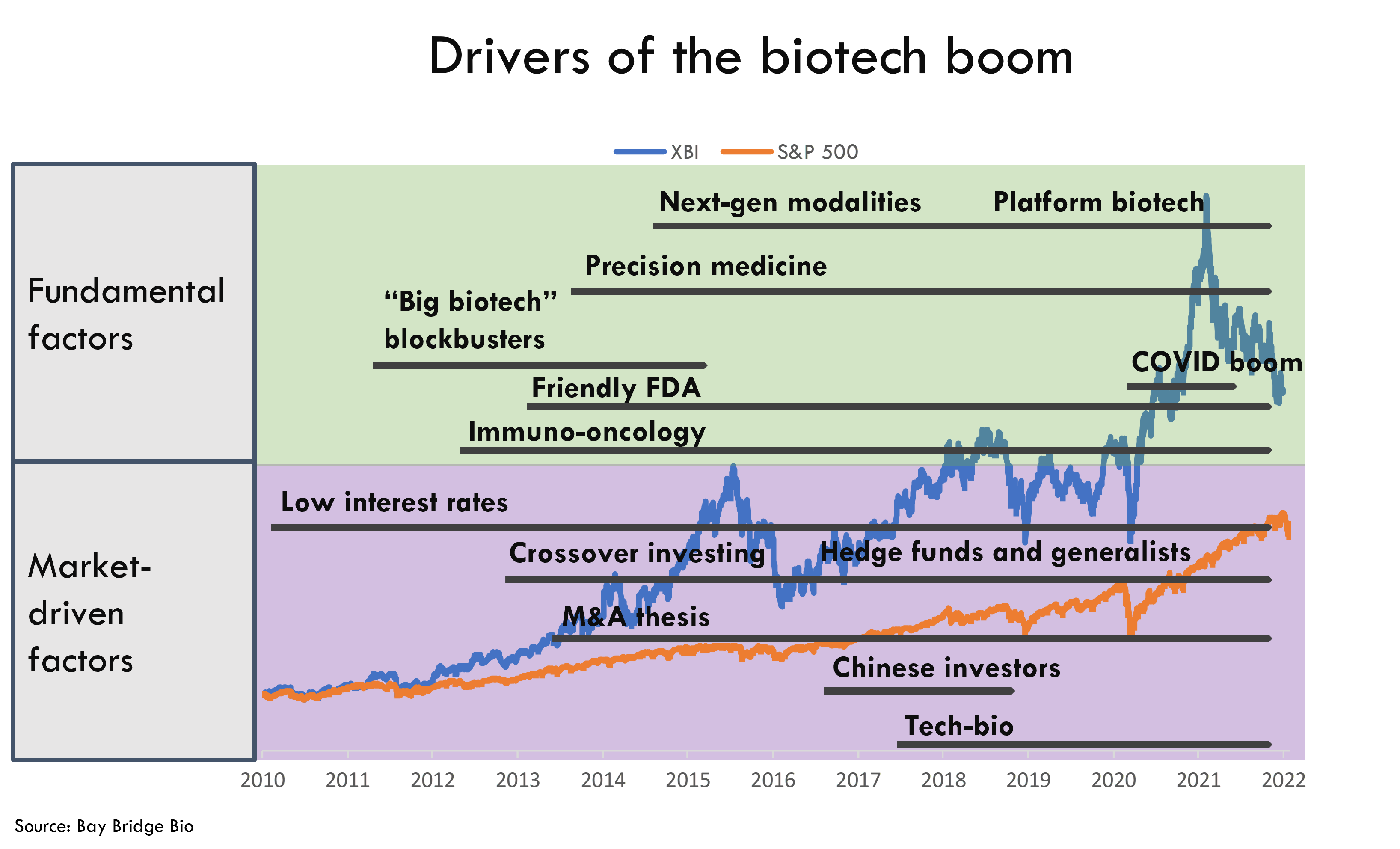
The biotech chart below is a useful retrospective illustration. It shows the XBI ETF against the S&P 500 and places multiple fundamental and market-driven drivers over the 2010–2022 cycle. It should not be read as proving that every labelled driver caused the price movement. Rather, it makes visible an important diagnostic point: technological and clinical progress, public-market valuations, low interest rates, crossover capital, and COVID-era attention can coexist in the same boom.
Reversal and capitulation: do not confuse a broken financing loop with a broken technology
A reversal starts when the marginal participant changes behaviour. This could be a crossover investor leaving, a visible follow-on failing, public comparables resetting, a regulatory or technical milestone disappointing, or a liquidity shock that makes future rounds more difficult.
The key feature is not simply negative sentiment. It is the emergence of evidence that the former reinforcing loop no longer sustains itself.
In reversal, look for:
- Longer fundraising processes and lower conversion from first meeting to term sheet.
- Greater investor selectivity, especially around burn, timing to milestone, and existing ownership.
- Down rounds, insider-led bridges, deferred launches, hiring freezes, or reduced customer subsidies.
- A few conspicuous failures being treated as evidence about the whole category.
- Growing divergence between stronger companies and weaker peers.
- A breakdown in the assumption that the next financing will be available on acceptable terms.
The category can still appear active in this phase because legacy funds have capital to deploy and companies retain runway. Private valuations can also remain stale. In that sense, reversal may be diagnosed first through behaviour and terms, not headline valuations.
George Soros - Reflexivity Explained
Watch Patrick Boyle’s “George Soros - Reflexivity Explained” for a concise account of the boom-bust shape in reflexive systems. It provides a useful conceptual check on the phase model.
Watch boom-bust anatomy. Focus on the interaction between an underlying trend and a misconception: a cycle can begin with a real improvement, yet become vulnerable when expectations extend beyond what the improvement can support.
Why a venture reversal is not a Minsky debt crisis
Minsky’s classic framework centres on debt, rising leverage, and forced liquidation. That mechanism applies directly to credit-driven asset markets, but much early-stage venture finance is equity-funded. It would be a category error to infer that a venture boom must have a debt-to-income analogue.
Yet the fragility insight transfers. A startup can be economically solvent in the ordinary sense and still be financially fragile if it requires another round before reaching a proof point that the next investor cohort accepts. In VC, the critical exposure is often:
A reversal becomes dangerous when the expected time to evidence lengthens while the availability or price of capital deteriorates.
Capitulation: category-wide stigma and indiscriminate withdrawal
Capitulation is deeper than reversal. It occurs when the category label itself becomes a liability. Investors no longer ask which company is differentiated; they begin with the premise that the category is uninvestable.
Typical signs are:
- Few credible firms can attract a lead, even at markedly reduced pricing.
- New company formation and specialised hiring fall sharply.
- Investors use a small set of prominent failures as category-wide proof.
- Media coverage and partner attention disappear rather than merely become more sceptical.
- Remaining financings are concentrated in insiders, strategic investors, or unusually well-capitalised firms.
- The few surviving companies reduce burn, narrow scope, or seek non-VC financing routes.
Capitulation can be the beginning of contrarian opportunity, but it is not automatically one. The crucial distinction is between temporary financing scarcity and a binding structural constraint.
A category deserves continued avoidance when the negative evidence identifies a constraint that capital cannot plausibly solve: scientific infeasibility, no customer willingness to pay, inherently uneconomic unit economics, an insurmountable regulatory barrier, or competition from incumbents with durable advantages.
By contrast, capitulation may be excessive when the category has viable customer demand and improving technical economics, but the market has generalized from failed firms that shared a different flaw: excessive burn, poor go-to-market design, reliance on subsidy, or an unrealistic financing schedule.
A practical diagnostic protocol
Use your causal-loop map as the starting point, then run this six-part protocol.
1. Fix the diagnostic boundary
Write one sentence before collecting evidence:
“I am diagnosing [subcategory] in [geography], at [stage], over a [time horizon] financing cycle.”
For example:
“I am diagnosing European pre-seed and Series A laboratory-automation software companies over the next 24 to 36 months.”
This avoids confusing a US public-market proxy with European early-stage financing, or a mature category leader with the conditions facing new entrants.
2. Identify the marginal signal
Ask which new fact is currently changing behaviour:
- A technical result?
- A customer deployment?
- A prominent VC investment?
- A public comparable’s multiple?
- A failed follow-on?
- A change in LP liquidity or fund formation?
- A regulatory decision?
Then classify it. Is it evidence about the category’s fundamentals, a signal of another actor’s belief, or an intervention that directly changes company capability? The same event can have all three components, but they should not be conflated.
3. Compare capital flow with fundamental progress
The central acceleration-versus-euphoria test is:
Is the quantity and price of capital rising faster than independently observable progress?
Do not require mature revenue metrics where they are inappropriate. For a biotech or deep-tech category, relevant proof may be technical reproducibility, validation quality, regulatory progress, time-to-experiment, deployment reliability, or credible design-partner conversion. For enterprise software, it may be paid deployment, usage depth, retention, sales-cycle duration, and implementation cost.
What matters is whether the evidence corresponds to the promise embedded in financing terms.
4. Look for crowding and duplication
Crowding is a balancing force often hidden by headline optimism. Assess:
- How many companies pursue nearly the same customer, scientific target, workflow, or distribution channel?
- Are customers becoming more educated, or simply more saturated with pilots?
- Is the talent pool deepening, or are competitors bidding against one another for the same scarce individuals?
- Does each new entrant add a differentiated experiment, or merely replicate an existing bet?
A rising company count is evidence of attention, not necessarily evidence of category quality.
5. Test the financing dependency
For each plausible company, estimate whether it can survive the category’s present phase:
| Question | Interpretation |
|---|---|
| What milestone makes the next round financeable? | Defines the actual proof requirement, rather than relying on a narrative of “momentum.” |
| How long does reaching it take under a realistic operating plan? | Exposes delay risk. |
| Is the company financed to that milestone with a margin for slippage? | Identifies vulnerability to reversal. |
| Does reaching the milestone depend on scarce talent, customer cooperation, regulation, or further subsidised spending? | Identifies external dependencies. |
| If outside financing disappears for 18 months, what remains true about the company? | Separates durable progress from financing-supported activity. |
This is not generic portfolio-management analysis. It is a test of whether a contrarian investment can remain alive long enough for the consensus error to be corrected.
6. State the phase and its disconfirming evidence
A disciplined diagnosis ends with a provisional conclusion, not a label alone:
Current phase: acceleration, moving toward euphoria.
Reason: capital and new entrants are increasing faster than paid adoption; comparable rounds are becoming the main justification for pricing; follow-on assumptions are unusually generous.
Evidence that would change the view: sustained paid conversion, differentiated customer retention, and an expansion of demand sufficient to absorb the growing field without heavy subsidy.
Or:
Current phase: capitulation with a possible discovery setup.
Reason: category formation and investor attention are low after salient failures, but the failures were concentrated in capital-heavy business models rather than in the underlying customer need; a recent cost reduction may alter unit economics.
Evidence that would invalidate the opportunity: continued customer resistance at the new cost base, or technical performance that fails to generalise beyond demonstrations.
The discipline lies in making the diagnosis vulnerable to facts.
A compact phase-scorecard
For live work, record the following evidence once per quarter. Do not reduce it mechanically to a single numerical score; its value lies in identifying contradictions.
| Evidence stream | Neglect / capitulation signature | Discovery / acceleration signature | Euphoria / reversal signature |
|---|---|---|---|
| Investor attention | Few specialists, low meeting volume, weak willingness to lead | Selective specialist engagement broadening gradually | Broad generalist participation, then sudden selectivity |
| Financing terms | Sparse rounds; insider dependence; low but sometimes stale prices | Terms improve alongside specific proof points | Terms detach from proof, then round delays and resets appear |
| Startup formation | Low formation or declining cohorts | New formation tied to identifiable opportunity | Rapid copying, then abrupt formation slowdown |
| Company behaviour | Conservative burn or forced retrenchment | Hiring and experimentation tied to milestones | Aggressive spending assumes easy future financing |
| Customer evidence | May be sparse, overlooked, or genuinely weak | Paid deployments and repeatability improve | Pilots, partnerships, and vanity metrics substitute for conversion |
| Narrative structure | Stigma or indifference | Specific claim about a changed constraint | Category labels and comparables dominate company-specific evidence |
The most valuable findings often sit in the mismatches. Strong customer progress with weak financing points toward neglect or capitulation. Frenzied financing with weak independent progress points toward euphoria. A collapse in funding with preserved technical and customer evidence may indicate reversal rather than thesis failure.
Key takeaways
A venture category’s phase is a diagnosis of its prevailing feedback regime, not a shorthand for valuation.
- Neglect is insufficient attention; it can be rational or an opportunity.
- Discovery is evidence-led recognition of a specific change.
- Acceleration broadens the loop between capital, behaviour, and genuine progress.
- Euphoria appears when financing and social proof increasingly validate themselves.
- Reversal begins when the marginal provider of capital or belief withdraws, often before private valuations visibly reset.
- Capitulation is category-wide stigma and indiscriminate abandonment; it may create opportunity only if the underlying constraint is not fatal.
The diagnostic standard is demanding: separate signals from fundamentals, monitor delays and financing dependency, and state what evidence would change your classification.
In the next lesson, you will use this phase diagnosis to distinguish a genuine contrarian opportunity from justified avoidance by testing base rates, structural constraints, and alternative explanations.