
Hello, and welcome to the first lesson in this course on algorithmic trading.
The course will move from market mechanics and research hygiene through statistical modeling, backtesting, portfolio design, execution, and production operations. This opening module establishes the vocabulary needed to keep those concerns distinct. A trading strategy is not merely a function that emits “buy” or “sell”: it is a system that turns uncertain forecasts into controlled, recorded market activity.
In this lesson, you will distinguish five essential responsibilities in a systematic trading stack:
- Alpha generation: forming a forecast or trading signal.
- Portfolio construction: deciding the desired holdings and sizes.
- Execution: turning desired holdings into actual trades.
- Accounting: maintaining an accurate record of orders, fills, positions, cash, and P&L.
- Risk control: enforcing limits and responding to unacceptable conditions.
The most important idea is simple: a good forecast is not yet a trade, and a submitted trade is not yet a position.
The system as a set of contracts
A useful systematic-trading architecture treats each layer as a component with a narrow job and a clear output. This is ordinary software design applied to a financially consequential setting: each layer should be testable, replaceable, and auditable without silently changing another layer’s logic.
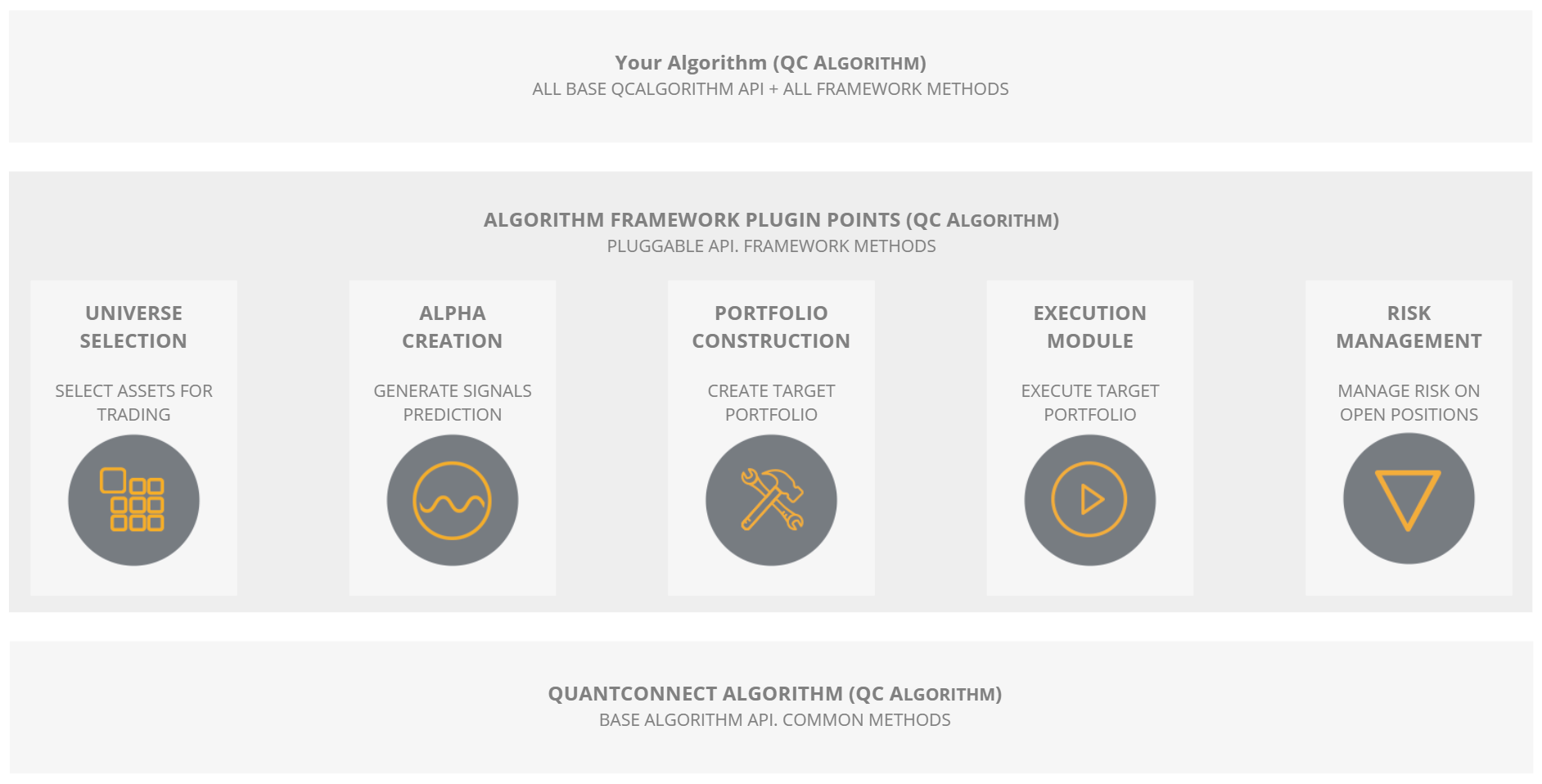
An upstream universe-selection process often chooses which assets the strategy is allowed to consider. For example, a daily equity strategy might restrict itself to stocks that meet minimum price, market-capitalization, and trading-volume requirements. This is useful context, but it is not one of our five central responsibilities: it determines where the system may look, not what it should hold or how it should trade.
The core stack can be stated as an ordered set of handoffs:
- Market data and research logic produce an alpha insight.
- Portfolio construction converts insights into target positions.
- Risk control checks, modifies, or rejects those targets and orders.
- Execution submits and manages orders intended to move current holdings toward approved targets.
- Accounting records the resulting facts: fills, positions, cash movements, fees, and profit and loss.
The distinction between a forecast, a target, an order, and a fill will recur throughout the course. Confusing any two of them is one of the most common sources of flawed backtests and dangerous live systems.
Read QuantConnect’s overview of a modular algorithm framework. It provides a concrete naming scheme for the handoffs between asset selection, alpha, portfolio construction, risk management, and execution.
At the top of the Overview page, read the module table that defines the Universe Selection model, Alpha model, Insight, Portfolio Construction model, PortfolioTarget, Risk Management, and Execution. Then read the explanation below the framework diagram, beginning with the module handoff. Focus on the changing meaning of the objects: a signal becomes a target, and a target is acted on by execution. Finally, read the subsection “Separation of Concerns.” In particular, study the design principle. Keep its practical implication in mind: an alpha model should not alter its prediction merely because a particular execution algorithm happens to be selected.
Alpha generation: a claim about future returns
Alpha is an expected return that is not already explained by the benchmark or risk exposures one has chosen to accept. In practical systematic trading, “alpha model” is also used more broadly: it means the component that produces a directional or relative-value trading forecast.
An alpha output may say any of the following:
- “This futures contract has positive expected excess return over the next month.”
- “Among this equity universe, this stock ranks near the top for expected return over the next five trading days.”
- “This spread is unusually wide relative to its historical relationship and may revert over several days.”
- “The probability of a positive return over the next hour is modestly above one half.”
The output should carry enough information to be actionable without dictating the whole portfolio. A robust signal specification normally includes:
| Signal attribute | Example |
|---|---|
| Asset or spread | Shares of a particular company; a futures contract; a pair trade |
| Direction | Positive, negative, or relative rank |
| Horizon | One day, ten days, one month |
| Strength | Expected return, z-score, probability, or rank |
| Timestamp | When the information became available |
| Expiry | When the forecast should no longer be trusted |
Suppose a model reports that Stock A has a strong positive forecast for the next ten trading days. That statement does not answer several essential questions:
- Should the system own Stock A at all, given its existing exposure?
- Should it hold 0.5% or 5% of capital in Stock A?
- Should it buy immediately or patiently place a limit order?
- What happens if Stock A is halted, the data feed is stale, or the trade would breach a position limit?
Those are not alpha questions. Keeping them separate prevents a model’s historical predictive success from being mistaken for a complete investment process.
A practical rule is:
Alpha estimates opportunity; it does not allocate capital.
This boundary also makes research clearer. You can evaluate an alpha model by asking whether stronger forecasts are associated with better subsequent returns, before asking whether a portfolio built from those forecasts produced attractive net performance.
Portfolio construction: from many forecasts to one coherent book
A portfolio is a collection of positions whose outcomes interact. Even if each individual forecast is reasonable, placing all capital in the single highest-ranked asset is usually fragile. Forecasts are noisy, assets can move together, and the cost of being wrong can differ greatly across instruments.
Portfolio construction determines which assets to hold and in what quantities or weights. It combines the alpha signal with information about:
- current positions,
- cash and leverage,
- volatility,
- correlations among assets,
- sector, country, or factor exposures,
- concentration limits,
- turnover and expected trading costs,
- benchmark requirements, if the strategy has one.
For a strategy with capital , a portfolio constructor might produce target weights . The target dollar exposure to asset is then:
A positive weight denotes a long exposure; a negative weight denotes a short exposure, subject to whether shorting is permitted and operationally feasible. The later lessons on portfolio construction will make this quantitative. For now, the crucial distinction is that the alpha model may rank Stock A first and Stock B second, while portfolio construction may assign them similar sizes, very different sizes, or even decline to hold one of them due to risk constraints.
Consider a deliberately simplified cross-sectional equity strategy:
- The alpha model ranks 200 liquid stocks by predicted ten-day return.
- Portfolio construction selects the highest-ranked and lowest-ranked subsets.
- It chooses position sizes that diversify across names and avoids excessive exposure to one sector.
- It considers positions already held, so it calculates only the change needed to reach the new target portfolio.
A signal of “strongly positive” might therefore result in a small target if the asset is volatile, highly correlated with current long positions, expensive to trade, or already close to a concentration limit. Conversely, a moderate signal can deserve a meaningful allocation when it diversifies the rest of the portfolio.
This is why “picking securities” and “constructing a portfolio” are different intellectual tasks.
Active Equity Investing: Portfolio Construction | CFA Institute
Read this CFA Institute discussion to sharpen the distinction between security analysis and portfolio construction, then connect position sizing to risk budgets and trading costs.
In the page’s “Introduction,” read from the opening argument, then continue through the paragraph’s explanation of security analysis versus portfolio construction. Notice why even a skilled ranking process does not justify putting all capital in one name. Next, locate the passage beginning optimization and risk budgeting. Continue to the list that begins risk constraints. Treat these as examples of conditions a portfolio process can deliberately manage, rather than properties automatically handled by an alpha signal.
Risk control: constraints, safeguards, and independent vetoes
Portfolio construction is often risk-aware: it attempts to find desirable target holdings while considering volatility, correlation, concentration, and other anticipated risks. But risk control is broader and more independent. It exists to make sure that the system remains within non-negotiable boundaries, including when another component is wrong.
A risk-control layer may operate at several moments:
| Moment | Example control | Purpose |
|---|---|---|
| Before targets are approved | Maximum gross leverage; sector exposure cap | Prevent an intended portfolio from being too concentrated or large |
| Before an order leaves the system | Maximum order size; price collar; stale-data check | Prevent erroneous or unsafe orders |
| During execution | Limit on unfilled exposure; cancel-on-disconnect behavior | Limit damage from partial completion or infrastructure failure |
| After fills and through the day | Drawdown limit; position reconciliation; kill switch | Detect and contain deteriorating conditions |
A hard constraint should not be overridden because an alpha estimate looks attractive. For instance, a model that accidentally interprets a split-adjusted price incorrectly may emit an enormous signal. A risk limit on order size can stop the resulting order before it reaches the market. The forecast can later be investigated; capital does not need to be exposed while that investigation occurs.
Risk control is not a guarantee against loss. Markets gap, liquidity disappears, correlations change, and models fail. Its purpose is to make losses and operational failures more survivable by limiting exposure, detecting anomalies, and ensuring that a single bug cannot freely determine the account’s risk.
There is an important architectural nuance. In a research framework, risk management is often represented as a stage that modifies portfolio targets before execution. In an actual live system, critical pre-trade checks should also be physically close to the order-routing path and should not depend solely on the strategy process behaving correctly.
Execution: making the desired portfolio real
Execution takes an approved target portfolio and seeks to trade from the current portfolio toward it. Its job is not to decide whether a forecast is good. It must decide how to obtain the desired exposure in a real market with spreads, limited displayed liquidity, changing prices, and possibly multiple venues.
Suppose the approved target is 1.0% of capital in Stock A, but accounting reports a current holding of 0.3%. Execution must attempt to acquire the remaining 0.7% exposure. It may choose among different order types and schedules based on urgency and market conditions:
- an aggressive order when rapid completion matters,
- a passive limit order when avoiding the spread matters more,
- a schedule that trades gradually to reduce market impact,
- a cancellation or replacement when the market moves or the target changes.
The resulting trade price can differ from the price assumed by research. That difference, along with commissions, fees, bid-ask spread, delay, and market impact, is part of the gap between a strategy’s paper return and its live net return.
Execution therefore faces an unavoidable trade-off:
- Acting rapidly reduces the risk that the desired exposure is never obtained, but it can increase spread and market-impact costs.
- Acting patiently can lower direct trading cost, but it increases the risk that prices move before completion or that the alpha decays before the trade is filled.
This is not merely implementation detail. A high-turnover signal with a tiny expected edge may be economically worthless once realistic execution costs are included.
The following short segment shows this distinction in an ultra-low-latency setting. The technologies are much more specialized than a first daily strategy requires, but the division of responsibility is general: routing chooses how and where to send an order, while risk checks can block unsafe instructions.
Inside a Real High-Frequency Trading System | HFT Architecture
Watch “Inside a Real High-Frequency Trading System | HFT Architecture” from ByteMonk for a compact operational view of order routing, pre-trade risk checks, and order-management records. Focus on the responsibilities, not on adopting the high-frequency hardware design.
Watch routing and checks, where the video distinguishes an intelligent order router from pre-trade risk validation. Then watch order records, which introduces the order management system and its record of submissions, fills, rejects, and timing. Relate these records to the accounting layer below.
Accounting: the factual record of what happened
An execution component has intentions and sends orders. Accounting records economic reality.
At any moment, the accounting system should be able to answer:
- Which orders were submitted, canceled, rejected, partially filled, or fully filled?
- What quantity is actually held in each instrument?
- What cash is available, reserved, or owed?
- What fees, commissions, financing charges, and realized P&L have occurred?
- What unrealized P&L results from marking current positions to current market prices?
- Does the internal record agree with broker, clearing, or custodian records?
For a basic cash equity portfolio, net asset value can be represented conceptually as:
Here, is the actual quantity held and is its current marked price. A production ledger must be more precise than this compact equation: it must account for fees, settlement timing, partial fills, corporate actions, borrowed shares for short positions, and instrument-specific conventions. Those details come later. The point now is that accounting uses actual fills, not desired weights, as its starting point.
This creates a critical separation:
- Target position: “The system would like to own 10,000 shares.”
- Order: “The system requested to buy 10,000 shares.”
- Fill: “The market executed 3,500 shares at these prices.”
- Position: “The system now owns 3,500 more shares than before.”
A system that treats an order acknowledgement as a fill can report false positions and send duplicate orders. A system that uses target weights instead of actual positions to calculate risk can believe it is hedged when it is not. Accurate accounting is thus not only a reporting function; it is a prerequisite for safe risk control and sensible execution.
Accounting also supplies feedback to other components. Execution needs the actual position to know the remaining trade. Risk needs actual exposures and available capital. Portfolio construction needs the current book before calculating a rebalance. This feedback must be based on authoritative state, not optimistic assumptions from the strategy logic.
One idea, five different responsibilities
Here is a compact way to classify decisions in a systematic strategy:
| Statement or action | Primary owner | Why |
|---|---|---|
| “Stock A is expected to outperform Stock B over ten days.” | Alpha generation | This is a predictive claim |
| “Hold Stock A at 1.2% and Stock B at negative 0.8% of capital.” | Portfolio construction | This determines exposures and sizing |
| “Reduce Stock A’s target to 0.7% because the sector cap would otherwise be breached.” | Risk control | This enforces a portfolio-level boundary |
| “Buy the required shares gradually with passive orders.” | Execution | This chooses the trading method |
| “Only 40% of the requested quantity filled; update cash, position, and P&L.” | Accounting | This records realized state |
| “Reject this new order because market data is stale.” | Risk control | This prevents unsafe action |
Some systems combine these responsibilities in a small script at first. That can be acceptable for early experimentation, but the conceptual boundaries should still be preserved. Otherwise, it becomes difficult to diagnose whether weak results came from bad forecasts, poor sizing, costly execution, an accounting mistake, or insufficient controls.
A useful diagnostic habit is to ask of every line of strategy code: Is it making a prediction, selecting an exposure, placing a trade, recording a fact, or limiting risk? If the answer is “several at once,” the design may need to be separated.
Key takeaways
A systematic trading stack converts an uncertain view of the market into controlled, measurable activity:
- Alpha generation produces a time-stamped forecast or ranking, not a trade size.
- Portfolio construction converts multiple forecasts into target holdings while balancing expected reward, diversification, exposure, and cost.
- Risk control applies independent limits and safety checks before, during, and after trading.
- Execution manages the practical task of moving actual positions toward approved targets under real-market frictions.
- Accounting is the factual ledger of orders, fills, positions, cash, and P&L; it must distinguish intention from completion.
The system is only as reliable as its interfaces. A promising signal can be undone by poor construction or expensive execution, while a sound strategy can become operationally unsafe without accurate accounting and independent risk controls.
Next, we will compare the two markets that will provide much of the course’s practical context: equities and futures. You will learn how their contract structures, leverage, liquidity, trading hours, and risks differ—and why those differences shape both strategy design and system architecture.
Can't find a good explanation? Sign up and we'll make it for you
Sign up