
Hello. In the previous lesson, we separated a systematic trading stack into alpha generation, portfolio construction, risk control, execution, and accounting. That separation matters immediately here: the same forecast can be expressed through very different instruments, and the instrument determines how the system must size, trade, finance, and monitor the resulting exposure.
This lesson compares U.S. equities and exchange-traded futures. By the end, you should be able to look at a proposed strategy and identify whether its instrument choice creates ownership exposure or contract exposure, how its leverage actually works, when liquidity is likely to be usable, and which risks the system must explicitly control.
Two ways to obtain market exposure
Buying an equity means purchasing shares in a company. If you buy 500 shares of a stock at , you own a position in that company. A long shareholder generally has economic rights associated with ownership, including dividends when declared and voting rights. The shares do not expire merely because time passes.
A futures contract is different. It is a standardized, exchange-traded agreement that creates exposure to the price of an underlying asset or reference, such as an equity index, interest rate, currency, energy commodity, or individual stock. A futures position is not ownership of the underlying company or index constituents. Rather, it is a long or short contractual exposure, with the clearinghouse standing between the buyer and seller.
For a futures contract, the core specifications are part of the instrument’s identity:
| Specification | Why an algorithm needs it |
|---|---|
| Underlying and contract month | Identifies what is being tracked and when the contract expires |
| Multiplier | Converts a one-point price movement into dollar P&L |
| Tick size and tick value | Defines the smallest price change and its monetary consequence |
| Settlement method | Determines whether the contract is cash-settled or can require delivery |
| Trading calendar and session | Defines when the strategy can observe, trade, and manage risk |
| Margin requirement | Determines collateral required, not the economic size of the position |
If a futures price is , the contract multiplier is , and the strategy holds contracts, its notional exposure is approximately:
A one-period futures P&L is approximately:
The key point is that notional exposure, not the amount posted as margin, determines the sensitivity of P&L to price movements.
For example, a contract priced at with a multiplier of represents:
of notional exposure per contract. A 1% move in the underlying reference therefore corresponds to roughly of P&L per contract before transaction costs.
A stock position has simpler identity: ticker, exchange, and number of shares. But it has its own operational complications: dividends, stock splits, mergers, delistings, and, for short positions, the availability and cost of borrowed shares.
Futures introduce a different set of complications. Each contract has an expiration date. A strategy intending to maintain exposure must normally close the expiring contract and open a later-dated one, a process called a roll. The price difference between the two contracts is economically meaningful; it should not be silently treated as trading profit or loss.
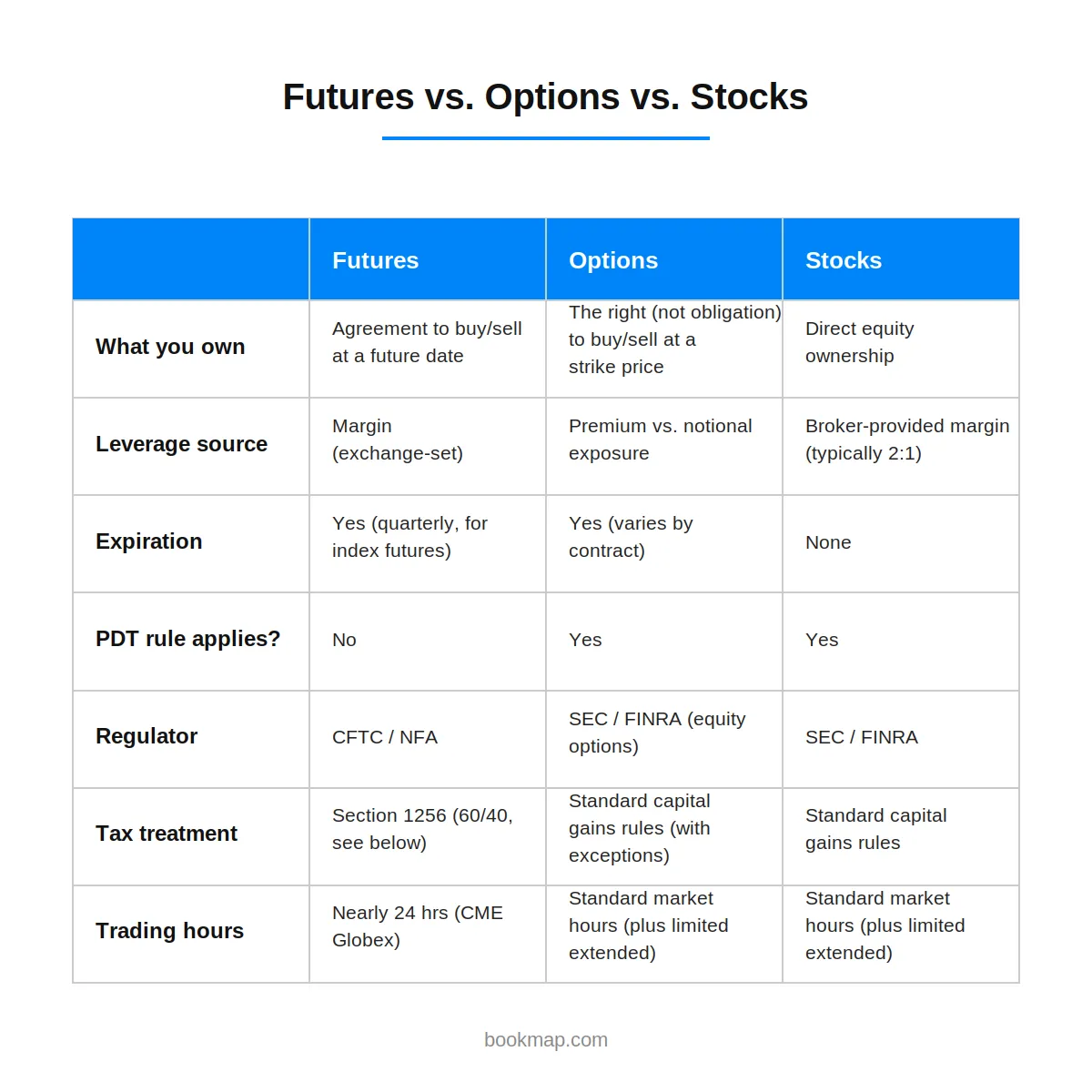
For systematic research, this distinction becomes a data-modeling requirement. A futures dataset cannot treat “the S&P 500 future” as one permanent ticker: it must record the specific contract month, its roll schedule, multiplier, and trading session. Later, when you build continuous futures histories, this will be essential.
Margin is not the same thing as position size
The word margin means something different in equities and futures, and confusing the two is a serious risk-management error.
With a margin equity account, an investor borrows from the broker to finance part of a share purchase. The investor still owns the shares, but also owes the broker a loan and typically pays interest on borrowed cash. In a conventional U.S. margin arrangement, initial borrowing is commonly limited to roughly half of a purchase’s value, although broker rules and account circumstances matter.
In futures, margin is a performance bond: collateral required to ensure that the trader can meet daily gains and losses on the contract. It is not a down payment toward buying the underlying asset, and it is not a loan from the broker.
Watch CME Group’s short video, Margin, for the official distinction between securities margin and futures margin. It gives the conceptual foundation for sizing futures safely rather than mistaking a small collateral requirement for a small position.
Watch the core contrast to distinguish borrowed funds for stock ownership from collateral for a futures position. Then watch margin thresholds for initial margin, maintenance margin, margin calls, and possible liquidation.
A futures account usually has two relevant thresholds:
- Initial margin is the amount required to open a new position.
- Maintenance margin is the minimum account equity required to keep that position open.
If losses reduce account equity below maintenance margin, the broker can demand additional funds, require the position to be reduced, or liquidate it. This can occur rapidly during a volatile session; a strategy cannot assume it has until the next day to respond.
Read Charles Schwab’s How Futures Margin Works to reinforce the equity-versus-futures margin distinction and the mechanics of a margin call. Its explanation is concise, but the accounting implication is fundamental: futures collateral is not a measure of maximum loss.
In the section “Futures margin vs. margin on stocks,” read the opening comparison. Focus on why the same word, “margin,” describes borrowing in one market and a good-faith deposit in the other. Then, in “Maintenance margin vs. initial margin,” read the full explanation through the final sentence before the crude-oil example. Notice that exchange requirements are baselines and a broker may impose stricter requirements.
A leverage example
Suppose two strategies each take of market exposure.
Equity position. The strategy buys 1,000 shares at .
If the price falls 2%, the approximate loss is:
Futures position. The strategy holds contracts whose combined notional exposure is also . If the relevant futures price falls 2%, the approximate loss is again .
The market move created the same dollar loss because the exposure was the same. But the futures strategy may have posted only a fraction of as margin. If it funded the position with only of account equity, that loss is a 20% loss of account equity.
This yields a practical risk rule:
Size futures from notional exposure, volatility, and loss tolerance—not from the minimum margin requirement.
Margin requirements themselves can change, particularly when volatility rises. A robust live system therefore monitors both position notional and available account equity, with buffers above broker minimums.
Futures are generally marked to market daily. Gains and losses are settled through variation margin: cash is credited or debited as the contract’s value changes. This differs from a cash equity position, where an unrealized loss usually remains unrealized until the shares are sold, although it still affects account equity and may matter for an equity margin account.
Liquidity and trading hours: availability is not quality
Liquidity is the ability to trade a desired amount promptly without materially moving the price. It is not a label that belongs permanently to an asset class. Both stocks and futures range from highly liquid to dangerously illiquid.
For an algorithm, useful liquidity has several dimensions:
- Tight spreads: a small gap between the best bid and best ask.
- Displayed depth: meaningful quantity available near the current price.
- Sufficient trading volume: consistent turnover over the strategy’s intended holding period.
- Resilience: new orders replenish the book after trades consume liquidity.
- Predictable session behavior: enough activity at the times your model intends to trade.
Equities
Large-cap U.S. stocks can be extremely liquid during regular trading hours. However, the equity market is fragmented across exchanges, alternative trading systems, and off-exchange venues. A strategy may see a consolidated quote, while actual execution quality depends on routing, venue rules, queue position, and the available liquidity at that moment.
For U.S. equities, the primary session is typically 9:30 a.m. to 4:00 p.m. Eastern Time. Many brokers provide pre-market and after-hours access, but spreads are often wider and displayed depth lower than during the main session. A daily equity strategy can often avoid these periods; an intraday strategy must model them explicitly.
Individual-stock liquidity also has substantial cross-sectional variation. A large technology company and a thinly traded small-cap stock are both “equities,” but they may require completely different execution assumptions.
Futures
A major futures contract on a centralized exchange often concentrates liquidity into a single primary order book for that contract. The most actively traded equity-index, Treasury, currency, and energy contracts can have deep liquidity during their active sessions.
Many CME futures trade for roughly 23 hours on weekdays, beginning Sunday evening and ending Friday, with a daily maintenance break. This provides access when the U.S. equity cash market is closed, which is particularly useful for reacting to scheduled macroeconomic releases or global events.
But nearly 24-hour access does not mean nearly constant liquidity. During overnight periods, a contract may show:
- fewer resting orders,
- wider spreads,
- lower volume,
- larger price impact for the same order size,
- greater vulnerability to sharp moves around news.
A further futures-specific issue is that liquidity migrates from the nearby contract to the next active contract as expiration approaches. A strategy that keeps sending orders to the old contract can trade a visibly worse market even while the “same” underlying exposure remains available in the new contract.
The comparison is best made conditional on the instruments and times that the strategy actually uses:
| Question | Liquid equity strategy | Liquid futures strategy |
|---|---|---|
| What is traded? | Shares of a specific company | A standardized contract with a defined expiry |
| Where is liquidity concentrated? | Across multiple venues and order books | Often in the most active contract on a central exchange |
| When is the strongest liquidity? | Usually the regular cash session | Often concentrated around regional cash-market hours and major releases |
| Can trading continue overnight? | Sometimes, but often with degraded access and liquidity | Often yes, though liquidity can be materially thinner |
| What changes over time? | Company events, index inclusion, shares outstanding | The active contract month and its roll schedule |
A sensible research universe is therefore not “all stocks” or “all futures.” It is a list of instruments with minimum liquidity thresholds, approved trading windows, and explicit rules for what happens around market holidays, expirations, and abnormal conditions.
Principal risks and their implications for a trading system
Both markets expose a trader to ordinary market risk: prices can move sharply against the position, spreads can widen, and a model can be wrong. The main differences lie in the mechanisms through which these losses emerge.
Equity-specific risks
A long stock position carries company-specific risk. Earnings surprises, fraud allegations, regulatory actions, acquisitions, bankruptcies, and trading halts can produce discontinuous moves. Diversification across stocks can reduce idiosyncratic risk, but it cannot eliminate broad market risk.
For an equity short position, the system must deal with additional constraints:
- shares must be available to borrow,
- borrow fees can change,
- the lender can recall shares,
- a broker can force a buy-in,
- losses can become very large if the stock price rises sharply.
Equity data and accounting must also correctly process corporate actions. A stock split should change share count and price without fabricating P&L; a dividend affects the economic return of a long holder and the obligations of a short seller.
Futures-specific risks
Futures embed leverage and operational time limits.
-
Leverage and margin-call risk. A relatively small adverse price movement can materially affect account equity when notional exposure is large relative to capital. Forced liquidation can turn a temporary loss into a realized one.
-
Contract-expiration and roll risk. A strategy must close or roll positions before expiration according to its contract’s rules. Failing to do so can lead to unwanted settlement or delivery exposure for physically settled products.
-
Basis and roll risk. A futures price does not always equal the current cash-market price of its underlying reference. The difference, called the basis, can change. A strategy holding a sequence of contracts also experiences the economics of moving from one contract month to another.
-
Contract-specification risk. A mistaken multiplier, tick value, or contract month can produce an order that is many times larger than intended. This is a common engineering failure mode because the order may look syntactically valid.
-
Overnight liquidity and gap risk. Extended-hour access enables risk management, but thin order books can make execution expensive precisely when the strategy most wants to trade.
-
Collateral and cash-management risk. Margin capital is tied up as collateral, and variation losses require liquid cash. A portfolio can be economically sound over a long horizon yet still fail if it cannot meet short-run margin demands.
The clearinghouse substantially reduces the need to evaluate the creditworthiness of an unknown trader on the other side of each futures trade. It does not remove market risk, broker risk, operational risk, or the danger of inadequate collateral.
Translate the comparison into system design
In code, an equity position and a futures position should not share only a generic quantity field. They require different metadata and controls.
For an equity, the system needs at least:
- number of shares,
- price,
- corporate-action treatment,
- short-borrow status and borrow cost when shorting,
- trading-session and venue assumptions.
For a futures contract, the system needs at least:
- contract root and exact expiry,
- multiplier, tick size, and tick value,
- current and next contract for the roll,
- initial and maintenance margin,
- settlement type,
- exchange session and holiday calendar.
Most importantly, position sizing must compare positions in a common risk unit: dollar exposure, expected volatility contribution, or stress loss. Comparing “100 shares” with “one futures contract” is nearly meaningless without their prices and multipliers.
Key takeaways
Equities and futures can both implement systematic forecasts, but they are different economic and operational objects:
- Equities represent direct ownership in a company, have no contractual expiration, and create company-specific and corporate-action considerations.
- Futures are standardized, expiring contracts that provide long or short exposure without ownership of the underlying; contract month, multiplier, tick value, and settlement method are essential data.
- Equity margin is borrowing used to purchase securities. Futures margin is collateral supporting a leveraged contractual position.
- Futures must be sized from notional exposure and risk, never from minimum margin alone.
- Liquidity is conditional on the particular instrument, active session, and order size. Extended futures hours can be valuable but may be much less liquid than peak hours.
- Equity shorts introduce borrow and buy-in risk; futures introduce margin, roll, basis, contract-specification, and expiration risks.
Next, we turn from the instrument level to the actual trading environment: the bid, ask, spread, displayed depth, and liquidity that determine the price an algorithm can realistically obtain.
Can't find a good explanation? Sign up and we'll make it for you
Sign up