
Introduction
Hello! Welcome back. In our last lesson, we witnessed the birth of the Muisca cosmos, where the supreme creator Chiminigagua brought light to the primordial darkness. We saw how this act established the sun (Sué) and the moon (Chía) as the primary divine forces, setting the stage for life to flourish.
Today, we transition from the creation of the universe to the origin of humanity. Your learning outcome for this lesson is to recount the myth of Bachué and the origin of humanity from Lake Iguaque.
This is a cornerstone of Muisca mythology. For your goal of illustrating these stories, the tale of Bachué is exceptionally rich. It's a narrative of origins, motherhood, and civilization, centered on a powerful female figure and a sacred, mystical landscape. It offers compelling visual elements: a serene highland lake, a divine mother and child, the growth of a people, and a final, magical transformation. Let's explore the story of the ancestral mother of the Muisca.
The Myth of Emergence and Creation
The Muisca world, now filled with light, was empty of people. The origin of the Muisca people is not tied to the grand, cosmic scale of Chiminigagua, but to a specific, sacred place on Earth: Lake Iguaque, a remote, beautiful lagoon nestled high in the Andes near modern-day Villa de Leyva.
The story unfolds in a clear narrative sequence:
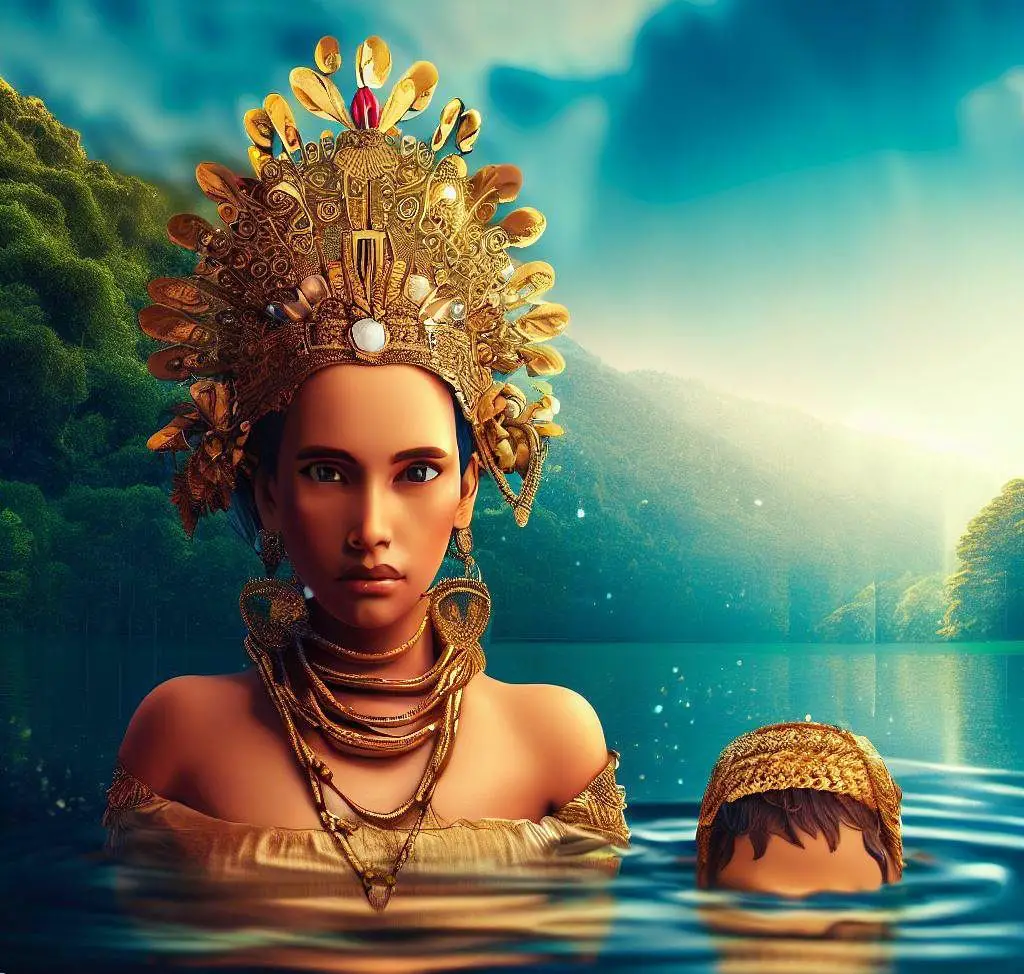
- The Emergence: From the calm, cold waters of Lake Iguaque, a woman emerged. This was Bachué. She was not alone; she carried a young boy in her arms.
- Populating the Land: They descended from the mountains to the Muisca flatlands, where they settled. The boy grew to be a man, and he became Bachué's husband. Together, they had many, many children, and their descendants multiplied, populating every corner of the Muisca territory. Bachué is thus known as the primordial mother, the ancestor of all Muisca people.
- The Civilizing Teachings: As her children spread across the land, Bachué taught them how to live. She gave them laws for social order and instructed them in agriculture and the crafts necessary for a thriving culture. She was not just a mother but also a foundational teacher.
- The Return: After many years, when the land was full of her descendants and her work was done, Bachué and her husband journeyed back to the sacred Lake Iguaque. There, on the shore, they bid farewell to the people and transformed into two giant snakes, slipping back into the waters from which they first came.
To get a feel for the rhythm and core details of the story, please watch this short segment.
The Muisca: Legends of Gold (subtitulos en español)
The video 'The Muisca: Legends of Gold' by Ancient Americas offers a concise telling of the Bachué myth, capturing the essential points of the narrative.
Watch the section from 21:53 to 22:45. Pay attention to how the narrative describes Bachué's emergence, her role in populating the land, and her final transformation.

Symbolism and Sacred Geography
The Bachué myth is more than just a story; it's a profound statement about the Muisca worldview. As a designer and storyteller, understanding these underlying themes will help you create more meaningful illustrations.
The Sacred Lake as a Portal
For the Muisca, Lake Iguaque was not merely a body of water. It was a sacred portal, a womb from which humanity was born. This ties into a wider theme in Muisca cosmology that you've already encountered: the spiritual significance of water. Lagoons were seen as gateways between the physical world and the spiritual or underworld realms. This imbues the landscape itself with a deep mythological power.
Bachué: The Mother Ancestor
Bachué's role is central. She represents fertility, nourishment, and the origin of life. The fact that the Muisca traced their lineage to a single maternal figure highlights the importance of women and matrilineal principles in their society. Her story is one of cyclical creation: she emerges from the water, creates life on land, and then returns to the water.
The Serpent Transformation
The transformation into snakes is a powerful and common symbol in many world mythologies. For the Muisca, snakes were often associated with water, wisdom, and the cycle of life, death, and rebirth. By becoming snakes and returning to the lake, Bachué and her husband complete this cycle, disappearing back into the source of all life.
The following reading delves deeper into these themes, connecting the myth to the physical landscape and the core beliefs of the Muisca.
The article 'Muisca mythology' provides a structured look at the myth, specifically highlighting the concept of 'Sacred Geography' and Bachué's role as a primordial ancestor.
Please read the sections titled 'Human Origins and Sacred Geography' and 'Bachué: Mother and Ancestor'. Focus on how the myth is tied to physical locations like Lake Iguaque and the symbolic meaning of Bachué's journey and transformation.
Test your understanding!
Imagine you are creating a visual "journey map" for Bachué, similar to how you might map a user's journey in product design. This map will illustrate her story for a museum exhibit.
What are the 4-5 key stages of her journey you would illustrate? For each stage, what is the core emotion or concept you would try to convey, and what key visual symbols (e.g., water, snakes, crowds of people) would you use?
Show answer
Here is one possible way to structure the journey map:
-
Stage: Emergence.
- Concept/Emotion: Mystery, genesis, quiet power.
- Symbols: The still, dark waters of Lake Iguaque under a starry or moonlit sky. Bachué and the child breaking the surface, radiating a soft light. The focus is on the connection between water and life.
-
Stage: Descending to the Plains.
- Concept/Emotion: Purpose, a new beginning.
- Symbols: Bachué and the growing child walking down the mountain path, with the vast, empty plains below them. The landscape is lush and ready for settlement.
-
Stage: Proliferation & Civilization.
- Concept/Emotion: Community, growth, order.
- Symbols: A vibrant scene showing a bustling Muisca village. Bachué is at the center, teaching people to weave or farm. The background is filled with families and children, showing the success of her creation.
-
Stage: The Return.
- Concept/Emotion: Fulfillment, transition, cyclicality.
- Symbols: An elderly Bachué and her husband standing by the shore of Lake Iguaque, with their people watching from a distance. The mood is respectful and somber, but not tragic.
-
Stage: Transformation.
- Concept/Emotion: Mysticism, eternity.
- Symbols: Two large snakes gliding into the lake, creating ripples that spread outward. The focus is on their disappearance back into the sacred source, perhaps with a faint glow remaining under the water.
A Critical Perspective: History, Myth, and Memory
Your interest in history and human behavior makes this next point particularly relevant. How do we know the story of Bachué? The primary accounts were written down not by the Muisca themselves, but by Spanish chroniclers like Fray Pedro Simón in the 17th century, well after the conquest had devastated Muisca society.
This raises important questions:
- Did the chroniclers understand the nuances of a culture and language so different from their own?
- Did they unintentionally project their own beliefs (e.g., from Greek or Roman mythology) onto the stories they heard?
- Could the story have been deliberately altered to serve a colonial agenda, perhaps by introducing elements that might seem strange or "pagan" to European minds?
The following reading explores this critical perspective. It doesn't seek to invalidate the myth, but rather to embrace its complexity and understand its role in cultural identity, both past and present.
The article 'B is for Bachué' by OÍSTE offers a fascinating look at the challenges of interpreting Muisca myths through colonial sources. It also connects these historical legends to the contemporary efforts of the neo-Muisca movement to reclaim their heritage.
Read the entire article. As you read, reflect on the author's questions about the reliability of the chroniclers. Consider the idea that a story's power can lie in its cultural significance for people today, even if its historical origins are uncertain.
This perspective adds a rich layer to your project. Illustrating a myth isn't just about depicting an ancient story; it can also be about engaging with the act of memory, the challenges of colonial history, and the enduring power of these narratives for cultural identity today.
Conclusion
In this lesson, we have recounted the Muisca myth of human origins. We followed the journey of Bachué, the mother of the Muisca people, from her mysterious emergence to her final, cyclical return to the sacred waters of Lake Iguaque.
Key Takeaways:
- The Narrative: Humanity, for the Muisca, originated with Bachué and a child emerging from Lake Iguaque. They populated the earth, taught the arts of civilization, and returned to the lake as serpents.
- Core Symbolism: The myth is rich with symbolism, including water as a portal of life, the serpent as a figure of transformation and renewal, and the powerful archetype of the Mother Ancestor.
- Sacred Geography: The physical landscape, particularly Lake Iguaque, is intrinsically linked to the mythological world, serving as a sacred site of origin.
- Historical Context: Our knowledge of this myth is filtered through the writings of Spanish chroniclers, and it remains a vital part of cultural identity and revitalization for Muisca descendants today.
Preview of the Next Lesson:
Now that the Muisca people have been created by Bachué, they need further guidance to build their society. In the next lesson, we will explore the story of Bochica, the great civilizing hero who arrived after Bachué to teach the Muisca more advanced laws, arts, and morals, and who left his own mark on the landscape.
Can't find a good explanation? Sign up and we'll make it for you
Sign up