
Introduction
Hello! Welcome back to our exploration of Muisca mythology. In our last lesson, we saw how the mother ancestor, Bachué, emerged from Lake Iguaque to create and populate the Muisca world, giving her children their first lessons in living as a community.
Today, we turn to the next chapter in the development of Muisca society. With the people established, a new figure arrives to elevate them from a simple community to a structured civilization. Your learning outcome for this lesson is to describe the story and significance of Bochica as a civilizing hero and teacher.
Bochica is one of the most important figures in the Muisca pantheon. His story is a classic narrative of a wise teacher who brings knowledge, order, and salvation. For your goal of illustrating these myths, the story of Bochica is a goldmine. It contains a clear protagonist, a dramatic conflict involving a great flood, and a visually spectacular resolution—the creation of a massive waterfall. Let's delve into the myth of this great teacher.
The Narrative of Bochica: An Outsider Brings Order
Sometime after Bachué had populated the land, the Muisca people were still living in a relatively rustic state. The myth tells of the arrival of a mysterious outsider who would change everything.
This figure, known as Bochica, is described as an old man with a long white beard, who came from the east, walking barefoot and carrying a staff. He wore a large tunic or robe, and his appearance was unlike that of the Muisca. He was not a conqueror, but a teacher.
To get a concise overview of his story, please watch the following video segment.
Historia de la Cultura Muisca (El Dorado): Los Muiscas Documental
The video 'Historia de la Cultura Muisca' provides a clear and animated summary of the Bochica myth, covering his arrival, the conflict he faced, and his most famous miracle.
Watch the clip from 07:01 to 08:23. Pay close attention to the description of Bochica's appearance, his teachings, the introduction of his adversary Huitaca, and the dramatic events of the flood and the creation of the Tequendama Falls.
As the video explains, Bochica's core mission was to civilize the Muisca people. His teachings were both practical and moral, providing the very foundation for their society.
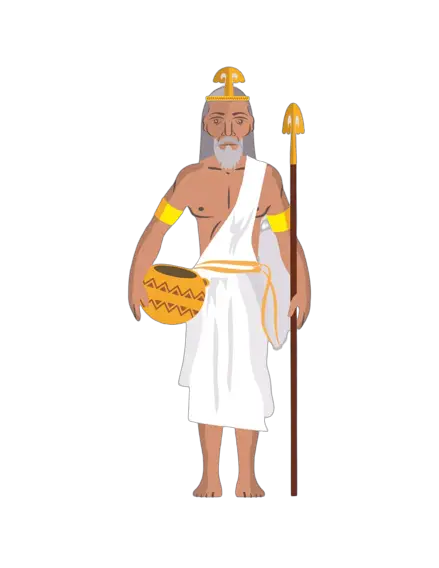
The Teachings of a Civilizing Hero
Bochica's significance lies not just in his heroic deeds, but in the knowledge he imparted. He was the architect of Muisca society. From a systems design perspective, you can see his work as implementing a complete operating system for their civilization.
For a deeper, more structured understanding of his contributions, the following reading is invaluable.
The 'Muisca mythology' article from Grokipedia provides a dense, well-organized summary of Bochica's role. It acts as a perfect reference for the specific skills and laws he introduced.
Please read the section titled 'Bochica: The Civilizing Figure'. Focus on the list of his specific teachings—in agriculture, crafts, and law. Note the conflict with his wife (Huitaca/Chía) and the cause of the great flood.
As you've just read, Bochica’s contributions were comprehensive:
- Practical Arts: He taught spinning cotton and weaving textiles, metalworking, and advanced agriculture (maize, quinoa). This moved the Muisca beyond subsistence.
- Social & Legal Order: He established laws governing marriage, property, and community conduct.
- Moral & Spiritual Guidance: He reinforced religious rites and ethical norms, discouraging vice and promoting a harmonious society.
This process of establishing order is beautifully captured in a more poetic retelling of the myth, which frames his legacy as a "living curriculum."
The Myth of Bochica – Muisca Civilization and the Birth ...
The article 'The Myth of Bochica' from FabulaHub explores the deeper meaning behind his actions. It moves beyond a simple list of deeds to explain the philosophy of his teachings.
Read from the 'Introduction' through to the 'Conclusion'. This is a more interpretive text. Pay attention to how it describes Bochica's laws not as commands, but as systems for living together—'a careful irrigation,' 'a moral architecture.' Consider how he taught the Muisca to 'listen to the land.'
The Great Conflict: Order vs. Chaos
A compelling story requires conflict, and Bochica's myth has it in abundance. This conflict plays out as a fundamental struggle between order and chaos, providing excellent dramatic tension for any illustration or retelling.
There are two main antagonists in the story:
-
Huitaca (or Chía): A beautiful woman who appeared after Bochica and preached a doctrine directly opposed to his. Where Bochica taught discipline, hard work, and moderation, Huitaca advocated for a life of pleasure, drunkenness, and licentiousness. She represents the forces of chaos, temptation, and social decay that threaten the new order Bochica is trying to build. In some versions, Bochica punishes her by turning her into an owl, or she is banished to become the moon (Chía), providing a mythological explanation for the night.
-
Chibchacum: The patron deity of the Muisca farmers, who became angered by the people's disrespect and their turn towards Huitaca's decadent lifestyle. As punishment, he used his power to cause a great flood that inundated the entire Bogotá savanna, destroying homes and crops and threatening to wipe out the Muisca.
This sets the stage for Bochica's greatest feat. The desperate people prayed to him for salvation. He reappeared on a rainbow over the flooded plains, struck the mountains with his golden staff, and created a massive opening. The floodwaters rushed through this new gorge, forming the magnificent Tequendama Falls and draining the savanna, making it fertile and habitable once more.
As a punishment for his destructive wrath, Bochica condemned Chibchacum to carry the weight of the Earth on his shoulders for eternity. The Muisca believed that whenever Chibchacum grew tired and shifted the planet from one shoulder to the other, it caused an earthquake.
Test your understanding!
Bochica's teachings can be viewed as "design patterns" for a functional society. Choose two of his key teachings (e.g., water management/agriculture, moral laws) and, using your background in systems thinking, describe how each functions as a "system."
For each system, identify:
- The Problem it was designed to solve.
- The key Components or Rules (the inputs/processes).
- The Desired Outcome.
Show answer
Here’s one way to analyze it:
System 1: Agricultural Teachings (e.g., crop rotation, canal irrigation)
- Problem: Food scarcity, soil exhaustion, and reliance on unpredictable rainfall. The Muisca needed a stable and sustainable food supply to grow their population.
- Components/Rules:
- Inputs: Seeds, land, water, labor.
- Processes: Building irrigation canals to manage water flow, rotating crops to maintain soil fertility, following a planting calendar aligned with the seasons.
- Desired Outcome: Increased and reliable food production (surplus), reduced famine risk, population growth, and a settled, non-nomadic lifestyle. This forms the economic foundation of the civilization.
System 2: Moral and Legal Charter
- Problem: Social chaos, internal conflict (disputes over property, etc.), and moral decay (as represented by Huitaca's influence). Society lacked a shared framework for resolving disputes and maintaining cohesion.
- Components/Rules:
- Inputs: Human interactions, potential for conflict, community gatherings.
- Processes: Codified laws for marriage and property, a system for fair dispute resolution, and established social norms against vice (idleness, promiscuity).
- Desired Outcome: Social harmony, justice, trust, and a stable community where individuals can cooperate. This forms the "moral architecture" that allows the civilization to function and endure.

Conclusion
In this lesson, we explored the story and significance of Bochica, the Muisca's great civilizing hero. We saw how he arrived as a wise teacher, established the pillars of Muisca society, and heroically saved his people from a catastrophic flood.
Key Takeaways:
- The Narrative: Bochica was an ancient, bearded outsider who taught the Muisca practical arts (weaving, agriculture), social laws, and moral codes.
- The Conflict: His teachings of order were challenged by the chaos of Huitaca and the destructive flood of Chibchacum.
- The Climax: He saved the Muisca by creating the Tequendama Falls to drain the flooded Bogotá savanna, a defining moment in their mythology.
- Significance: Bochica is the archetypal "civilizing hero." He represents wisdom, order, and the transition from a simple community to a complex, structured society. His legacy is the very framework of Muisca civilization.
Preview of the Next Lesson:
In the story of Bochica, we saw two other major deities play key roles: the rebellious and beautiful Huitaca, often associated with the moon goddess Chía, and the powerful but wrathful earth god Chibchacum. In our next lesson, we will focus directly on them, exploring their individual myths and their complex roles within the Muisca worldview.
Can't find a good explanation? Sign up and we'll make it for you
Sign up