Hello! Welcome back to our module on "Fundraising for Your Venture Fund."
In our previous lesson, we established the core economic pillars of a venture fund: management fees for operations and carried interest for performance. We briefly introduced the "distribution waterfall" as the mechanism that governs how profits are paid out. You learned that it's not a simple 80/20 split of all proceeds; there's a specific sequence to it.
This lesson delivers on the promise of a deep dive into that sequence. Our goal is to describe the structure of a fund's waterfall distribution, including hurdle rates. For you, as an aspiring solo GP with a technical background, we will approach this in a structured, almost algorithmic way. Understanding these mechanics is not just a financial exercise; it's a critical strategic component of designing your Limited Partnership Agreement (LPA) and successfully negotiating with your future investors.
By the end of this lesson, you will be able to model a distribution waterfall and understand the strategic implications of its key components.
1. The Anatomy of a Distribution Waterfall
Think of a waterfall as a series of buckets, one spilling into the next. Cash from successful exits fills the top bucket first, and only when it's full does it spill over to the next one. This ensures an orderly, contractually-defined process for distributing money that prioritizes the LPs' initial investment.
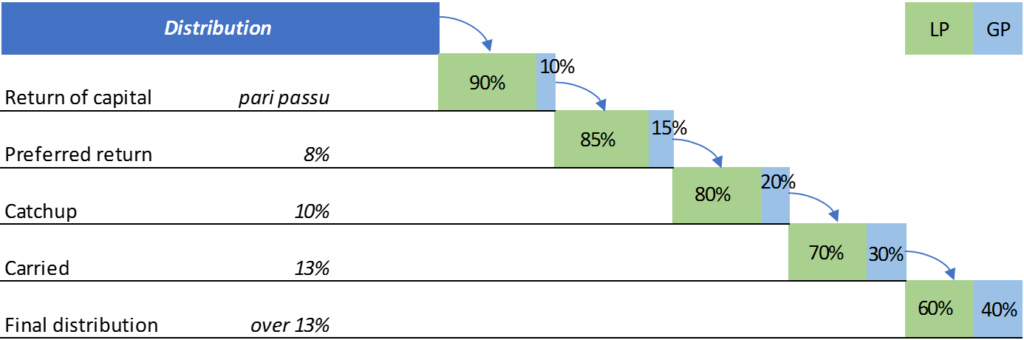
The structure for this process is laid out in your fund's Limited Partnership Agreement (LPA). While terms can be customized, a typical waterfall follows four standard tiers.
Hurdle Rate: Explainer for Fund Managers and Investors
This article from Carta, 'Hurdle Rate: Explainer for Fund Managers and Investors', provides a clear and detailed breakdown of the waterfall structure. We'll use it as a reference throughout this section.
Please read the section titled 'How does the hurdle rate impact the distribution waterfall?'. Focus on the descriptions of the four standard tiers: Return of capital, Preferred return (the hurdle), GP catch-up, and Carried interest split. This will provide a solid framework for the rest of the lesson.
As outlined in the article, the four tiers are:
- Return of Capital: 100% of initial distributions go to the LPs until they have received back all of their contributed capital.
- Preferred Return (Hurdle Rate): After capital is returned, LPs continue to receive 100% of distributions until they have earned a pre-agreed minimum annual return (e.g., 8%) on their investment. This is the hurdle rate.
- GP Catch-Up: Once the LPs have received their capital and preferred return, the GP enters the "catch-up" phase. Here, the GP receives a large portion (often 100%) of the distributions until their share of the total profits "catches up" to the agreed-upon carried interest percentage (e.g., 20%).
- Carried Interest Split: After the GP is "caught up," all remaining profits are split according to the final carried interest arrangement—typically 80% to the LPs and 20% to the GP.
2. Understanding the Hurdle Rate and GP Catch-Up
The hurdle rate and catch-up are fundamentally about aligning incentives between you (the GP) and your investors (the LPs).
The Hurdle Rate
The hurdle rate serves as a performance benchmark. It effectively tells your LPs, "You will earn a baseline return on your money before I get paid any performance fee."
- For LPs: It's their minimum acceptable return, compensating them for the time and risk of locking up capital in your fund.
- For you (the GP): It's the performance threshold you must cross to become eligible for carried interest.
Typical hurdle rates are around 6-8% annually. The rate you set will depend on market conventions, your fund's strategy (riskier strategies often warrant higher hurdles), and your track record.
An important technical distinction you'll need to discuss with your legal counsel is the difference between a hard hurdle and a soft hurdle.
- Hard Hurdle (LP-Friendly): You earn carry only on the profits above the hurdle rate.
- Soft Hurdle (GP-Friendly): Once you clear the hurdle rate, you earn carry on all profits, including those below the hurdle.
For a first-time fund, LPs will almost certainly expect a hard hurdle.
The GP Catch-Up
The catch-up mechanism ensures that after the LPs get their preferred return, the GP's carried interest is ultimately calculated on all profits, not just the profits above the hurdle. It's a "catch-up" because the LPs get the first slice of profits (the preferred return), so the GP needs to receive the next slice to re-balance the split back to the intended 80/20.
3. Modeling the Waterfall: A Step-by-Step Example
The best way to understand this is to walk through the numbers. The following video provides a fantastic, detailed walkthrough using an Excel spreadsheet, which should resonate with your structured way of thinking.
Carry Calculation & Waterfall with Preferred Return, GP LP Split, & GP Catch Up
This video, 'Carry Calculation & Waterfall', provides a step-by-step numerical example of a complete distribution waterfall. It's the most practical way to see how the capital flows through each tier.
Watch from 03:20 to 19:38. The presenter will build the waterfall calculation from scratch. Pay close attention to how he calculates: The preferred return. The GP catch-up (he uses a clever method of assuming the preferred return is 80% of a whole to find the 20% catch-up). The final 80/20 split of remaining cash.
Let's summarize the logic from the video with a simplified scenario:
Scenario:
- Fund Size: $10M (all from LPs)
- Exit Proceeds: $50M
- Hurdle Rate: 8% annual (simple interest, 5 years for simplicity)
- Carried Interest: 20%
- Catch-up: 100% to GP
Distribution Flow:
-
Tier 1: Return of Capital
- The first $10M goes to the LPs.
- Remaining Proceeds: $50M - $10M = $40M
-
Tier 2: Preferred Return
- Calculate the total preferred return owed to LPs.
- $10M (Capital) x 8% (Hurdle) x 5 (Years) = $4M
- This $4M is distributed to the LPs.
- Remaining Proceeds: $40M - $4M = $36M
- Total Profit so far: $4M (all to LPs)
-
Tier 3: GP Catch-Up
- The goal is to get the GP to a 20% share of total profits.
- The LPs have received $4M in profit. To be "caught up," the GP needs to receive a distribution that makes the LP's share equal to 80% of the total profit distributed so far.
- If $4M (LP Profit) = 80% of total profit, then total profit = $4M / 0.80 = $5M.
- Therefore, the GP catch-up amount is $5M (Total Profit) - $4M (LP Profit) = $1M.
- This $1M is distributed to the GP.
- Remaining Proceeds: $36M - $1M = $35M
- Check: Total profit distributed is $5M ($4M to LPs, $1M to GP). The GP's share is $1M/$5M = 20%. The catch-up is complete.
-
Tier 4: Carried Interest Split
- The remaining $35M is split 80/20.
- LPs' Share: 80% of $35M = $28M
- GP's Share: 20% of $35M = $7M
Final Tally:
- Total to LPs: $10M (Capital) + $4M (Preferred Return) + $28M (Profit Split) = $42M
- Total to GP: $1M (Catch-up) + $7M (Profit Split) = $8M (This is the total carried interest)
Test your understanding!
Let's try another scenario. A fund has $20M in committed capital and generates $100M in total exit proceeds after 8 years. The terms are an 8% annual hurdle and 20% carry. Assuming simple interest and a 100% GP catch-up, how much do the LPs and GP receive in total?
Show answer
- Return of Capital: LPs get back $20M. Remaining proceeds: $80M.
- Preferred Return: $20M x 8% x 8 years = $12.8M. This goes to LPs. Remaining proceeds: $67.2M.
- GP Catch-Up: The LPs' profit so far is $12.8M. If this is 80% of total profit, then the catch-up for the GP is ($12.8M / 0.80) * 0.20 = $3.2M. Remaining proceeds: $64M.
- Final Split:
- LPs get 80% of $64M = $51.2M.
- GP gets 20% of $64M = $12.8M.
Final Distribution:
- Total to LPs: $20M (Capital) + $12.8M (Preferred Return) + $51.2M (Split) = $84M
- Total to GP: $3.2M (Catch-up) + $12.8M (Split) = $16M
4. Strategic Decision: European vs. American Waterfalls
The final piece of the puzzle is deciding when the waterfall calculation is applied. This is the distinction between European and American waterfalls, a key negotiating point with your LPs.
What is the Waterfall Model in VC and How Does It Help?
The GoingVC article 'What is the Waterfall Model in VC and How Does It Help?' does an excellent job of comparing the two main waterfall models and discussing their strategic implications.
Please read the section 'Types of Waterfall Models'. Focus on the pros and cons of the European and American models from both the LP and GP perspectives.
-
European Waterfall (Whole-Fund): You (the GP) only receive carried interest after all LP capital for the entire fund has been returned, plus the preferred return.
- Pros (for LPs): Most secure. Protects them from a scenario where one big win pays you carry, but subsequent losses erode the fund's overall return.
- Cons (for GPs): Carry is deferred until late in the fund's life.
-
American Waterfall (Deal-by-Deal): You can start taking carry on each successful exit, even before all the fund's capital has been returned.
- Pros (for GPs): Much faster access to carried interest, which improves GP cash flow.
- Cons (for LPs): Riskier. To mitigate this, LPs will demand a clawback provision, which obligates you to pay back carry if later losses mean the fund ultimately underperforms the hurdle.
As a first-time fund manager, LPs will almost universally expect you to use a European waterfall. It is the most common and investor-friendly approach.
Conclusion
You now have a detailed, mechanical understanding of how money flows out of a fund and how your performance compensation is calculated. This knowledge is not just theoretical; it will form the basis of your negotiations with LPs and the legal drafting of your LPA.
Key Takeaways:
- The distribution waterfall is a four-tiered process: Return of Capital, Preferred Return (Hurdle), GP Catch-up, and Final Split.
- The hurdle rate is a minimum performance threshold (typically 8%) that must be returned to LPs before you can earn carry.
- The GP catch-up realigns the profit split to the agreed-upon carry percentage after the hurdle is paid to LPs.
- The choice between a European (whole-fund) and American (deal-by-deal) waterfall is a critical strategic decision that impacts the timing of your compensation and the level of risk for your LPs. A European model is standard for new managers.
Preview of the next lesson:
Now that you have a firm grasp of the fund economics and the structure you'll be offering to investors, the next logical step is to figure out who those investors are. In our next lesson, we will focus on how to "Identify and create a target list of appropriate LPs (family offices, HNWIs)." We'll shift from the "what" of your fund proposal to the "who" you will be pitching to.