Hello! Welcome back to your course on Radioelectronics.
Introduction
Approximate time to complete: 45 minutes
In our previous lessons, we've built a variety of op-amp circuits—inverting and non-inverting amplifiers, summing amplifiers, integrators, and differentiators. A common, unspoken thread connecting all these circuits is that they rely on feeding a portion of the output signal back to the inverting input. This technique is the key to their stable and predictable behavior.
Today, we will formalize this crucial concept. The learning outcome for this lesson is to understand Feedback Concepts: Positive and Negative Feedback in Amplifiers. We will dissect the general principles of feedback, mathematically model its effects, and explore why one type of feedback is used to build stable amplifiers while the other is used to create oscillators.
Recap from previous lessons:
- All the op-amp configurations we have studied (amplifiers, integrators, etc.) use a feedback path from the output to the inverting (-) input.
- This configuration gives rise to the "virtual ground" or "virtual short" principle, where , which has been fundamental to all our analyses.
Let's start by building an intuitive understanding of feedback.
1. The Core Idea: Negative vs. Positive Feedback
At its heart, feedback is about self-correction and control. In an electronic system, it means taking a fraction of the output signal and mixing it back in with the input. How you mix it determines everything.
To build a strong intuition for this, please watch the first part of the following video. Professor Curtis Meyer provides excellent real-world analogies that clearly distinguish between the stabilizing nature of negative feedback and the destabilizing nature of positive feedback.

Please watch from 01:05 to 03:43. Pay close attention to the analogies of steering a car and a room thermostat.
As you saw, the two types of feedback are:
- Negative Feedback: The feedback signal is subtracted from the input. This is a corrective or stabilizing action. If the output drifts too high, the feedback causes the input to decrease, bringing the output back down. This is the principle behind the car staying in its lane and the thermostat maintaining a stable temperature. All stable amplifiers are built using negative feedback.
- Positive Feedback: The feedback signal is added to the input. This is a reinforcing or runaway action. If the output drifts high, the feedback causes the input to increase further, pushing the output even higher until it saturates. While destructive for an amplifier, this principle is intentionally used to build oscillators and certain switching circuits.
2. The General Feedback Amplifier Model
To analyze the effects of feedback mathematically, we use a generalized block diagram. This model is abstract but incredibly powerful, as it applies to any system that uses feedback, not just op-amps.
The video below introduces this general structure and derives the single most important equation in feedback theory.
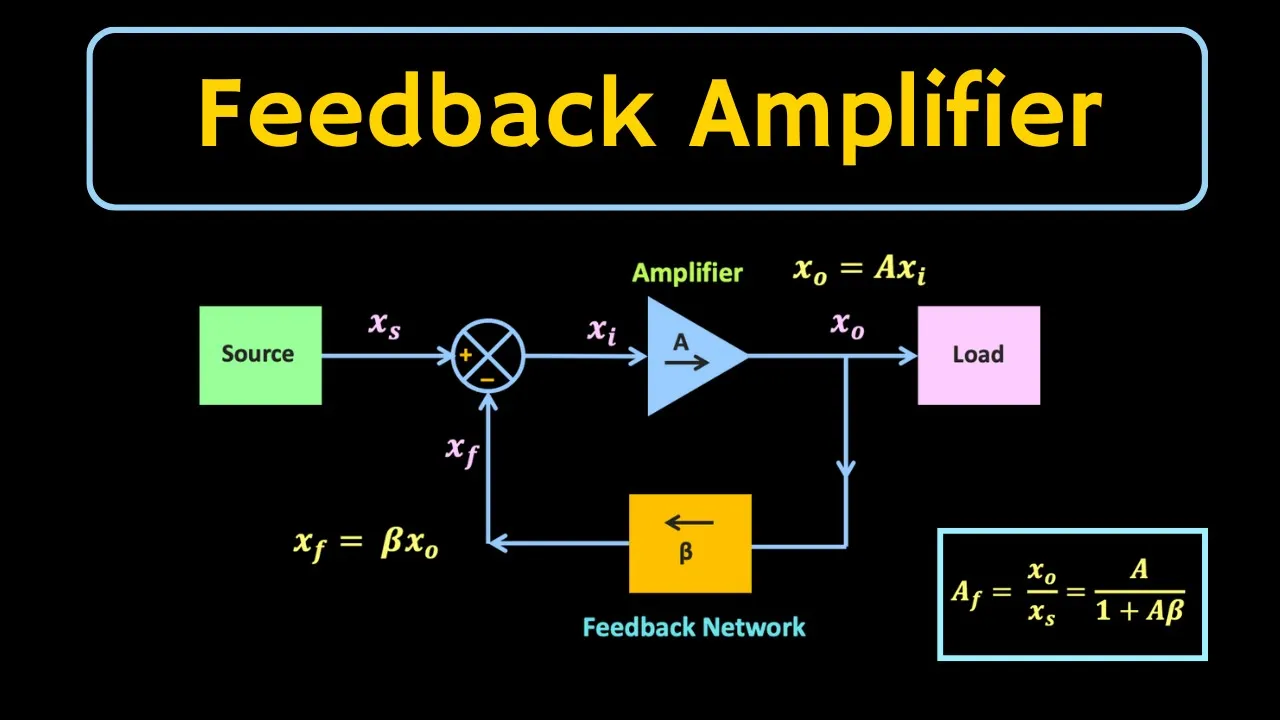
Please watch from 04:05 to 09:06. This segment will walk you through the derivation of the closed-loop gain.
Let's break down the key components from the video: A general block diagram of a feedback amplifier. The output signal is sampled by the feedback network (), which produces the feedback signal . This is subtracted from the source signal to create the input signal .
- : The Open-Loop Gain of the basic amplifier. This is the amplifier's intrinsic gain without any feedback (e.g., the very large, unstable gain of a raw op-amp).
- : The Feedback Factor. This is the fraction of the output signal that is "fed back" by the feedback network. is determined by the components in the feedback path (usually resistors).
- : The Loop Gain. This is the total gain experienced by a signal making a full loop through the amplifier and the feedback network. As we will see, the magnitude of the loop gain determines the behavior of the entire system.
- : The Closed-Loop Gain, which is the overall gain of the system with feedback ().
As derived in the video, the relationship between these terms is:
This is the fundamental equation for negative feedback. The term is called the amount of feedback. It's the factor by which the open-loop gain is reduced to get the closed-loop gain.
3. The Power of Negative Feedback: Stability and Precision
The equation above holds a remarkable secret. What happens when the loop gain is very large, which is typical in op-amp circuits?
If , then . The equation simplifies dramatically:
This is a profound result. It means that if the loop gain is high, the overall closed-loop gain becomes almost entirely independent of the amplifier's open-loop gain . The gain is now determined solely by the feedback factor , which is set by stable, precise passive components like resistors.
This is called gain desensitization. We trade a massive, unstable gain () for a smaller, but extremely stable and predictable gain ().
To see just how effective this is, watch this short segment with a numerical example.
Please watch from 07:40 to 08:51.
As the example showed, even when the open-loop gain () varied by three orders of magnitude (from 5,000 to 5,000,000), the closed-loop gain remained stable to within about 2%. This is the primary reason why we use negative feedback in amplifiers.
Beyond gain stability, negative feedback provides several other key benefits, as mentioned in the first video:
- Reduces non-linear distortion.
- Reduces the effects of noise.
- Increases the amplifier's bandwidth (at the expense of gain).
- Allows control over input and output impedances.
4. Revisiting the Op-Amp: Virtual Ground Explained
Now we can finally explain why the virtual ground/short principle works. It's a direct consequence of a high loop gain in a negative feedback system.
Look at the feedback equation again: . We can rearrange it to find the signal at the amplifier's input, :
Since , we have:
This shows that the input to the basic amplifier, , is the source signal divided by the amount of feedback. For an op-amp where is huge, is also huge, and therefore becomes extremely small.
In an op-amp circuit, is the differential voltage . For this to be near zero, it must be that . This is the "virtual short" we've been using all along!
The following video segment provides an excellent, detailed analysis using the non-inverting amplifier. It perfectly connects the general feedback theory to the practical op-amp circuits we've been studying.
Please watch from 09:06 to 20:40. This is a longer segment, but it brilliantly demonstrates:
- How the resistors R1 and R2 form the feedback network and determine .
- Why the gain formula is just a specific case of .
- How the virtual short concept holds true when the loop gain is large, and how it starts to fail when the loop gain is small.
5. A Brief Look at Positive Feedback
What happens if we add the feedback signal instead of subtracting it? Our block diagram's summer becomes an adder, and the gain equation changes:
Notice the minus sign in the denominator. As the loop gain approaches 1, the denominator approaches zero, and the closed-loop gain shoots towards infinity. This is the mathematical signature of instability. The circuit's output will rapidly grow until it hits the power supply limits, and it will often begin to oscillate.
While this is undesirable for an amplifier, it's exactly what's needed for an oscillator. By designing a feedback network where at a specific frequency, we can create a circuit that generates a stable, periodic waveform.
Conclusion
In this lesson, we formalized the concept of feedback, which has been the silent partner in all our amplifier designs.
Key Takeaways:
- Feedback involves returning a fraction of the output signal to the input.
- Negative Feedback subtracts the feedback signal, stabilizing the system. It is the cornerstone of amplifier design. Its main benefit is gain desensitization, making the amplifier's gain precise and predictable () at the cost of reducing the overall gain.
- Positive Feedback adds the feedback signal, destabilizing the system. It is used to create oscillators and other regenerative circuits.
- The virtual short () in op-amp circuits is a direct result of applying negative feedback with a very high open-loop gain.
Now that we have a solid grasp of the ideal op-amp and the power of feedback, we are ready to explore the imperfections. In the next lesson, we will examine Real Op-Amp Limitations, including slew rate, offset voltage, and bandwidth, to understand how they affect the performance of our circuits in the real world.