
Good to continue from the scorecard rather than jumping straight to a new offer. Last lesson established whether the removal of the single pack produced a credible shift in AOV, conversion, revenue per session, pack mix, and automatic-discount exposure. Now the question becomes more demanding:
If a customer chooses a three-pack rather than a two-pack, how much additional contribution does that order actually generate?
A larger order is not automatically a better order. The three-pack may trigger an automatic discount, cost more to produce, move into a higher shipping-weight band, or incur a larger payment fee. This lesson gives you a compact calculator and a clear gate for deciding whether the three-pack deserves more prominence on the product page.
Plan for about 35–40 minutes. You will leave with a two-pack versus three-pack contribution model that can be completed today using your Shopify data, 3PL or courier rates, payment-fee terms, and current product costs.
Contribution is the amount left after costs that move with the order
Contribution margin is the revenue remaining after variable costs. It is not the same as gross margin, which usually subtracts only COGS. For this decision, you want to see the economics of an actual order: product cost, fulfillment, shipping subsidy, payment fees, and discounts.
eCommerce Contribution Margin: A Comprehensive Guide ...
Read the concise explanation from Saras Analytics to establish the distinction between revenue, variable costs, and contribution margin. Its main value here is the discipline of including every cost that changes when a shopper selects a larger pack.
In the section “What is eCommerce Contribution Margin,” read the variable-cost checklist. Then, in “How to Calculate eCommerce Contribution Margin,” read the worked calculation. For your immediate model, focus on COGS, fulfillment and shipping, payment fees, and discounts; marketing is held constant because this pack-choice test is intended to increase AOV without increasing CAC.
The Unit Economics Layers visual shows why revenue needs to be peeled back in stages rather than treated as profit.
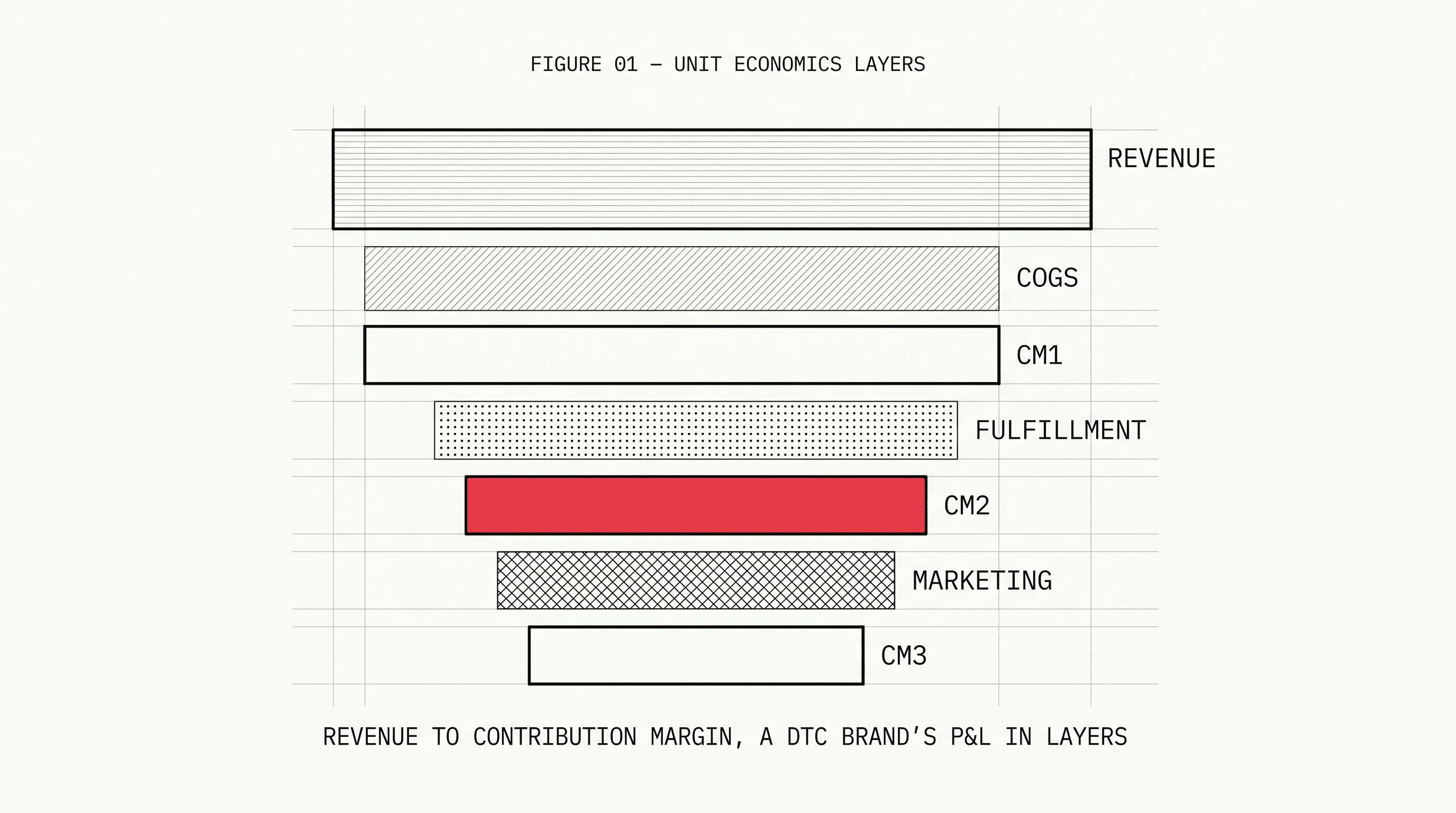
One clarification: the image’s labels such as “CM1,” “CM2,” and “CM3” refer to successive layers of contribution accounting. They do not refer to your two-pack and three-pack. In the calculator below, use for two-pack contribution and for three-pack contribution.
For the narrow decision in this course, use:
where:
- is either the two-pack or three-pack scenario.
- is net product revenue after automatic discounts.
- is landed COGS, including product and packaging.
- is fulfillment cost, such as pick, pack, and order-specific packing materials.
- is net shipping cost, meaning courier cost less any shipping amount collected from the customer.
- is the payment-processing fee.
The key result is not merely . It is the difference:
If is positive, a three-pack order contributes more cash toward fixed costs and profit than a comparable two-pack order. If it is negative, a bigger basket is making the business worse off on a per-order basis.
Define comparable order scenarios before entering numbers
Your model must compare like with like. Do not compare an unusually large three-pack order containing several add-ons with a bare two-pack order and assume the difference came from the pack choice.
For the primary calculation, use a clean product-page scenario:
| Scenario | Include | Exclude |
|---|---|---|
| Two-pack order | One Throat Soothing Pops two-pack, its applicable automatic discount, order fulfillment, shipping, and payment fee | Other products, manual discounts, unusual shipping upgrades |
| Three-pack order | One Throat Soothing Pops three-pack, its applicable automatic discount, order fulfillment, shipping, and payment fee | Other products, manual discounts, unusual shipping upgrades |
This clean scenario answers: what changes if a shopper viewing the Pops page selects the three-pack rather than the two-pack?
If a material share of customers commonly add a spray, syrup, or another product, create a second scenario later with the same add-on in both carts. Keep the primary scenario clean; otherwise, it becomes difficult to see what the pack architecture itself is doing.
Gather five inputs for each pack
Use current costs and current promotion rules, not rough averages from a past quarter.
| Input | Where to obtain it | Important detail |
|---|---|---|
| Gross product revenue | Shopify product or variant price | Use the actual customer-facing price before any automatic discount. |
| Automatic discount | Shopify discount configuration and a test cart | Record the exact discount that the modeled cart earns today. |
| Landed COGS | Finance, inventory, or purchase-order data | Include product, direct product packaging, freight, duty, and any other cost embedded in inventory. |
| Fulfillment and carrier cost | 3PL invoice, warehouse rate card, and courier invoice | Separate pick-and-pack from carrier shipping if both are charged. |
| Payment fee | Shopify Payments or payment-gateway settlement data | Use the fee schedule actually charged for the relevant payment method. |
For the first pass, use your most common prepaid payment method if it dominates checkout. If COD fees or payment-method fees differ materially, make a second scenario for that payment method. A contribution model is only as good as the cost drivers it includes.
Treat shipping as a net cost
Because you offer free shipping above ₹599, both the two-pack and three-pack may have zero shipping revenue collected from the customer. But they still have a carrier cost.
Calculate net shipping cost as:
where:
- is the courier or shipping-label cost for the order.
- is the shipping amount paid by the customer.
When shipping is free, , so the full carrier cost remains in . If customer-paid shipping exceeds the courier charge, becomes negative; that means the order generated a small shipping surplus. Keep that result rather than forcing it to zero.
Avoid double counting:
- If outer mailers and packing materials are included in your 3PL fulfillment charge, do not also include them in COGS.
- If the fulfillment invoice includes courier charges, do not add a separate shipping-label cost.
- If you use net revenue after discounts, do not subtract the discount again as a separate cost.
Build the two-pack versus three-pack calculator
Create one spreadsheet tab named Pack Contribution Gate. Use rows like these, with one column for the two-pack and one for the three-pack.
| Calculator row | Two-pack | Three-pack | Notes |
|---|---|---|---|
| Gross product price, | ₹ | ₹ | Before automatic discount |
| Automatic discount, | ₹ | ₹ | Use the live applicable amount |
| Net product revenue, | ₹ | ₹ | |
| Landed COGS, | ₹ | ₹ | Product plus direct packaging |
| Fulfillment cost, | ₹ | ₹ | Pick, pack, packing material if applicable |
| Carrier shipping cost, | ₹ | ₹ | Actual or rate-card estimate |
| Shipping paid by customer, | ₹ | ₹ | Zero for free shipping |
| Net shipping cost, | ₹ | ₹ | |
| Payment fee, | ₹ | ₹ | Actual fee or fee-model result |
| Contribution, | ₹ | ₹ | |
| Contribution-margin ratio | % | % |
For a percentage-plus-fixed payment-fee structure, calculate payment fees as:
where:
- is the payment-fee percentage in decimal form.
- is the payment amount on which your processor charges the fee.
- is the fixed transaction fee, if any.
Use the settlement statement to determine . Depending on your payment provider, it may include product revenue, shipping paid by the customer, and tax. Do not assume it is only the discounted product subtotal.
Model the discount explicitly
Your current rules make this step essential. A three-pack can look attractive at its list price but trigger a discount that changes the economics.
For example, if the two-pack does not qualify for an automatic discount but the three-pack qualifies for 5%, enter:
- Two-pack discount: ₹0
- Three-pack discount: three-pack gross price multiplied by 5%
Do not use a generic “average discount rate” from all Shopify orders. The right discount is the one the specific modeled cart earns. Verify it with a test cart or a recent completed order at each pack level.
If the actual three-pack price reaches the ₹1,299 threshold and earns a deeper automatic discount, model that exact higher discount. This is precisely the kind of threshold effect that can turn a headline AOV improvement into a weaker contribution outcome.
Worked illustration: a three-pack can add contribution even with a discount
The figures below are fictional and only show the mechanics. Replace every number with your actual price, cost, and fee data.
Assume:
- The two-pack is priced below the ₹799 discount threshold.
- The three-pack crosses the ₹799 threshold and earns a 5% automatic discount.
- Both carts qualify for free shipping.
- Payment processing is 2% of the captured amount plus ₹5.
- The three-pack costs more to ship, but not enough to enter a dramatically different courier band.
| Row | Two-pack | Three-pack |
|---|---|---|
| Gross product price, | ₹780.00 | ₹1,170.00 |
| Automatic discount, | ₹0.00 | ₹58.50 |
| Net product revenue, | ₹780.00 | ₹1,111.50 |
| Landed COGS, | ₹250.00 | ₹375.00 |
| Fulfillment cost, | ₹35.00 | ₹35.00 |
| Carrier shipping, | ₹65.00 | ₹70.00 |
| Shipping paid, | ₹0.00 | ₹0.00 |
| Net shipping cost, | ₹65.00 | ₹70.00 |
| Payment fee, | ₹20.60 | ₹27.23 |
| Contribution, | ₹409.40 | ₹604.27 |
| Contribution-margin ratio | 52.5% | 54.4% |
The incremental contribution is:
In this illustration, each clean three-pack order contributes ₹194.87 more than a comparable two-pack order. The 5% discount reduces the three-pack’s net revenue, but it does not eliminate the extra contribution.
The calculation also surfaces conditions worth checking in your own business:
- A 5% discount is not automatically bad. What matters is its effect after all costs.
- A higher shipping band can reduce the benefit of the larger pack.
- The fixed portion of the payment fee is usually incurred once per order, so it may not change much between packs; the percentage component does.
- If fulfillment is charged per item or if three-packs require different packing, do not assume fulfillment stays flat.
Set a promotion gate before giving the three-pack more prominence
The next module will prepare a product-page test. Before you elevate the three-pack with hierarchy, value framing, or a “recommended” treatment, define a rule that prevents you from promoting a larger pack that is economically weak.
Use a two-part gate.
1. Non-negotiable contribution checks
The three-pack should pass both conditions:
Here, is the minimum extra contribution you require from a three-pack order relative to a two-pack order.
With no fixed-cost or retention data supplied yet, set the initial minimum viable value as:
This means the three-pack must at least create more contribution than the two-pack after discounts and order-specific variable costs. It is a floor, not an ambitious target.
A practical decision rule for the immediate experiment is:
| Result | Decision |
|---|---|
| Do not promote the three-pack. It is contribution-negative. | |
| , but | Do not promote it as an upgrade. It is less valuable than the two-pack despite a higher order value. |
| and | It passes the minimum economic gate and can proceed to a controlled merchandising test. |
2. A margin-quality check
Also calculate:
Set an internal minimum contribution-margin ratio, , from your finance team’s required first-order DTC contribution margin. The relevant rule is:
Do not import a generic ecommerce benchmark as your company’s target. Your acceptable margin depends on your fixed costs, return and replacement rate, payment mix, and the degree to which repeat purchases are expected.
If you do not yet have a finance-approved threshold, record that explicitly rather than inventing one:
Temporary rule: Three-pack must have positive contribution and non-negative incremental contribution. Margin-ratio floor pending finance confirmation.
That is sufficient for a short, controlled product-page test, but not sufficient to justify a permanent sitewide push or a deeper discount.
Use a conservative scenario when costs are uncertain
If courier cost, payment fees, or COGS are uncertain, calculate two versions:
| Scenario | Inputs |
|---|---|
| Expected case | Your best current estimate of each cost |
| Conservative case | Higher plausible COGS, fulfillment, shipping, fee, and discount cost |
Use the conservative calculation for the gate:
For example, if the expected three-pack clears the gate by ₹150 but a higher shipping band and deeper discount reduce that to negative contribution in the conservative case, the right response is not to promote it yet. First resolve the uncertain inputs.
Keep marketing cost consistent with the question being asked
The curated reading correctly includes variable marketing spend in a full contribution-margin view. For this specific pack-choice calculation, however, do not add your blended CAC to one pack and not the other.
The planned change is on the product page for visitors you already acquire. If it does not increase paid acquisition spend, marketing cost is held constant across the two scenarios and does not affect the incremental comparison.
Include incremental marketing cost only if the promotion itself creates one, for example:
- A dedicated paid campaign pushing the three-pack
- A separate affiliate commission that applies only to the three-pack
- A pack-specific incentive paid per sale
This keeps the calculation aligned with the course goal: growing AOV without higher CAC.
What to save today
Before moving to product-page implementation, save a screenshot or export of the completed calculator and record:
- The exact two-pack and three-pack prices
- The automatic-discount rule applied to each modeled cart
- The source and date for COGS
- The source and date for fulfillment and courier rates
- The payment-fee assumption or actual settlement-fee evidence
- Your expected and conservative contribution results
- Your selected and
- A plain-language result: three-pack passes or three-pack fails
A concise decision statement might read:
“For a clean Throat Soothing Pops order, the three-pack produces ₹[amount] contribution versus ₹[amount] for the two-pack. Its conservative incremental contribution is ₹[amount], and its contribution-margin ratio is [percentage]. Therefore, it passes / fails the defined promotion gate.”
The key takeaway is straightforward: AOV is revenue per order; contribution is the value of that order after costs that move with it. Promote the three-pack only when its live discount, product cost, fulfillment, shipping subsidy, and payment fees leave it with positive contribution and at least the incremental contribution you require.
In the next lesson, if the three-pack passes this gate, you will turn that result into a launch-ready Throat Soothing Pops product-page brief: a clear pack hierarchy, price-per-pop framing, and only supported usage-duration cues—without changing price or discount rules.
Can't find a good explanation? Sign up and we'll make it for you
Sign up