Hello! Welcome back to the course.
In our last session, we crafted a single, sharp cold email designed to earn a reply. But in B2B, one "yes" is rare. More often, you get silence. This is where the real work of a copywriter begins: turning that initial spark of interest—or even just silence—into a conversation.
Today, we're moving from a single shot to a strategic campaign. Our goal is to outline the strategic purpose and core message for each email in a 3-part B2B nurture sequence. You'll learn how to plan a series of emails that intelligently guide a prospect from mild curiosity to being ready for a sales call.
1. From a Single Email to a Guided Journey
A single email is an interruption. A nurture sequence is a conversation spread out over time. Its purpose is to build trust and educate a prospect who has shown interest (e.g., by downloading a resource) but isn't ready to buy yet.
To do this effectively, we need to map our emails to the buyer's mental state. This is often visualized as the "Buyer's Journey."
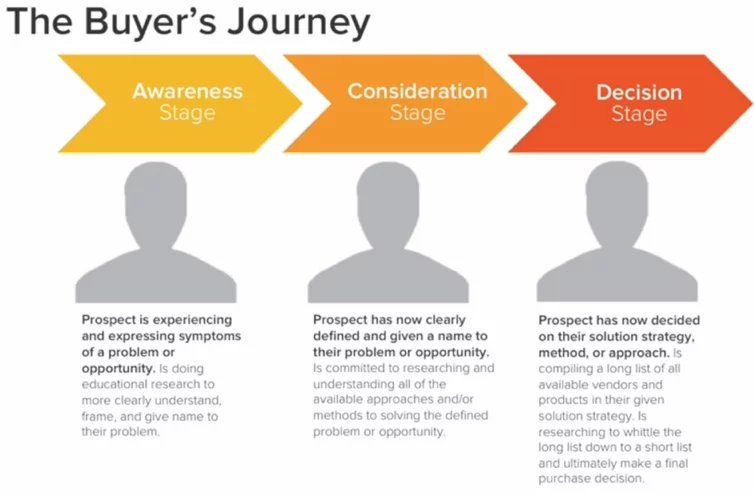
A 3-part nurture sequence is a microcosm of this journey:
- Email 1 often addresses the Awareness stage by being helpful and educational.
- Email 2 moves into the Consideration stage by providing proof and showing how a solution works.
- Email 3 pushes toward the Decision stage by making a clear, low-friction ask.
2. The Anatomy of a Nurture Sequence
Different situations call for different types of sequences. A sequence to welcome a new subscriber is different from one designed to re-engage a cold lead. For our purposes, we'll focus on the most common B2B scenario: nurturing a lead who has downloaded a piece of content.
The following resource provides an excellent framework for this exact scenario.
Your Guide to Lead Nurturing in 2025: Tactics, Tools & Examples
The article 'Your Guide to Lead Nurturing' from Martal Group breaks down several types of nurture campaigns. We're going to focus on their model for educating a mid-funnel lead.
Please read 'Example 2: Educational Nurture Series for Mid-Funnel Leads'. Pay close attention to the 'Scenario' and 'Why it works' sections. This will give you the strategic logic behind a classic three-part sequence.
As you saw in the reading, the sequence isn't just a random series of "check-ins." Each email has a specific job to do. Let's formalize this into a reusable structure.
The "Value -> Proof -> Action" Framework
A powerful 3-part nurture sequence generally follows this persuasive flow:
-
Email 1: Deliver Value & Build Trust
- Strategic Purpose: To immediately prove your value beyond the initial download. You're not just a gatekeeper of content; you're a helpful expert. This aligns with the buyer's Awareness stage, where they are seeking education.
- Core Message: "Here's the resource you requested. Because you care about [Topic X], you might also find [Bonus Tip/Resource Y] useful."
-
Email 2: Provide Proof & Build Credibility
- Strategic Purpose: To connect the prospect's abstract problem to a concrete solution. By showing how a similar company achieved a tangible result, you move the conversation from "what" to "how." This pushes them into the Consideration stage.
- Core Message: "Solving the problem you're researching is possible. Here’s a quick story of how a company like yours achieved [Quantifiable Outcome]."
-
Email 3: Propose Action & Qualify Intent
- Strategic Purpose: To convert the trust and credibility you've built into a sales conversation. You've earned the right to ask for their time. This moves them toward the Decision stage.
- Core Message: "You're exploring [the problem] and have seen the results we can deliver. Is it worth a brief chat to see how this might apply to your specific goals?"
This structure respects the buyer's time by front-loading the value and only asking for a meeting once a foundation of trust has been laid.
3. Your Turn: Outline a Nurture Sequence
Now, let's apply this framework. This exercise is about planning, not writing the full email.
Scenario:
You're a copywriter for a SaaS company that sells "Forecastly," an AI-powered tool that helps B2B companies predict their sales pipeline more accurately. A lead, who is a Sales Manager, has just downloaded your e-book titled "Beyond the Crystal Ball: A Guide to Data-Driven Sales Forecasting."
Task (10 minutes):
For a 3-part nurture sequence to follow up on this download, outline the strategic purpose and core message for each of the three emails. Write one clear sentence for each.
- Email 1:
- Purpose: ...
- Message: ...
- Email 2:
- Purpose: ...
- Message: ...
- Email 3:
- Purpose: ...
- Message: ...
My Outline Example
Once you've finished, compare your outline to mine below. There's no single right answer, but the underlying strategy should be similar.
-
Email 1: The Value-Add
- Purpose: To deliver the e-book and immediately establish our expertise by offering a practical, related tool.
- Message: "Here is your e-book on sales forecasting, along with a simple spreadsheet template we built to help you calculate your team's current forecast accuracy."
-
Email 2: The Social Proof
- Purpose: To show the tangible business impact of improving forecast accuracy and build credibility for our AI-driven approach.
- Message: "We recently helped SaaS company 'Acme Corp' improve their forecast accuracy by 25% in one quarter, which allowed them to reallocate their budget to higher-performing channels."
-
Email 3: The Gentle CTA
- Purpose: To transition their interest in the topic of forecasting into a sales-qualified conversation about their specific challenges with their pipeline.
- Message: "Are you open to a 15-minute call to explore where the biggest gaps in your team's current forecasting process might be?"
Conclusion
You now have a strategic blueprint for planning an effective B2B email nurture sequence. By aligning each message with the buyer's journey, you move from simply "checking in" to intelligently guiding your prospect toward a solution.
Key Takeaways:
- A nurture sequence is a guided conversation, not a series of random follow-ups.
- Map your emails to the buyer's journey: Awareness -> Consideration -> Decision.
- Use the Value -> Proof -> Action framework to structure your sequence.
- Email 1 provides educational value to build trust.
- Email 2 offers social proof to build credibility.
- Email 3 makes a low-friction ask to start a sales conversation.
In our next lesson, we'll bring this outline to life. You'll take the strategic plan we've built today and write the full copy for a 3-part nurture sequence.