Hello! Welcome back.
In our last lesson, we crafted subject lines engineered to earn the open. But a great subject line only gets you in the door. The first few lines of your email determine whether the reader stays to listen.
Today, we're going to write the email itself. Our goal is to write a cold outreach email that earns a reply by leading with a buyer-relevant insight. This is the essence of "thinking like a buyer." Instead of pitching your product, you're going to demonstrate that you understand your prospect's world so well that you're worth talking to.
1. The Shift from "What We Do" to "What I've Noticed"
Most B2B copywriting focuses on explaining what a product does. Cold outreach, however, is an interruption. To earn the right to that interruption, you need to prove your relevance in seconds. You do this by leading with a buyer-relevant insight.
An insight is more than just a generic pain point. It's a specific observation about the prospect's company, role, or industry that shows you've done your homework and have a valuable perspective.
- Feature-led (weak): "We sell a tool that helps you rank on Google."
- Insight-led (strong): "I saw your top two competitors are landing all the jobs from people searching for 'roof repair' in your city. I have an idea for how you can show up first."
The first approach is about you. The second is about them. Let's see the impact of this shift in a real-world example.
Fixing His Cold Email Campaign In 20 Minutes
The following video from the Instantly channel analyzes two versions of a cold email. Pay close attention to why the simpler, more outcome-focused version performed twice as well.
Watch the section from 07:17 to 09:43. Notice how the better-performing email avoids jargon like 'SEO' and focuses directly on the outcome the business owner cares about: 'landing more jobs'.
As the video demonstrates, buyers don't care about your process (SEO, rankings, backlinking); they care about the outcome (more jobs, more revenue). The winning email led with an insight derived from a quick competitive search, framed in the language the buyer understands.
2. A Simple Framework for Your Cold Email
A successful cold email isn't a long essay. It's a short, structured message designed to start a conversation. A highly effective structure follows a four-part persuasion flow.
Best Cold Email Templates for B2B Sales in 2023 (with examples)
This video from the email experts at Lavender presents a simple but powerful framework for structuring your cold emails. They call it the 'Vanilla Ice Cream' framework.
Watch the segment on the 'Vanilla Ice Cream' framework from 01:04 to 02:43. Focus on the four components: Observation: The context for why you're reaching out. Pain Point/Insight: Highlighting a relevant problem. Credibility: Using social proof to show you can solve it. Call to Conversation: An easy, low-friction question.
Let's break down that framework:
- Observation: Start with your buyer-relevant insight. This proves you're not a spammer.
- Connect to Pain: Briefly explain the problem or challenge this observation implies.
- Establish Credibility: Offer a brief, concrete proof point (a client result, a statistic) to show you're legitimate.
- Call to Conversation: Ask a simple, interest-based question. Don't ask for a meeting directly; ask if they're interested or open to discussing it.
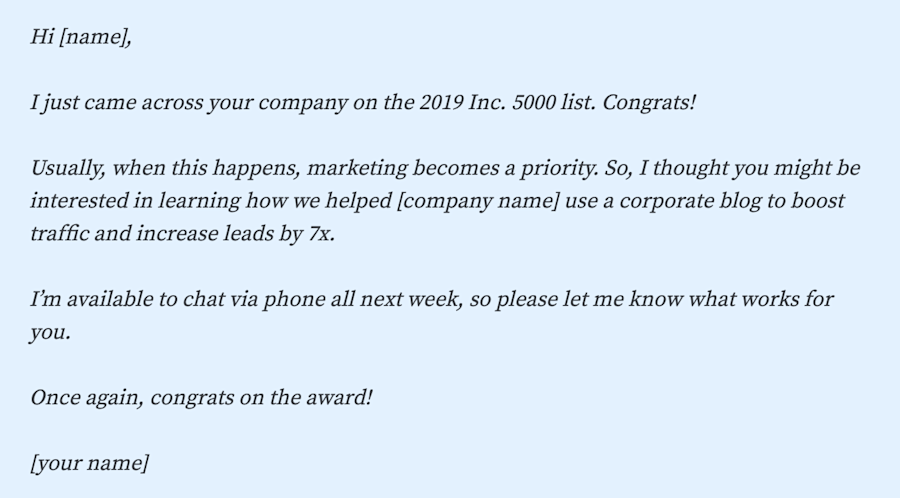
Here is an example of this framework in action. The insight here is a trigger event: the company made the Inc. 5000 list.
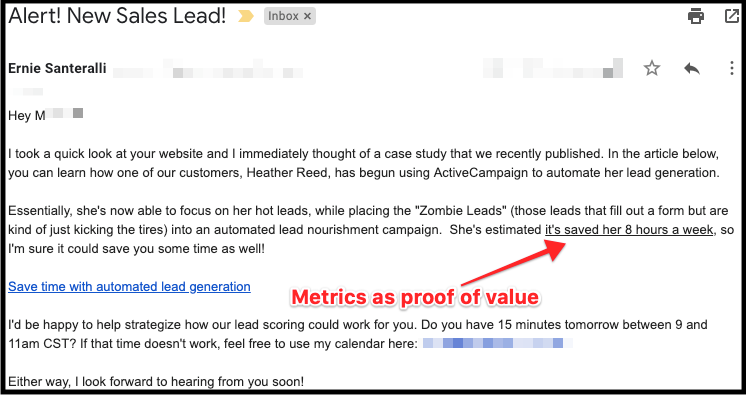
Here's another example that leads with a powerful piece of social proof as its hook.
3. Finding Your Insight
The quality of your email depends entirely on the quality of your initial insight. This is where your research skills come in. Before writing, spend a few minutes looking for clues:
- LinkedIn: Check the person's recent posts and the company's page. Are they hiring? Announcing a new product? Did they just win an award?
- Company Website: Read their blog, press releases, or case studies. What are their stated goals and challenges?
- Industry News: Is there a trend impacting their business that you can speak to?
Your goal is to find one specific, timely piece of information that you can use to frame your email around their world. For a deeper look at this research process, "The Art of Cold Emailing: Buyer Persona Research" from SalesHive is an excellent resource.
4. Your Turn: Write an Insight-Led Email
Time to put this into practice.
Scenario:
You're selling a project management software called "SyncFlow," which is specifically designed for remote creative teams. Your target is the Head of Creative at "Noma Digital," a fully remote digital agency.
Your Insight:
You found a recent article where the CEO of Noma Digital mentioned the challenges of "maintaining creative collaboration and project visibility" with a distributed team.
Task (10 minutes):
Write a short cold email (under 150 words) to the Head of Creative at Noma Digital. Use the four-part framework we discussed:
- Observation: Reference the CEO's comment.
- Connect to Pain: Empathize with the challenge of managing remote creative projects.
- Credibility: Briefly mention how SyncFlow helps, perhaps with a specific outcome.
- Call to Conversation: Ask a low-friction question.
My Feedback and Example
Here is my version of the email. Compare the structure and tone to yours.
Subject: Noma Digital & creative collaboration
Hi [First Name],
I read your CEO's recent comments on the challenges of maintaining project visibility with a remote team. It's a problem we hear often from creative agencies.
Keeping track of feedback, assets, and deadlines across different time zones can lead to missed details and slowed-down projects.
We built SyncFlow to solve this. It helped another remote agency, DesignCo, cut their project review times by 40% by centralizing all creative feedback.
Would you be open to seeing if a similar approach could benefit your team at Noma Digital?
Best,
[Your Name]
Why it works:
- Subject: It's relevant, personalized, and creates curiosity.
- Observation: It opens with the specific insight, showing the email is tailored.
- Pain: It validates the problem in a relatable way.
- Credibility: It provides a specific, quantifiable result (
cut review times by 40%). - CTA: It's a soft, interest-based question, making it easy to say "yes."
Conclusion
You now have a powerful framework for writing cold emails that don't feel "cold." By leading with a buyer-relevant insight, you shift the conversation from a sales pitch to a valuable consultation. This approach respects the buyer's time, demonstrates your expertise, and dramatically increases your chances of getting a reply.
Key Takeaways:
- Effective cold emails lead with a specific, relevant insight about the buyer's world.
- Focus on the buyer's outcomes, not your product's features.
- Structure your email using the Observation -> Pain -> Credibility -> Call to Conversation framework.
- Your CTA should be a low-friction question that starts a dialogue, not a demand for a meeting.
In our next lesson, we'll expand on this. What happens after you get a reply, or if you don't? We will outline the strategic purpose and core message for each email in a 3-part B2B nurture sequence.