Hello! Welcome to the next lesson in our exploration of modern language model architectures.
In our previous session, we analyzed scaling laws and saw how the optimal balance between model size (N) and dataset size (D) is critical for training efficiency. We learned that while the "Chinchilla-optimal" recipe minimizes training cost, real-world applications often favor smaller, more efficient models trained on vast amounts of data to reduce inference costs. This highlights a crucial theme: architectural efficiency is paramount.
Today, we will dive into one of the most significant architectural innovations that has enabled this new generation of efficient and powerful models: Rotary Positional Embeddings (RoPE). This technique, a cornerstone of models like LLaMA, PaLM, and GPT-NeoX, is a masterclass in elegant mathematical design. Our learning outcome is to implement advanced positional embeddings like Rotary Positional Embeddings (RoPE). We'll build a deep intuition for how it works, derive its mathematical properties, and translate that theory into a practical PyTorch implementation.
1. The Problem: The Rigidity of Absolute Positions
To appreciate the elegance of RoPE, we must first understand the limitations of the methods it replaced. As you'll recall from our earlier modules, Transformers are inherently permutation-invariant; they don't have a built-in sense of sequence order. Early models like the original Transformer, BERT, and GPT-2 solved this by adding a unique vector, an absolute positional embedding, to each token's embedding.
This is like giving each word a fixed street address. While simple, this approach has a major flaw.
Give me 30 min, I will make RoPE click forever
To start, let's watch a segment from the video "Give me 30 min, I will make RoPE click forever" by Zachary Huang. It does an excellent job of illustrating the fundamental problem with absolute positional embeddings.
Watch from 01:24 to 04:04. Pay close attention to the example of the phrase 'the red car'. Notice how the final input vector for the word 'red' changes completely when its absolute position shifts, even though its relative meaning in the local context is the same. This highlights the core inefficiency RoPE aims to solve.
As the video explains, if the model sees the word "red" at position 1 and later at position 3, it receives two completely different input vectors. It's forced to re-learn the meaning and relationships of words at every single position in the sequence, which is massively inefficient.
The ideal system would encode position in a way that the attention score between two words depends only on their content and their relative distance (e.g., "3 words apart"), not their absolute positions (e.g., "at index 5 and index 8").
2. The RoPE Solution: Position as Rotation
RoPE introduces a brilliantly simple yet powerful idea: instead of adding positional information, we rotate the query and key vectors.
The core insight is to separate a vector's responsibilities:
- Vector Magnitude (Length): Represents the semantic meaning of the token.
- Vector Angle (Direction): Represents the position of the token.
By rotating a vector, we change its angle without changing its length. This allows us to inject positional information without corrupting the original semantic meaning embedded in the vector's magnitude. This is a concept with parallels in physics and signal processing, where phase and amplitude can encode different information.
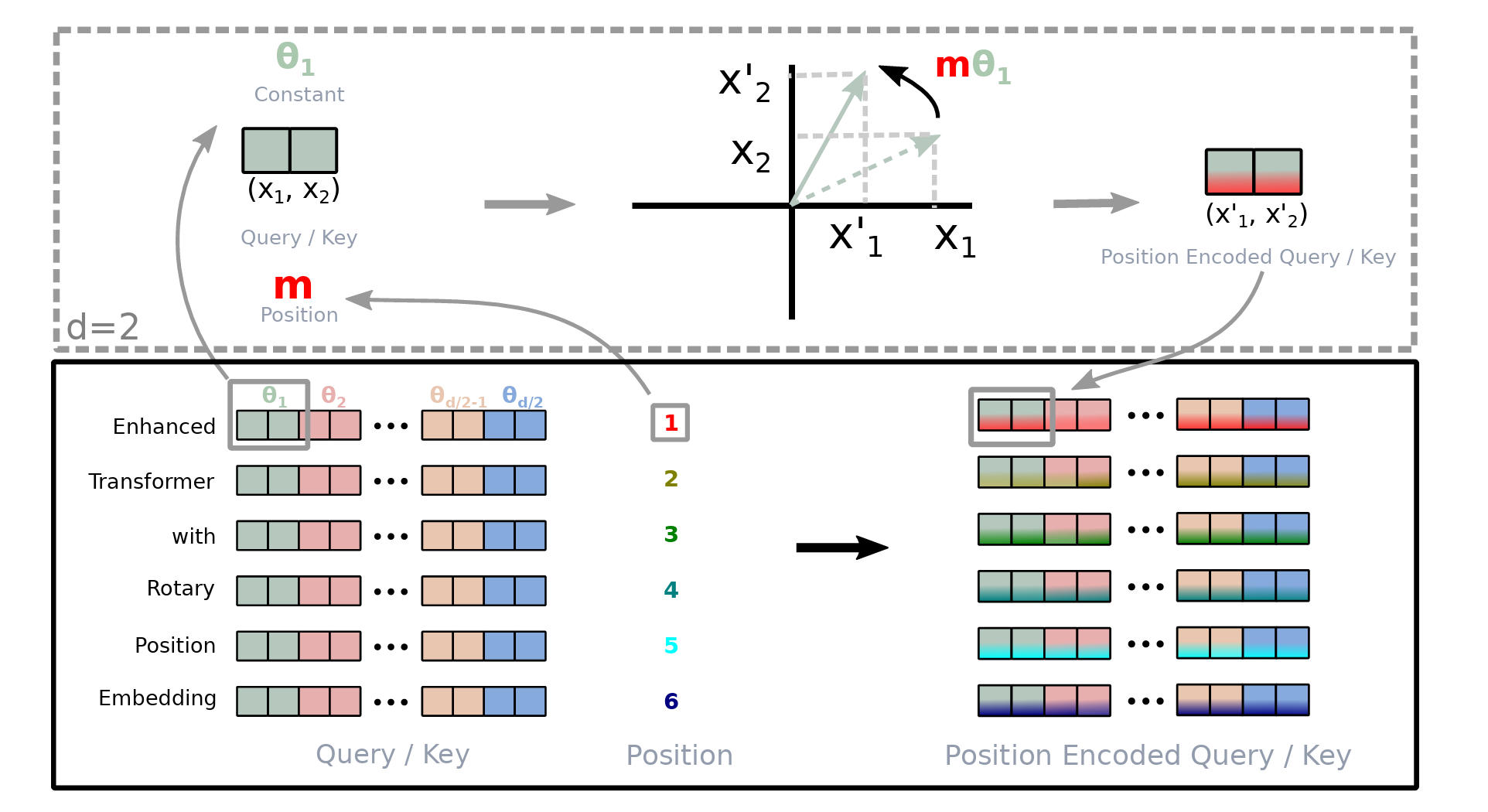
How is this rotation performed? With a simple 2D rotation matrix from trigonometry. For a 2D vector , rotating it by an angle is done by:
A key property of this transformation is that the length of the vector remains unchanged: .
3. Scaling to High Dimensions: A Symphony of Clocks
Modern LLMs use high-dimensional vectors (e.g., 4096 dimensions in LLaMA 3). How do we rotate a 4096-dimensional vector? Performing a single 4096x4096 rotation would be computationally prohibitive. RoPE uses a clever two-part strategy:
-
Pairwise Split: The -dimensional vector is viewed as pairs of 2D vectors. We then apply a simple 2D rotation to each pair independently.
-
Varying Frequencies: If we rotated every pair by the same amount, the encoding would be ambiguous. To create a unique positional signature, each pair is rotated at a different "speed" or frequency.
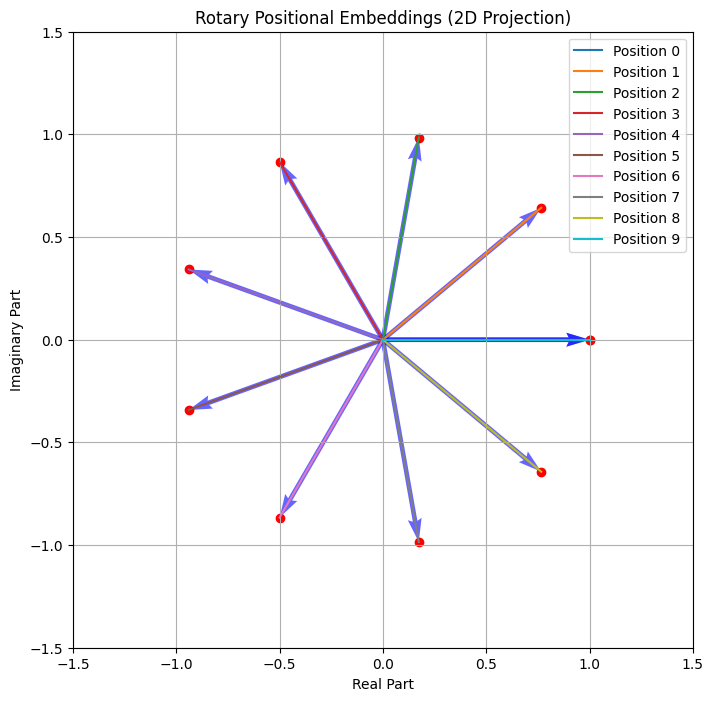
This is analogous to the hands of an analog clock: the second hand moves fast, the minute hand moves slower, and the hour hand moves very slowly. The unique combination of their angles tells you the precise time. Similarly, in RoPE, the first few pairs of dimensions rotate quickly, while the later pairs rotate very slowly. This combination gives every position a unique rotational signature.
The rotation speed (frequency) for the -th pair of dimensions is defined by a fixed, non-learned formula:
where:
dis the total embedding dimension.iis the index of the dimension pair (from to ).baseis a large constant, typically 10,000.
The final rotation angle for a token at position m for the i-th pair is simply .
Give me 30 min, I will make RoPE click forever
The Zachary Huang video provides a fantastic animated explanation of this 'pairwise split' and 'varying frequencies' strategy.
Watch the segment from 10:15 to 13:09. This will solidify your intuition for how a high-dimensional rotation is broken down into many small, efficient 2D rotations, and how the 'symphony of clocks' analogy works in practice with the frequency formula.
4. The Mathematical Guarantee of Relative Positions
We now have the mechanism. But why does this specific mechanism result in relative positional encoding? The magic lies in the properties of rotation and the dot product used in attention.
The goal is to show that the dot product between a query at position and a key at position , after applying RoPE, depends only on .
Give me 30 min, I will make RoPE click forever
Let's walk through the proof. This next segment of the video demonstrates, using properties of rotation matrices, how the absolute positions m and n cancel out, leaving only the relative position m-n.
Watch from 16:01 to 20:49. This is the mathematical payoff. Follow the derivation to see how transpose(R_m) * R_n simplifies to R_{n-m}. This is the heart of why RoPE works.
For those who appreciate a more formal derivation, the original method uses complex numbers, where a 2D rotation is equivalent to multiplication by .
Rotary Embeddings: A Relative Revolution
The EleutherAI blog post that introduced RoPE to many researchers provides a formal derivation using complex numbers. This is a more rigorous look at the same principle shown in the video.
Read the 'Derivation' section. Your background in engineering mathematics should make you comfortable with the formulation in the complex plane. Notice how the logic flows to the same conclusion: the final embedding is a function of the token itself and its position m, and the inner product will depend on the relative position m-n.
The final result of the dot product for any given pair of dimensions in the query vector and key vector is:
This shows the dot product is a function of the original vectors and their relative distance . Absolute positions are gone.
5. Implementation in PyTorch
Now, let's fulfill our learning objective by implementing RoPE. A naive implementation using block-diagonal matrices would be slow. In practice, we use a highly efficient, vectorized approach that you, as a software engineer, will appreciate.
The core trick is to realize that the 2D rotation formula:
can be rewritten without matrix multiplication. If we have our vector and create a "partner" vector , the entire rotation can be done with element-wise operations:
where is element-wise multiplication and is a vector of angles () for each dimension.
This x_partner vector is created with a rotate_half function.
Let's look at a clean, practical implementation.
Rotary Embeddings: A Relative Revolution
The EleutherAI blog provides an excellent, production-ready PyTorch implementation of RoPE. We will analyze it step-by-step.
Focus on the 'GPT-NeoX (PyTorch)' code block under the 'Implementation' section. We will break down the Rotary class and the apply_rotary_pos_emb function.
Let's dissect the code provided in the resource.
1. Rotary Class Initialization and Forward Pass:
This class is responsible for pre-computing and caching the sine and cosine values.
class Rotary(torch.nn.Module):
    def __init__(self, dim, base=10000):
        super().__init__()
        # Calculate the inverse frequencies (theta_i values)
        inv_freq = 1.0 / (base ** (torch.arange(0, dim, 2).float() / dim))
        self.register_buffer("inv_freq", inv_freq)
        # Cache for efficiency
        self.seq_len_cached = None
        self.cos_cached = None
        self.sin_cached = None

    def forward(self, x, seq_dim=1):
        seq_len = x.shape[seq_dim]
        # If sequence length changes, recompute the cache
        if seq_len != self.seq_len_cached:
            self.seq_len_cached = seq_len
            t = torch.arange(seq_len, device=x.device).type_as(self.inv_freq)
            # Outer product to get m * theta_i for all positions and frequencies
            freqs = torch.einsum("i,j->ij", t, self.inv_freq)
            # Duplicate for each element in the pair, e.g., [a,b] -> [a,a,b,b]
            emb = torch.cat((freqs, freqs), dim=-1).to(x.device)
            # Cache the cos and sin values
            self.cos_cached = emb.cos()
            self.sin_cached = emb.sin()
        # Return the cached values sliced to the current sequence length
        return self.cos_cached[:seq_len, ...], self.sin_cached[:seq_len, ...]
The key steps are pre-calculating the frequencies inv_freq, then using an outer product (einsum) to get all the values, and finally caching their cos and sin.
2. rotate_half and apply_rotary_pos_emb:
These functions perform the actual rotation in a vectorized way.
def rotate_half(x):
    # Splits the last dimension in half
    x1, x2 = x[..., : x.shape[-1] // 2], x[..., x.shape[-1] // 2 :]
    # Returns the concatenation of (-x2, x1), creating the "partner" vector
    return torch.cat((-x2, x1), dim=-1)

def apply_rotary_pos_emb(q, k, cos, sin):
    # Reshape cos and sin to be broadcastable with q and k
    # (assuming q, k are [batch, seq_len, heads, dim])
    cos = cos[None, :, None, :]
    sin = sin[None, :, None, :]

    # Apply the rotation formula
    q_rotated = (q * cos) + (rotate_half(q) * sin)
    k_rotated = (k * cos) + (rotate_half(k) * sin)
    return q_rotated, k_rotated
rotate_half efficiently creates the partner vector. apply_rotary_pos_emb then executes our vectorized formula for both the query and the key tensors. This is applied inside each attention block of the Transformer, before the QKᵀ dot product is computed.
Test your understanding!
Consider the rotate_half function. If you have a 4-dimensional tensor x representing a single token's embedding in one attention head, x = torch.tensor([10, 20, 30, 40]), what would be the output of rotate_half(x)? How does this output relate to the 2D rotation formula?
Show answer
The output would be torch.tensor([-30, -40, 10, 20]).
Here's how:
x1becomesx[..., :2], which is[10, 20].x2becomesx[..., 2:], which is[30, 40].- The function concatenates
(-x2, x1), resulting in([-30, -40], [10, 20]), which gives[-30, -40, 10, 20].
This output is the "partner" vector. The rotation for the first pair (10, 20) uses (-20, 10) (if it were just a 2D vector), and the rotation for the second pair (30, 40) would use (-40, 30). The rotate_half function cleverly computes all these partner components for all pairs at once. The final calculation (x * cos) + (rotate_half(x) * sin) applies the full rotation across all pairs simultaneously.
Conclusion
Today we've demystified Rotary Positional Embeddings, a technique that elegantly solves the problem of positional encoding in Transformers. It's a prime example of how deep, first-principles thinking can lead to more efficient and powerful architectures.
- Key Takeaways:
- RoPE injects positional information by rotating query and key vectors, not by adding to them. This preserves the semantic meaning encoded in the vector's magnitude.
- It achieves relative positional encoding because the dot product between two rotated vectors depends only on the difference in their rotation angles, which is a function of their relative distance ().
- It is implemented efficiently for high-dimensional vectors by splitting them into 2D pairs and rotating each pair at a different frequency, creating a unique positional signature.
- The implementation is highly vectorized, using a
rotate_halftrick to avoid slow matrix multiplications and enable massive parallelism on GPU hardware.
Preview of the Next Lesson:
RoPE is just one of several key innovations that define modern LLMs like LLaMA. To complete our understanding of this architecture, our next lesson will analyze other crucial components, including the SwiGLU activation function for more effective feed-forward networks and Grouped-Query Attention (GQA) for reducing the memory and compute overhead of attention during inference.