
Hello and welcome back.
In our last lesson, we established Moksha as the ultimate goal of the Jain path: the soul's final liberation from the karmic cycle to realize its true, blissful nature. We learned that this liberation depends on stopping the influx of new karma and shedding the old. A crucial piece of this puzzle, as we've touched upon, is that our internal states and intentions (bhāva) are what bind karma to the soul.
Today, we dive into a concept that is central to this inner world, especially in the teachings of Acharya Mahapragya. We will explore Adhyavasāya (अध्यवसाय). This technical term from Jain psychology refers to the deepest layer of our mental activity—the primal dispositions or vibrations that arise in the soul even before we form a conscious thought. Understanding adhyavasaya is the key to understanding the very root of our actions, emotions, and karmic bondage.
Our learning outcome for this lesson is to: Explain the concept of adhyavasaya (mental disposition) in Jain psychology. This will build a critical foundation for our later discussions on meditation and transforming consciousness.
1. Locating Adhyavasāya: Beyond the Brain
In modern science, we often equate the mind with the brain. However, Jain philosophy presents a more layered model of consciousness. Adhyavasāya is considered more fundamental than brain activity. It is the raw, pre-cognitive psychic expression that animates all living beings, even those without a complex nervous system.
To understand this, let's look at the spiritualist's view of a living organism as a hierarchy, starting from the innermost soul and moving outwards to the physical body.
Preksha Dhyana: Perception of Psychic Colours
The following text, from Acharya Mahapragna's book Preksha Dhyana: Perception of Psychic Colours, introduces this hierarchical model and pinpoints where adhyavasaya fits in.
Please read the sections titled 'Microcosm of Psychic Action' and 'Brain and Adhyavasaya'. Focus on the sequence described: from the soul's psychic energy to the formation of adhyavasaya, and how this is distinct from the later activity of the brain and mind (citta).
As the reading explains, we can visualize the process like this:
- The Soul (Ātman/Jīva): At the very center is the pure, conscious soul, which is the source of all psychic energy.
- The Karma Śarīra: The soul is enveloped by the karma śarīra (karmic body). This body of karmic matter creates a field of defilement known as kaṣāya (passions like anger, ego, deceit, and greed).
- The Birth of Adhyavasāya: The pure psychic energy radiating from the soul must pass through this field of kaṣāya. The interaction between the soul's energy and the passions creates a new field or expression. This is adhyavasāya.
Think of it as a pure white light (the soul's consciousness) shining through a set of colored filters (the kaṣāyas). The resulting colored beam of light is adhyavasāya—it is no longer pure white, but has taken on the "color" of the karmas it passed through. This happens at a subtle, non-physical level, before any message is sent to the brain.
This is why adhyavasāya is called the "primal psychical expression." It's the most basic form of mental activity, the raw disposition that will eventually blossom into a recognizable emotion or thought.
2. The Karmic Cycle: The Cause and Effect of Adhyavasāya
Adhyavasāya is not random; it is a direct result of our past karmas coming to fruition. Simultaneously, the nature of our adhyavasāya determines the new karmas we bind. It is both an effect of old karma and a cause of new karma.
This cyclical relationship is fundamental to Jain philosophy.
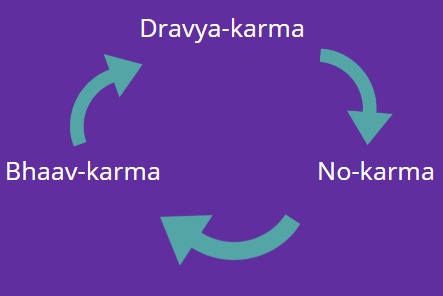
The type of adhyavasaya we experience—whether it's agitated, peaceful, greedy, or compassionate—is determined by which of our eight karmas are currently "rising" or active.
The resource below explains this connection, stating that adhyavasāya are "vibrations in the soul due to active karma."
Soul-Mind-Body Interaction Model of Human Performance
This article, 'Soul-Mind-Body Interaction Model of Human Performance', further clarifies the origin of our inner states, connecting adhyavasaya directly to active karmas.
Please read the section titled 'Lesya' in this article. Pay close attention to the sentence: 'The soul experiences vibrations under the influence of bhava karma. These vibrations are known as adhyvasaya.' This directly links the concept to the activity of our karma.
When a krodha kaṣāya (anger passion) karma rises, it generates angry adhyavasāya. When a lobha kaṣāya (greed passion) karma rises, it generates greedy adhyavasāya. These dispositions are the first stirrings of karmic effect within our consciousness.
3. The Pathway to Action: From Subtle Vibration to Physical Reality
So, a subtle vibration called adhyavasāya occurs deep within the soul. How does this translate into a flushed face of anger, a spoken word of kindness, or a complex decision?
Acharya Mahapragya provides a fascinating model that bridges this gap, integrating ancient Jain concepts with modern physiology. The pathway involves another subtle body, the taijasa śarīra (electric/energy body), and a concept we will explore next: leśyā (psychic coloration).
Preksha Dhyana: Perception of Psychic Colours
Let's return to Perception of Psychic Colours to trace the journey of adhyavasāya as it manifests in the physical body. This section is key to your goal of linking Jain philosophy with science.
Read the sections 'Lesya-Endocrine-Action' and 'Functions of Lesya'. Focus on the chain of command: adhyavasāya (as ultramicro-waves) interacts with the endocrine system, which releases hormones, which in turn influence the neuro-endocrine system (brain/nerves), ultimately shaping our thoughts and actions.
The chain of events described is as follows:
- Adhyavasāya is generated by the interaction of the soul's consciousness and the kaṣāya field.
- These psychic vibrations (described as ultramicro-waves) then pass through the field of Leśyā, which refines them into benevolent or malevolent impulses.
- These impulses directly influence the endocrine system (the collection of hormone-producing glands like the pituitary, thyroid, and adrenal glands).
- The glands release hormones (chemical messengers) into the bloodstream in response to these psychic signals.
- These hormones interact with the brain and nervous system, producing our recognizable feelings, emotions, thoughts, and behavioural patterns.
This model proposes that our most subtle inner states have a direct, causal influence on our biology. A surge of anger isn't just a "feeling"; it originates as a specific type of adhyavasāya that triggers a cascade of hormonal and neurological events.
Test your understanding!
Imagine you are working and suddenly feel a wave of intense irritation towards a colleague for no apparent reason. Using the model we just discussed, try to trace this feeling back to its origin. What might have been the sequence of events?
Show answer
According to the model:
- An old, anger-related karma (krodha kaṣāya) might have "risen" or become active.
- This caused an adhyavasāya of irritation or hostility to be generated in your soul.
- This psychic vibration influenced your endocrine system to release stress hormones (like adrenaline or cortisol).
- These hormones traveled to your brain, creating the conscious, subjective feeling of irritation that you then directed towards your colleague.
The key insight is that the feeling didn't start in your conscious mind; it was the end product of a much deeper psycho-spiritual process.
4. The Possibility of Purity
If our soul is always surrounded by the field of kaṣāya, are we doomed to always produce impure adhyavasāya? How is it ever possible to have a pure intention or a virtuous thought?
Acharya Mahapragya explains that we can indeed generate pure adhyavasāya. This insight forms the very foundation of Preksha Dhyaan.
Preksha Dhyana: Perception of Psychic Colours
This final reading from the same book explains how pure adhyavasāya can be generated, providing the rationale for meditative practice.
Read the section titled 'Emotional Purity'. Note the two ways of counteracting the polluting forces of kaṣāya: objective perception (acting as a spectator) and generating delusion-subsiding waves.
There are two primary ways to generate pure adhyavasāya:
- Becoming a Spectator (Draṣṭā): When the consciousness is purely objective—when it is simply a "knower" or "seer" without any attachment or aversion (like or dislike)—its psychic energy is not polluted by the kaṣāya field. It passes through unchanged, resulting in pure adhyavasāya. This is the core practice of perception in Preksha Dhyaan.
- Generating Counter-Waves: Through specific meditative practices (like contemplation or visualization), one can intentionally generate "delusion-subsiding" waves. These positive waves can neutralize or override the "delusion-producing" waves emerging from the kaṣāya, resulting in a purer emotional state.
This is a profoundly empowering concept. It means that while we are subject to the influence of our past karmas, we are not their helpless victims. Through conscious practice, we can change the quality of our adhyavasāya at its source.
Conclusion
Today we have delved into the subtle but powerful concept of adhyavasāya. It is the bridge between the metaphysical world of soul and karma and the physical world of our brains, bodies, and behaviors.
Key Takeaways:
- Adhyavasāya is the primal psychic expression or mental disposition, created when the soul's energy interacts with the defiling field of kaṣāya (passions) from the karmic body.
- It is more fundamental than conscious thought and exists even in organisms without brains.
- It is both the effect of rising karmas and the cause of new karmic bondage, forming a continuous cycle.
- Adhyavasāya influences our physical body by affecting the neuro-endocrine system, which in turn releases hormones that shape our emotions and actions.
- Through meditative practice, we can purify our adhyavasāya by cultivating objective perception and generating positive psychic energy, thereby breaking the karmic cycle at its root.
Preview of the Next Lesson:
We've now defined adhyavasāya as the root of our mental states. In the next lesson, we will explore a closely related idea: the distinction between conscious and unconscious mental states in Jain thought. We will see how adhyavasāya operates both within our awareness (as conscious intentions) and outside of it (as subconscious drives and tendencies), which is crucial for understanding how karmas can accumulate even when we are not consciously aware of our actions, such as during sleep.