
Hello and welcome back.
In our last lesson, we explored adhyavasāya, the primal psychic disposition that forms at the boundary of the soul and its karmic sheath. We learned that this subtle vibration is the root of our emotions and actions, translating karmic effects into biological reality through the neuro-endocrine system.
Today, we build directly on that foundation. If adhyavasāya is the seed of our mental states, where does it grow? How does it give rise to the thoughts we are aware of, versus the deep-seated urges and habits that seem to operate on their own? This brings us to a fundamental distinction in both modern psychology and Jain thought: the difference between the conscious and unconscious mind.
Our learning outcome for this lesson is to: Describe the difference between conscious and unconscious mental states in Jain thought. Understanding this division is essential to grasp how karma operates beyond our awareness—especially during states like sleep—and to appreciate why the goal of meditation, as taught by Acharya Mahapragya, is to illuminate these hidden depths of the mind.
1. The Two Minds: A Conceptual Overview
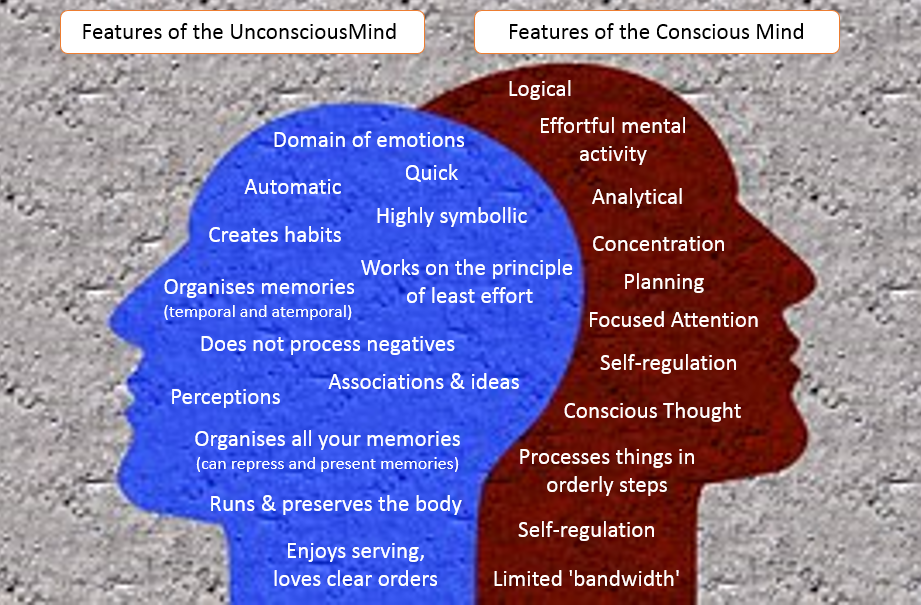
In modern psychology, the mind is often divided into the conscious mind (our current awareness, logical thinking) and the unconscious mind (a vast reservoir of memories, emotions, and primal drives that operate outside our awareness).
Jain philosophy presents a similar, yet more structurally defined model. It posits that what we call the "mind" is not a single entity but an interplay between two distinct, yet interconnected, structures. These structures are made of different kinds of subtle matter, or varganas.
To explore this, we will turn to a text that directly maps these Jain concepts to the language of conscious and unconscious minds.
Jain Dualism-2: Fields and Interactions
The following reading from the paper 'Jain Dualism-2: Fields and Interactions' by Dr. Narayan Lal Kachhara introduces the specific types of subtle energy fields (varganas) that constitute these two aspects of the mind.
First, read the introductory section titled 'Vargana (Energy Fields)'. Note the mention of 'Mano (Mind) vargana' and 'Karman vargana'. Then, read the first paragraph of the section 'Psychical Karma, Conscious Mind and Brain'. Focus on how the text explicitly links these varganas to the conscious and unconscious minds.
Based on this reading, we can establish the core Jain terminology:
- The Unconscious Mind corresponds to the Karma Śarīra (karmic body), which is composed of Karman Vargana. This is the deep, hidden repository of all our past karmic imprints.
- The Conscious Mind corresponds to a structure made of Mano Vargana (mind-matter). In the previous lesson, we referred to its functional aspect as the citta, the "chief psychical executive" that manages our thoughts, speech, and actions in the present.
Let's now examine each of these in more detail.
2. The Unconscious Mind: The Karma Śarīra
The Karma Śarīra is the most subtle body accompanying the soul. It is a dynamic record of all karmas accumulated over countless lifetimes. Think of it not as a static storage drive, but as a living field of information that continuously influences our being.
Here are its key characteristics as the "unconscious mind":
- Vast Repository: It contains the complete record of every action, thought, and intention from all past lives, not just the current one.
- Inaccessible by Effort: The information stored here—the karmic imprints themselves—cannot be recalled through ordinary conscious effort. You cannot "remember" a specific karma from a past life in the way you remember what you ate for breakfast.
- Source of Dispositions: Its influence is felt indirectly. As we discussed in the last lesson, when karmas within the Karma Śarīra mature and "rise," they generate adhyavasāya—the primal urges, feelings, and dispositions that bubble up into our consciousness.
- Holographic Nature: Jain texts suggest this body is holographic, meaning the complete karmic record is present in every part of it, bound to every part (pradeśa) of the soul.
Jain Dualism-2: Fields and Interactions
Let's revisit 'Jain Dualism-2' to further solidify our understanding of the Karma Śarīra as the unconscious mind.
Read the section 'Karma body' for a description of its dynamic nature. Then, read the first two paragraphs of the discussion that begins 'What is the relation between unconscious mind and conscious mind?'. Pay close attention to how it describes the unconscious mind containing all memories and regulating the body unconsciously, leaving the conscious mind free.
This reading clarifies that the Karma Śarīra is the ultimate source of our deepest programming. It unconsciously manages the very blueprint of our body (physiological karma) and also generates the psychic impulses that shape our personality and behaviour (psychical karma).
3. The Conscious Mind: Mano Vargana and Citta
The conscious mind is the aspect of our mentality that we experience directly. It is our internal workspace for navigating the present moment.
Its key characteristics are:
- Current-Life Focus: It primarily deals with information gathered in this life through the senses. Its memory is biographical, not karmic.
- Analytical and Logical: It is the seat of reason, planning, analysis, and decision-making. When you consciously weigh pros and cons, you are using this faculty.
- Limited Bandwidth: Unlike the vast unconscious, the conscious mind can only focus on a few things at once. It operates sequentially.
- Executive Function: As the citta, it directs the brain and physical body to carry out decisions through thoughts, words, and actions.
- Receiver of Impulses: Crucially, the conscious mind is the recipient of the adhyavasāya generated by the unconscious Karma Śarīra. It takes these raw urges and shapes them into recognizable emotions and thoughts.
A repressed impulse, as mentioned in Acharya Mahapragya's Preksha Dhyana, is one that the conscious mind suppresses but which continues to "fester" in the unconscious, only to resurface later.
Test your understanding!
Consider the following mental events. Based on our discussion, would you primarily associate them with the activity of the Conscious Mind (Mano Vargana) or the Unconscious Mind (Karma Śarīra)?
- A sudden, inexplicable feeling of anxiety when entering a new place.
- Mentally rehearsing a presentation for work.
- Having a recurring dream theme you don't understand.
- Deciding which route to take to the grocery store.
Show answer
- Unconscious Mind (Karma Śarīra): The feeling is "inexplicable," suggesting it's not based on conscious logic but is an adhyavasāya (perhaps fear-related) bubbling up from a past karmic imprint.
- Conscious Mind (Mano Vargana): This is a clear example of planning, analysis, and using current-life information.
- Unconscious Mind (Karma Śarīra): Recurring dreams with deep emotional content are often seen as manifestations of unconscious processes or rising karmas seeking expression.
- Conscious Mind (Mano Vargana): This involves logical decision-making based on present-moment data (traffic, time, etc.).
4. Bridging the Gap: The Path of Awareness
In our normal, everyday state, the conscious mind is mostly oblivious to the workings of the unconscious Karma Śarīra. It experiences the effects—the emotions, moods, and urges—without perceiving the cause. This is why we can feel "hijacked" by our emotions or trapped in habitual patterns. We are being driven by karmic forces we do not consciously perceive.
This is where the path of meditation becomes revolutionary. Practices like Preksha Dhyaan are designed to quiet the ceaseless activity of the conscious mind so that it can turn its attention inward. The goal is to develop the capacity to perceive the subtle vibrations of adhyavasāya as they arise, before they become full-blown emotions.
Jain Dualism-2: Fields and Interactions
Let's read a final passage from 'Jain Dualism-2' that speaks directly to this potential for bridging the conscious and unconscious.
Go back to the section that starts 'What is the relation between unconscious mind and conscious mind?'. Read the paragraph that begins 'The conscious mind does not allow access to psychical karma...'. This is a vital point for our course.
The text makes a powerful statement: "if the conscious mind can be silenced, access to psychical karma is possible."
This is the essence of the spiritual project you wish to undertake. By silencing the "noise" of ordinary thought, you create a space to become a "spectator" of the inner world. You can begin to notice the raw psychic energy of adhyavasāya and, through awareness, prevent it from automatically solidifying into karmic bondage. This is the mechanism for transforming consciousness and achieving the nirjara (shedding of karma) you are aiming for, even during states that are normally unconscious, like sleep.
Conclusion
Today we have drawn a clear distinction between the conscious and unconscious mental states as understood in Jain philosophy. This is not just an abstract model; it is a practical map for inner exploration.
Key Takeaways:
- The Unconscious Mind is the Karma Śarīra, a vast, holographic repository of all past karmic imprints. It is inaccessible to normal conscious recall but is the source of our primal dispositions (adhyavasāya).
- The Conscious Mind is a structure of Mano Vargana (whose function is citta). It is a limited, analytical faculty that processes current-life information and is normally unaware of the unconscious karmic forces driving it.
- The interaction flows from unconscious to conscious: maturing karmas in the Karma Śarīra generate adhyavasāya, which are then experienced by the conscious mind as emotions, urges, and thoughts.
- The goal of meditation is to silence the conscious mind's external focus, allowing it to turn inward and gain direct awareness of these deeper, unconscious processes, thereby breaking the chain of automatic karmic reaction.
Preview of the Next Lesson:
Now that we understand that adhyavasāya is the link between the unconscious and conscious, our next step is to look closer at these dispositions themselves. In the next lesson, we will explain the four types of adhyavasāya according to Jain texts. This will allow us to classify the different "qualities" of psychic energy that shape our inner world and drive our actions.