
Hello! Welcome to our next lesson in the module on the mind in Jainism.
In our previous session, we established a critical concept: conventional, unaware sleep (supta nidra) is a state of deep negligence where our unsupervised inner passions can bind new karma. We identified leshyas as one of the key psychic components that remain active during this state.
Today, we will dive deep into this fascinating concept to fulfill our learning outcome: to describe the concept of leshya (psycho-spiritual coloring) and its levels. We will unpack what leshya truly is, explore its six distinct types, and understand how it serves as a "mood ring" for the soul, reflecting our innermost intentions and karmic purity. This understanding is foundational for our ultimate goal of transforming sleep into a conscious, spiritually productive practice.
1. What is Leshya? The Color of the Soul
At its core, Leshya (लेश्य) refers to the psycho-spiritual coloring of the soul. It's not a literal, physical color you can see with your eyes, but rather a subtle vibration or aura that reflects the soul's current disposition (bhāva) and is intricately linked to its karmic load.
Think of it as the immediate consequence of our passions (kaṣāya). When anger, pride, deceit, or greed arise, they don't just exist as abstract thoughts; they tinge the very essence of our consciousness, creating a specific leshya.
To understand this more technically, let's look at the causal chain:
- Soul Vibrations & Karma: As we've learned, the soul vibrates due to the influence of our passions.
- Adhyavasāya (Mental Disposition): These vibrations pass through the karmic body (kārmaṇa śarīra), becoming "colored" by the active karmas. This colored vibration, a raw mental disposition, is known as adhyavasāya.
- Leshya (Psycho-spiritual Coloring): This adhyavasāya then interacts with the tejas śarīra (the luminous body of vital energy). This interaction transforms the disposition into a leshya—a subtle wave or particle that embodies the quality of that disposition.
To grasp this technical flow, let's read a short section from the paper 'JAINA DOCTRINE OF KARMA'. It clearly explains how soul vibrations evolve into adhyavasāya and then into leshya.
Please read the paragraph starting 'The soul vibrates under the influence of passion...' and ending just before 'The adhyasaya themselves form the subtle citta...'. Focus on the sequence: soul vibrations -> colored by Karma body -> adhyvasaya -> interact with tejas body -> lesya.
This process reveals two facets of leshya:
- Bhāva Leshya (Psychic Leshya): The actual state of consciousness, the feeling or disposition itself (e.g., the feeling of anger).
- Dravya Leshya (Material Leshya): The subtle matter or waves produced by that state, which have specific attributes like color, taste, and smell.
This dravya leshya is incredibly important because it acts as the bridge between our subtle inner world and our gross physical body. As the paper you read explains, these leshyas influence our endocrine glands, which secrete hormones that, in turn, affect our emotions, thoughts, and actions. It is the mechanism that connects a karmic state to a physiological reality.
2. The Six Levels of Leshya: The Mango Tree Analogy
Jain philosophy classifies leshya into six primary types, which represent a spectrum of purity from intensely malevolent to perfectly equanimous. These are divided into two groups:
- Three Inauspicious (Aśubh) Leshyas: These are associated with negative qualities and lead to the accumulation of heavy, negative karma.
- Three Auspicious (Śubh) Leshyas: These are associated with positive qualities and lead to lighter karma or the purification of existing karma.
A classic story is used to illustrate these six levels. Imagine six travelers who come across a tree laden with delicious mangoes. Each decides to get the fruit, but their inner disposition—their leshya—dictates how they do it.
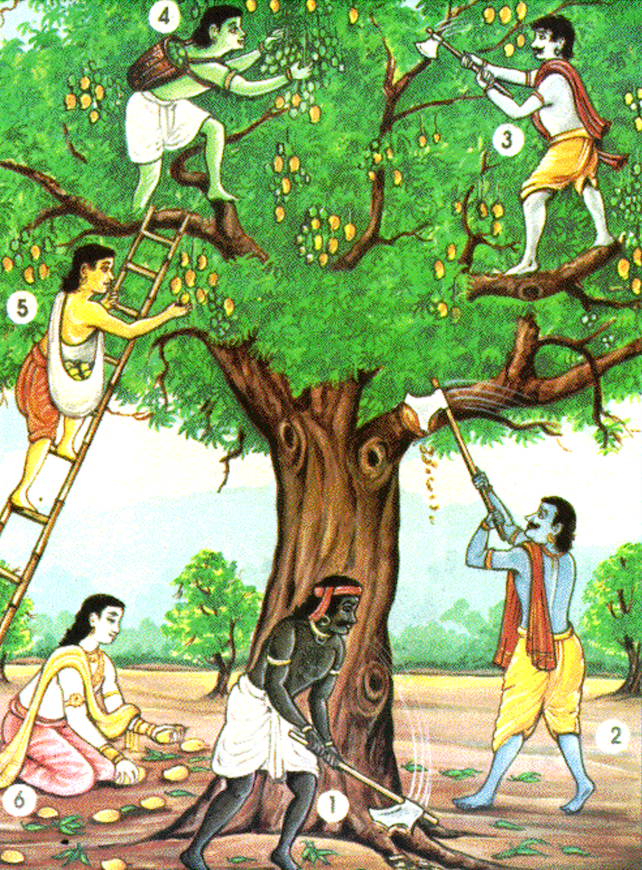
Let's analyze each traveler's action, which corresponds to one of the six leshyas:
-
Krishna (कृष्ण) Leshya (Black): The first person is so ruthless and impatient that he decides to cut down the entire tree to get the mangoes. This represents a state of intense cruelty, anger, and violence, with no thought for the consequences. This is the most inauspicious leshya.
-
Neel (नील) Leshya (Blue): The second person is not quite as destructive but is still driven by extreme selfishness and laziness. He cuts down a large, fruit-bearing branch. This reflects a state of pride, envy, and indulgence.
-
Kapot (कापोत) Leshya (Grey/Pigeon-colored): The third person is characterized by a complaining, anxious, and dejected mindset. He decides to chop off smaller branches to get the fruit, still causing significant harm out of agitation and fault-finding.
-
Tejo (तेजो) Leshya (Red): Here we cross into the auspicious leshyas. The fourth person is more thoughtful. He decides it's better to just cut the smaller twigs that hold the mangoes, avoiding major damage to the tree. This shows discrimination, mindfulness, and a sense of what is right and wrong.
-
Padma (पद्म) Leshya (Yellow/Lotus-colored): The fifth person is even more benevolent. He sees no need to harm the tree at all and simply plucks the ripe mangoes. This reflects a state of compassion, self-control, and gentleness.
-
Shukla (शुक्ल) Leshya (White): The final traveler embodies the highest state of purity. He sees the ripe mangoes that have already fallen to the ground and is content to pick those up, causing zero harm. This represents a state of perfect equanimity, detachment, and non-violence. This is the most auspicious leshya.
3. The Characteristics of Each Leshya
The mango tree analogy gives us a behavioral understanding of the six leshyas. Jain texts further describe them with associated colors, tastes, smells, and psychological qualities.
Leshya Aur Manovigyan - Book Summary
To get a more comprehensive view, let's consult the summary of the book 'Leshya Aur Manovigyan' (Leshya and Psychology). This book's explicit goal is to bridge Jain philosophy with modern psychological understanding.
First, review the summary of Chapter 1, particularly the points on 'Dravya Leshya' and 'Bhava Leshya' and 'auspicious (Shubh) and inauspicious (Ashubh) Leshyas'. Then, read the summary of Chapter 3, focusing on the point 'Leshya Colors with Analogies' which links the colors to psychological states.
Synthesizing what we've learned, here is a summary of the characteristics of each leshya:
| Leshya | Color | Taste | Classification | Core Psychological Traits |
|---|---|---|---|---|
| Krishna | Black | More bitter than poison | Inauspicious | Intense anger, cruelty, violence, mercilessness, lack of compassion. |
| Neel | Blue | More pungent than chili | Inauspicious | Intense pride, envy, deceit, laziness, indulgence, greed. |
| Kapot | Grey | Sour/Astringent | Inauspicious | Sadness, anxiety, fault-finding, complaining, causing pain to others. |
| Tejo | Red | Spicy but pleasant | Auspicious | Humility, righteousness, discrimination between good and bad, carefulness. |
| Padma | Yellow | Sweet like honey | Auspicious | Forgiveness, self-control, compassion, charity, calmness, minimal passion. |
| Shukla | White | Sweet like sugar | Auspicious | Perfect equanimity, detachment, selflessness, purity of thought, meditation. |
This table shows a clear progression. As we move from Krishna to Shukla Leshya, the intensity of negative passions decreases, and the qualities of awareness, control, and compassion increase.

Test your understanding!
A person sees a negative comment about themselves online. Their immediate reaction is a flash of intense anger and a desire to write a scathing, hurtful reply (though they don't). After taking a few deep breaths, they decide it's not worth it, feel compassion for the other person's negativity, and simply delete the comment.
Which leshyas were likely present in this sequence?
Show answer
- The initial flash of intense anger and desire to retaliate is characteristic of Krishna Leshya (Black) or Neel Leshya (Blue), which are dominated by passions like anger and pride.
- The conscious decision to pause, reflect, and then act with compassion represents a rapid shift into the auspicious leshyas, specifically Padma Leshya (Yellow), which is marked by forgiveness and self-control.
This shows that while we may have a dominant leshya, it can fluctuate moment by moment based on our awareness and choices.
Conclusion: Leshya as a Barometer of the Soul
Today we have explored the intricate concept of leshya. We've seen that it's far more than a simple metaphor; it is a core mechanism in Jain psychology that links our deepest intentions to our karmic destiny and even our physiological reality.
Key Takeaways:
- Leshya is the psycho-spiritual coloring of the soul, created when our karmic dispositions (adhyavasāya) are transformed by our vital energy (tejas body).
- It is the bridge connecting the subtle world of karma and the soul to the gross world of the body and actions.
- There are six levels of leshya, ranging from three inauspicious ones (Krishna, Neel, Kapot) driven by intense passions, to three auspicious ones (Tejo, Padma, Shukla) characterized by awareness, control, and compassion.
- Our dominant leshya shapes our personality, but it is a dynamic state that changes with our thoughts and intentions, making transformation possible.
Preview of the Next Module:
Understanding leshya is not just a theoretical exercise. The entire purpose of knowing about it is to learn how to purify it. How do we consciously move from the dark, heavy vibrations of Krishna Leshya towards the pure, tranquil state of Shukla Leshya?
This question brings us to the threshold of our next module, where we will begin our study of Preksha Dhyaan. We will explore the foundational principles and techniques developed by Acharya Mahapragya, such as kayotsarga (relaxation with self-awareness), which are designed specifically to help us perceive and transform these very psycho-spiritual colorings. We will move from knowing what leshya is to learning how to change it.