
Hello! Welcome back to our study of the mind in Jainism.
In our last lesson, we established a foundational principle: awareness is the circuit breaker for karmic bondage. We saw how pramāda (carelessness or unawareness) allows the cycle of karma to perpetuate itself. We concluded by introducing Acharya Mahapragya's crucial distinction between supta nidra (unaware sleep) and jagrit nidra (aware sleep), hinting that conventional sleep is not a neutral state.
Today, we will build directly on that foundation to address our learning outcome: to explain how the lack of awareness during conventional sleep contributes to karmic accumulation from a Jain perspective.
We will go "under the hood" of the sleeping state to understand what is happening internally, according to Jain philosophy, that allows for the binding of new karma even when we are unconscious. This exploration is vital for understanding why practices like Preksha Dhyaan aim to transform the very nature of our rest.
1. The Karmic Cause of Sleep
From a modern scientific viewpoint, sleep is a biological necessity regulated by brain chemistry and circadian rhythms. Jain philosophy offers a complementary, deeper explanation rooted in the theory of karma.
Sleep itself is considered the result of a specific type of karma coming into fruition.
Soul-Mind-Body Interaction Model of Human Performance
To understand the root cause of sleep, please read a passage from the paper 'Soul-Mind-Body Interaction Model of Human Performance.' This will introduce the specific karma responsible for the state of sleep.
First, in the section 'Doctrine of Karma,' find the description of 'Perception-obscuring (Darshanavaraniya) karma.' Note its sub-type '(e-i) Five sleep-related awareness-obscuring karma.' Then, jump to the section titled 'Dreaming' and read the very first sentence. This connects the theory to the actual state of sleep.
As you've just read, the state of sleep is caused by the rise of sleep-type perception-obscuring karma (nidrā darśanāvaraṇīya karma).
The term darśanāvaraṇīya breaks down as:
- Darśana: Perception, intuition, or general awareness. This is one of the soul's innate qualities.
- Āvaraṇīya: Obscuring or veiling.
Therefore, this karma specifically functions to obscure the soul's natural capacity for awareness, plunging it into the state of unconsciousness we experience as sleep. This is not just a passive rest state; it is an active obscuration caused by past karma.
2. The Inner World: What Remains Active During Sleep?
When perception-obscuring karma rises, our connection to the external world via the senses is severed, and our conscious, rational mind goes offline. However, this does not mean all activity ceases. The inner world of the soul remains intensely active.
So, what's still "on" when we're asleep?
Soul-Mind-Body Interaction Model of Human Performance
The 'Dreaming' section of the same paper provides a detailed inventory of the psychic components that remain functional during sleep. This is crucial for understanding how we can bind karma while unconscious.
Please read the first paragraph of the 'Dreaming' section again, this time focusing on what is described as being active. Look for mentions of the soul's intelligence, memories, Deluding karma (passions), and Lesyas.
Based on this reading, here is the cast of characters active in your mind during supta nidra:
- Past Memories & Intellect: The soul's intelligence and ability to access memories are still functional. This is the raw material from which dreams are constructed.
- Deluding Karma (Mohanīya Karma): This is the most powerful and dangerous karma. Its two main components, related to deluded belief and deluded conduct, remain active. This means the passions (kaṣāya)—anger, ego, deceit, greed—and quasi-passions—fear, sorrow, indulgence, etc.—are fully operational.
- Leshya: These psycho-spiritual colorings, which are generated by our karmic state, continue to produce our deep-seated dispositions (bhava) and feelings, independent of conscious thought. We will study leshyas in detail in our next lesson.
- The Unconscious Mind (Achetan Manah): In Jain psychology, this is the repository of past-life memories, instincts, and deep-seated urges generated by our karmic history. This "unconscious mind" is highly active during sleep and has a significant effect on our internal state.
In essence, while the "conscious supervisor" is asleep, the "unconscious factory floor" is running at full capacity, fueled by our deepest karmic conditionings.
3. The Mechanism of Bondage: The Unwatched Mind
Now we can connect the dots. We have an active inner world filled with karmic impulses, and a complete lack of awareness to supervise it. This is the perfect recipe for karmic bondage.
The process follows the cycle we learned about previously, but it all happens internally.
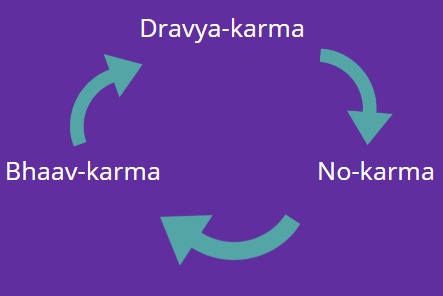
Let's walk through an example:
- Internal Stimulus: During a dream, a memory of a past conflict surfaces.
- Activation of Passions: The latent mohanīya karma (deluding karma) related to anger (krodha) and pride (māna) is activated by this memory.
- Formation of Bhava-karma: The soul, in its state of unawareness, fully identifies with these feelings. It experiences intense anger and resentment within the dream. This internal state of being angry is the bhava-karma (psychical karma). The thought itself is the act.
- Binding of Dravya-karma: This intense mental and emotional state creates vibrations in the soul. These vibrations, charged with passion, attract new particles of physical karmic matter (dravya-karma) which then bind to the soul.
The crucial point, as the resource you read highlights, is that "In the absence of external contacts soul acts in a way as if no one is observing." Without the waking mind's social inhibitions and rational filters, our rawest passions can manifest. A fleeting annoyance in waking life might become a furious, prolonged rage in a dream, leading to an even greater accumulation of negative karma.
Test your understanding!
Imagine a person has a dream about winning a lottery but then losing the ticket. From a Jain perspective, how could this seemingly meaningless dream lead to the bondage of new karma?
Show answer
Even though the event isn't "real," the emotions experienced are.
- Indulgence (Rati): The initial joy of winning the lottery activates the quasi-passion of indulgence, creating a feeling of intense attachment and pleasure. This is a form of bhava-karma.
- Greed (Lobha) & Sorrow (Shoka): When the ticket is "lost," the passions of greed (attachment to the imagined wealth) and sorrow are intensely activated.
- Bondage: Because the person is in an unaware state of supta nidra, their soul fully identifies with these powerful emotions. The resulting vibrations of attachment, greed, and sorrow attract and bind new dravya-karma related to mohanīya karma (deluding karma) and vedanīya karma (feeling-producing karma). The dream may be forgotten, but the karmic stain remains.
Conclusion: Sleep as a State of Deep Negligence
Today we have dissected the state of conventional sleep from a Jain perspective and understood why it is considered a period of significant karmic risk. It is not a passive void, but an active inner space where, without the light of awareness, our deepest karmic patterns run unchecked.
Key Takeaways:
- Conventional sleep (supta nidra) is caused by the fruition of perception-obscuring karma, which veils the soul's natural awareness.
- During sleep, the soul's intellect, memories, deluding karma (passions), and leshyas remain fully active, creating a vibrant inner world.
- Without the supervision of awareness (pramāda), the soul identifies with the thoughts and emotions that arise in this inner world (e.g., in dreams).
- This identification is a form of bhava-karma (psychical karma), which creates vibrations that attract and bind new dravya-karma (physical karmic matter).
- Therefore, conventional sleep is a state of deep negligence where the cycle of karmic bondage continues, driven by our unsupervised internal dispositions.
Preview of the Next Lesson:
We have repeatedly mentioned leshya as a key component of the inner world that is active during sleep. To deepen our understanding, our next lesson will be dedicated to this concept. We will address the learning outcome: Describe the concept of leshya (psycho-spiritual coloring) and its levels. We will explore the six types of leshya—from malevolent black to benevolent white—and see how they act as a "mood ring" for the soul, reflecting our inner purity and shaping our actions and karmic destiny.