Hello! Welcome back to our course.
In our last lesson, we explored a critical question for any new entrant: will the established players in your market fight you or accommodate you? We used a game tree and backward induction to see that by strategically choosing your entry point, you can make "accommodation" the most profitable and logical choice for an incumbent.
Today, we'll build directly on that idea. We're going to analyze the inherent advantages you possess as a small, new firm. Understanding these strengths is the key to crafting the very strategies that make incumbents want to leave you alone. Your size isn't a weakness; it's a strategic asset, and by the end of this lesson, you will be able to analyze the advantages of a small firm (e.g., speed, specialization) when competing with a large incumbent.
1. The Incumbent's Curse: The Innovator's Dilemma
Why would a large, successful company ever choose to ignore a new competitor? It often comes down to a powerful concept known as the "innovator's dilemma." Large companies are optimized to serve their current, most profitable customers with ever-improving products. This focus, while profitable, creates blind spots that a nimble challenger can exploit.
To understand this dilemma from its source, let's watch a short video from the late Professor Clayton Christensen, who coined the term.
Disruptive Innovation Explained
This video from Harvard Business Review features Professor Christensen explaining his groundbreaking theory. He describes why successful companies often fail to catch the next wave of innovation, creating massive opportunities for newcomers.
Please watch from the beginning until the 3:54 mark. Pay close attention to: The definition of 'disruptive innovation.' The 'dilemma' managers face when deciding whether to invest in high-profit existing products or low-profit 'worse' products for new markets. The automotive example of how Toyota disrupted GM, and how Hyundai and Kia later did the same to Toyota.
As Christensen explains, incumbents face a difficult choice:
- Option A: Invest in making better products to sell for higher profits to their best customers.
- Option B: Invest in making "worse" (simpler, more convenient, or cheaper) products that their best customers don't want, for a new market that is currently small and unprofitable.
For a rational manager in a large firm, Option A almost always wins. This is your opening.
Applying this to your woodworking business:
Imagine a large, established custom cabinetry company in your area. Their business is built on high-touch, full-service kitchen remodels for wealthy clients, costing tens or hundreds of thousands of dollars. Your idea to sell premium, precision-milled cabinet doors directly to consumers is a "worse" product in their eyes. It's lower margin, serves a different customer, and doesn't fit their business model. Their rational choice is to focus on their high-end projects and ignore your niche—at least for now.
2. The Challenger's Toolkit: Speed, Focus, and Agility
Knowing that incumbents have these blind spots, how can you specifically take advantage of them? Your small size gives you a toolkit of advantages that are difficult for a large company to replicate. Let's explore some of the most powerful ones.
This next video offers a great overview of different ways a business can differentiate itself. Many of these are natural strengths for a small company.
How Small Business Can Beat the Larger Competition - 10 Winning Strategies for Success
In his video 'How Small Business Can Beat the Larger Competition,' branding expert Philip VanDusen outlines ten distinct strategies. We will focus on the ones that are most relevant to a small challenger.
Please watch the video from 1:35 to 10:46. As you watch, consider how each of the following strategies could apply to your woodworking business: Speed: Delivering faster than the competition. Quality/Specialization: Focusing on doing one thing exceptionally well. Personalization: Offering customized solutions. Adaptability: Quickly changing in response to the market (pay special attention to this one at 9:06).
Let's break down how these advantages play out in your favor:
-
Adaptability and Speed: As the video highlights, this is a crucial advantage for small firms. A large furniture company might take a year to develop and launch a new product line. You, on the other hand, can see a new design trend on Instagram, program it into your CNC machine, and have a prototype ready in a week. This allows you to test ideas, respond to customer feedback, and pivot much faster than an incumbent who is slowed by bureaucracy and legacy systems.
-
Specialization (or "Radical Differentiation"): The video mentions Cinnabon's strategy of doing one thing "insanely well." This is a powerful play for you. Instead of trying to be a full-service cabinet shop, you can become the go-to expert for a very specific product—for instance, minimalist, handle-less doors for IKEA kitchens, or intricate, parametric designs that only a CNC can produce. This focus allows you to build deep expertise and a strong reputation in a niche that's too small for a giant to focus on.
-
Personalization: A large company builds processes for scale, which often limits customization. You can build your process around it. You can talk to every customer, offer custom dimensions down to the millimeter, or experiment with unique wood types they request. This high-touch approach builds strong customer loyalty and is something a large competitor simply cannot afford to replicate at scale.
3. A Unifying Framework: Judo Strategy
There is a strategic framework that elegantly ties all these ideas together: Judo Strategy. The core principle of judo is not to oppose strength with strength, but to use an opponent's size, weight, and momentum against them.
As a business strategy, this means turning an incumbent's greatest strengths—their size, established assets, and brand recognition—into disadvantages.
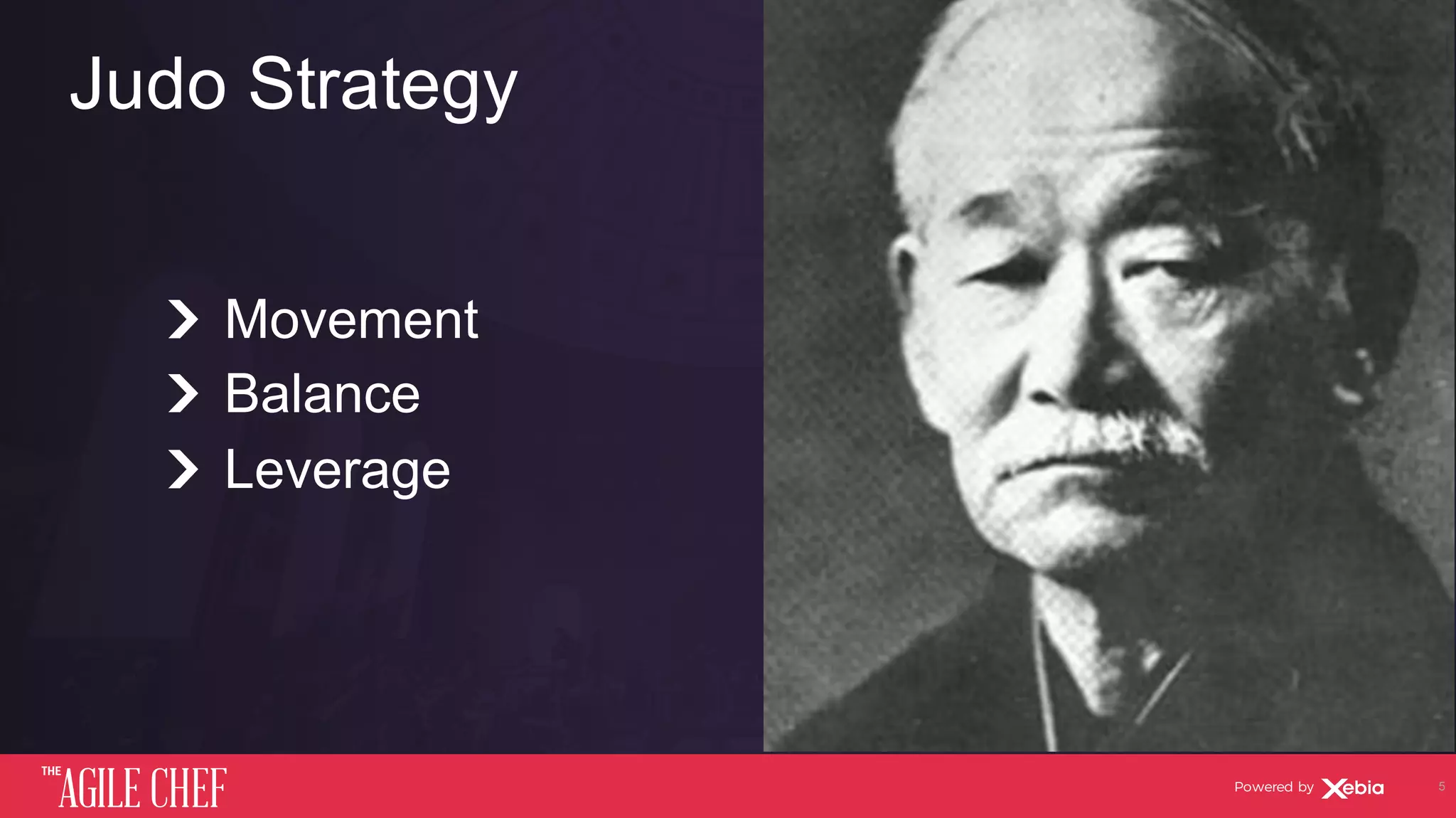
To dig into how this works, we'll read an article that outlines the core techniques of Judo Strategy.
10 Techniques for Beating a Stronger Opponent
The article '10 Techniques for Beating a Stronger Opponent' by David Yoffie and Mary Kwak is the foundational text on Judo Strategy. It translates the principles of the martial art into concrete business tactics.
Please read the following parts of the article: Mastering Movement: Read about the three techniques here, focusing on the 'puppy dog ploy' and 'define the competitive space.' Mastering Balance: Focus on the technique 'avoid tit-for-tat.' Mastering Leverage: Focus on the technique 'leverage your opponent’s assets.' As you read, think about how these apply to your situation. For example, how can an incumbent's large showroom or expensive advertising budget be turned into a weakness?
Let's connect these Judo techniques to your business:
-
Movement (Agility): The "puppy dog ploy" is about keeping a low profile to avoid provoking a massive response. This perfectly complements our discussion in the last lesson about encouraging accommodation. By starting in a small niche, you appear unthreatening. "Defining the competitive space" means you don't play their game. If they compete on full-service installation, you compete on direct-to-consumer e-commerce and fast shipping.
-
Balance (Engagement): The key here is to "avoid tit-for-tat." If a large competitor runs a big sale on their standard cabinets, your instinct might be to match it. Judo strategy advises against this. A price war is a battle of strength, which you would lose. Instead, you should respond asymmetrically—perhaps by highlighting the superior precision of your CNC joinery or offering a new, unique design. You don't match their move; you make a different one that plays to your strengths.
-
Leverage (Using Their Strength Against Them): This is the most powerful principle. An incumbent's assets can become liabilities.
- Brand: If they have a 50-year-old brand known for traditional, handcrafted quality, you can leverage that by positioning yourself as the modern, technology-driven, contemporary choice. Their brand makes it harder for them to compete in your space without confusing their own customers.
- Physical Assets: A large showroom and factory represent huge fixed costs. Your leaner model (perhaps operating from a smaller workshop with online sales) gives you a cost advantage. You can leverage their high overhead against them.
- Processes: Their processes are built for large, slow projects. Your process, built around a CNC machine, is optimized for speed and precision on smaller-batch items. Their strength becomes a weakness when the nature of the competition changes.
Test your understanding!
Imagine a large, established competitor in your region is famous for its "Lifetime Warranty" and extensive, highly-trained installation team. Using the principle of Leverage, how could you turn these strengths into weaknesses for them when you launch your direct-to-consumer business for cabinet doors?
Show answer
Here are a few ways to apply leverage:
- Leverage the Warranty: Their lifetime warranty is supported by high prices and a process designed to minimize service calls. You could reframe this by offering a product that's so simple and well-made that it's easy for a DIYer to install or replace themselves. Your message could be "Why pay for a lifetime warranty when you can have a perfect-fit, easily replaceable product at a fraction of the cost?" You leverage their complex promise into a story about your simplicity and value.
- Leverage the Installation Team: Their team is a massive overhead cost built into their pricing. You can leverage this by celebrating the DIY-ethic. Your marketing can focus on the satisfaction and savings of installing the doors yourself, providing excellent online tutorials and support. You turn their "full service" strength into a "costly and unnecessary" feature for your target customer.
In both cases, you aren't trying to match their strengths; you're creating a new game where their strengths become irrelevant or even burdensome.
Conclusion
Today, we've established why being a small, new firm is a source of strategic power. You are not just a scaled-down version of a large company; you are a different kind of competitor with a unique set of advantages.
Key Takeaways:
- Large, successful companies are often constrained by the Innovator's Dilemma, forcing them to focus on existing high-profit customers and ignore disruptive newcomers.
- As a small firm, your key advantages are speed, adaptability, specialization, and a personal connection to customers—all things that are difficult for large incumbents to replicate.
- Judo Strategy provides a powerful mental model for competing with larger firms by using their strengths against them through the principles of Movement, Balance, and Leverage.
Preview of the Next Lesson:
We've identified your inherent advantages. The next logical step is to put them into action. In our next lesson, we will focus on how to "Formulate a defensible niche market strategy to avoid direct confrontation with established players." We'll take the principles from today and use them to carve out a specific, profitable, and protected space in the market for your woodworking business.