Hello! Welcome back.
In our last lesson, we looked at one of the most aggressive "fight" responses you might face: predatory pricing. We saw how a large incumbent could use below-cost pricing to try and drive you out of the market. This naturally leads to a critical question for any new entrepreneur: when you enter a market, will the established players fight you, or will they accommodate you?
Your ability to anticipate this reaction is fundamental to your success. It shapes everything from the products you choose to offer to the customers you target. Today's lesson is designed to give you a framework for making that prediction.
Our learning outcome is to evaluate when to accommodate new competitors versus fight for market share. We will flip this around to your perspective as the new entrant. You will learn to analyze a competitive situation to predict an incumbent's most likely reaction to your new woodworking business, allowing you to craft a smarter entry strategy.
1. Your Move, Their Move: The Entry Game
When you launch your business, you are initiating a sequential game. This is different from a simultaneous game (like a pricing decision where you and a competitor set prices at the same time without knowing the other's choice). In a sequential game, one player moves first, and the other observes that move and then reacts.
- You Move First: You decide whether to enter the market with your line of premium CNC-milled doors.
- The Incumbent Reacts: An established high-end custom cabinet maker in your area sees your new business. They must now decide how to respond. Will they "fight" (e.g., start a price war, launch a negative ad campaign) or "accommodate" (e.g., do nothing, or adjust their own marketing to emphasize their handcrafted offerings)?
To analyze this, we need a way to visualize the sequence of decisions and their outcomes. This is done using a game tree.
A game tree, or a game in "extensive form," maps out the choices. Each point where a decision is made is a node, and each possible choice is a branch. Let's look at a classic example.
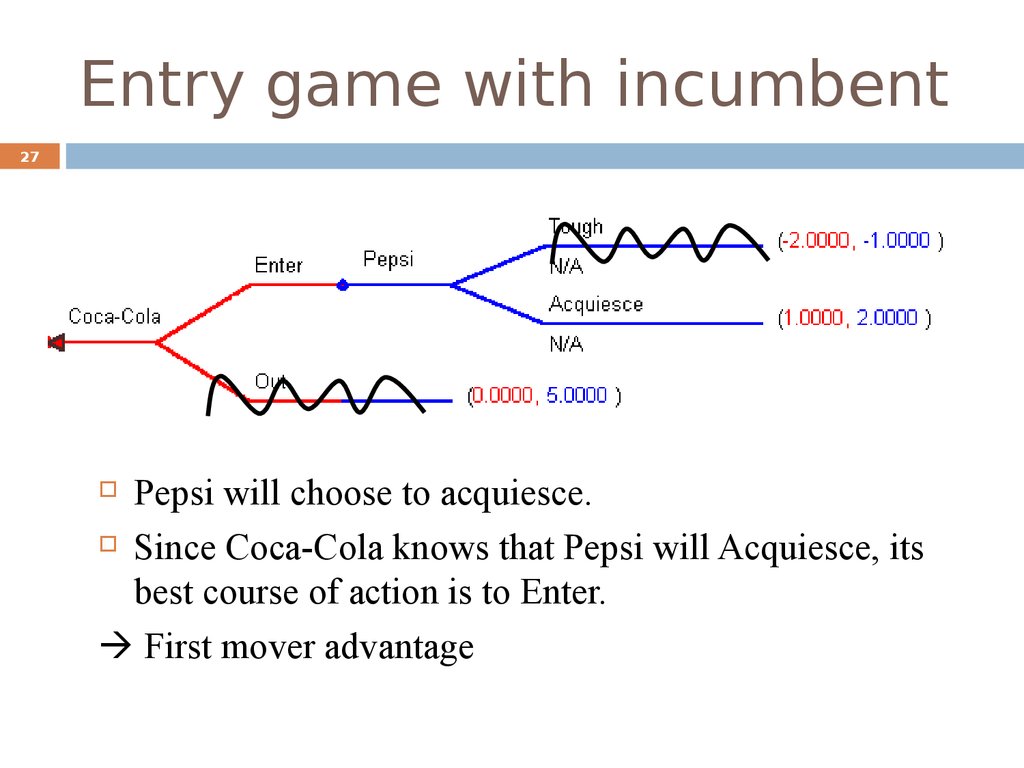
As you can see, the game flows from left to right, showing the logical order of choices and the resulting profit or loss for each player at the end of each path.
2. Predicting the Outcome with Backward Induction
Looking at the game tree, how can Coca-Cola predict what Pepsi will do? And how does that prediction inform Coca-Cola's own decision to enter? The key is to think backward from the end of the game, a powerful technique called backward induction.
To see how this works in detail, we'll consult a text that walks through this exact scenario.
17 Sequential Games - Profit Analytics for Entrepreneurs
To understand how to predict your competitor's reaction, we need a formal tool. The text 'Sequential Games' provides the perfect framework. It introduces the monopolist-entrant game and shows how to solve it.
Please read the sections titled 'Constructing Seqential Games in Normal Form,' 'Constructing Sequential Games in Extensive Form,' and 'Solving Sequential Games Through Backward Induction.' Focus on how the example moves from a confusing matrix to a clear decision tree, and how working backward reveals the incumbent's most rational move.
Let's break down the logic of backward induction as explained in the reading:
- Start at the End: Put yourself in the incumbent's shoes. The entrant (you) has already entered the market. The incumbent now faces a choice: Fight or Accommodate. They will compare the payoffs of these two choices. In the image example, Pepsi compares a payoff of -1 (Fight) to a payoff of +2 (Acquiesce/Accommodate).
- Find the Incumbent's Best Response: A rational incumbent will choose the action that gives them the higher payoff. Here, +2 is better than -1, so Pepsi will choose to accommodate. The "Fight" branch is effectively pruned from the tree because it's an irrational move for the incumbent after the entrant is already in.
- Move to the Beginning: Now, go back to your decision as the entrant. You can now predict with confidence that if you enter, the incumbent will accommodate. So, you compare the payoff of entering (and being accommodated) to the payoff of not entering. In the example, Coca-Cola compares a payoff of +1 (Enter) to a payoff of 0 (Stay Out).
- Find the Entrant's Best Move: Since +1 is better than 0, you choose to enter.
The outcome of the game is: You enter, and the incumbent accommodates. This outcome is called a subgame perfect equilibrium.
The Power of Non-Credible Threats
This analysis reveals a crucial concept: the non-credible threat. The incumbent might threaten a price war to scare you off ("Don't you dare open that shop, or I'll slash my prices and drive you into bankruptcy!"). However, if carrying out that threat would hurt them more than simply sharing the market, their threat is not credible. Backward induction proves this by showing it would be irrational for them to follow through.
Test your understanding!
Let's apply this to your woodworking business. Imagine you're considering entering the premium custom door market. An established incumbent exists. You estimate the following annual profits (in thousands of dollars) for you and the incumbent.
- If you Don't Enter: Your profit is $0. The incumbent's profit is $100.
- If you Enter and the incumbent Fights (starts a price war): You lose $20. The incumbent's profit drops to $30.
- If you Enter and the incumbent Accommodates: Your profit is $40. The incumbent's profit is $70.
Using backward induction, what should you do? What will the incumbent's response be?
Show answer
- Start with the incumbent's decision: If you have already entered, the incumbent compares their profit from Fighting ($30k) with their profit from Accommodating ($70k).
- Incumbent's best response: Since $70k is greater than $30k, the incumbent will accommodate. Their threat to fight is not credible.
- Your decision: You now know that if you enter, you will be accommodated, earning a profit of $40k. You compare this to the $0 profit from not entering.
- Your best move: Since $40k is greater than $0, you should enter the market.
The predicted outcome is that you will enter, and the incumbent will accommodate.
3. Strategy: How to Make "Accommodate" an Easy Choice
The model is clear: an incumbent will accommodate if fighting is too costly or unprofitable for them. The payoffs in the model aren't random; you, the entrant, can influence them through your strategy. Your goal should be to shape the game so that "accommodate" is the obvious and most profitable choice for your competitors.
How do you do that? An excellent article on startup strategy provides practical answers.
The game theory model shows that if fighting is too costly for the incumbent, they will accommodate. So, how do you, as a startup, make fighting an unattractive option for them? This article, 'How startups beat incumbents,' provides brilliant, practical strategies.
Please read the sections 'Address a niche,' 'Be worse but acceptable in most dimensions,' and 'Be low-cost against the profit-center.' Think about how each of these strategies changes the payoffs in the game we just analyzed, making it more likely for an incumbent to accommodate you.
Let's connect these strategic ideas to your woodworking business and the payoffs in our game tree.
-
Address a Niche: The article highlights that incumbents can't afford to target small niches. If the local custom cabinet giant does everything from kitchens to libraries for wealthy homeowners, don't compete head-on. Instead, you could focus exclusively on cabinet doors and fronts for IKEA kitchen systems, targeting design-savvy but more budget-conscious customers. For the incumbent, starting a price war over a market segment they barely serve is a low-payoff move. They are much more likely to accommodate (i.e., ignore) you.
-
Be "Worse But Unique": The incumbent might offer unparalleled hand-finishing and on-site consultation. You can't match that. But your CNC machine offers something they can't: precision, speed, and potentially unique geometric patterns that are difficult to do by hand. You can be "worse" on the dimension of personal service but "unique and better" on the dimension of modern design and turnaround time. This differentiation means you aren't a direct threat to their core business, making accommodation a low-cost, logical reaction.
-
Be Low-Cost Against Their Profit Center: The incumbent likely has a business model with high overhead (large workshop, showroom, sales staff) supporting high-margin, full-project sales. Their pricing for custom doors is part of this model. Your leaner, technology-driven process might allow you to produce a high-quality product at a lower cost profitably. They cannot easily lower their prices to fight you without destroying the profitability of their entire business model. Faced with this, they will likely choose to accommodate you and protect their high-margin core business.
By strategically positioning your business in these ways, you make the payoff of "Fighting" you very low for the incumbent, while making the payoff of "Accommodating" you relatively high. You rig the game in your favor.
Conclusion
Today, we've moved from simply recognizing a fight to strategically avoiding one. By understanding the sequential nature of a market entry game, you can predict and influence how established competitors will react to your new business.
Key Takeaways:
- Market entry is a sequential game, best analyzed with a game tree and backward induction.
- You can predict an incumbent's reaction by analyzing which choice—fight or accommodate—is more profitable for them after you've already entered.
- A threat to fight is only credible if it's in the incumbent's rational self-interest to follow through. An unprofitable war is a non-credible threat.
- Your entry strategy is your most powerful tool. By targeting a niche, differentiating your product, and having an efficient cost structure, you can make "accommodation" the incumbent's most logical and profitable response.
Preview of the Next Lesson:
We're now moving into the next module of the course, "Market Entry and Positioning." In our next lesson, we'll build directly on today's concepts. You will "Apply a game tree and backward induction to analyze your market entry decision," using these tools to map out a concrete strategic plan for your own woodworking venture.