
Hello! Welcome to your second lesson in the Statics module.
In our first lesson, we learned how to draw a Free-Body Diagram (FBD) to isolate a body and identify all the external forces and moments acting on it. This is the crucial first step in analyzing any mechanical system.
Today, we'll build directly on that foundation. Now that we can identify the forces, we need to learn how to work with them mathematically. The learning outcome for this lesson is to resolve forces into components and calculate resultant forces and moments using vector methods. This set of skills will give you the algebraic tools necessary to analyze the FBDs you now know how to create.
Why Vectors are Essential in Mechanics
In your electronics background, you're familiar with quantities like voltage and current, which can often be treated as scalars. However, a force is a vector quantity – it has both a magnitude (how strong the push or pull is) and a direction. Where you apply the force also matters, which gives rise to moments.
To handle these properties, we use vector algebra. This allows us to break down complex, angled forces into a standard coordinate system (like x, y, and z), making them much easier to sum up and analyze.
Part 1: Resolving a Force into Components
The most common way to work with forces is to break them down into rectangular components. For a 2D system, this means finding the equivalent parts of the force that act along the x-axis and y-axis.
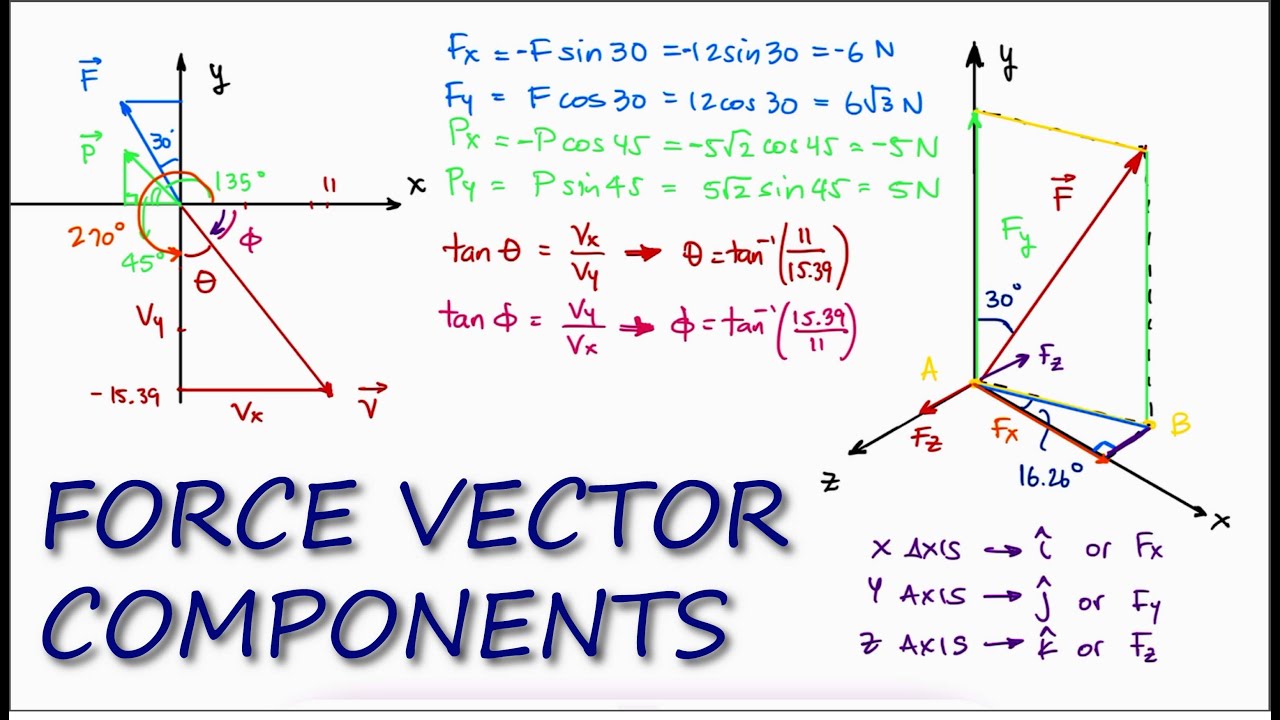
The video below explains this process clearly, showing how to use basic trigonometry to find the components of a force. It also shows how to do the reverse: find the magnitude and direction of a force if you know its components.
Force Vectors and VECTOR COMPONENTS in 11 Minutes! - STATICS
This video from the 'Less Boring Lectures' channel provides a concise explanation of how to decompose 2D force vectors into components.
Please watch from 02:24 to 05:38. Focus on how sine and cosine are used to find the x and y components of a force, and how the Pythagorean theorem and the tangent function are used to go back to the magnitude and direction.
Key Formulas for 2D Force Components:
If you have a force with magnitude and an angle measured from the positive x-axis:
- x-component:
- y-component:
If you have the components and :
- Magnitude:
- Direction: (Be mindful of the quadrant to get the correct angle!)
Test your understanding!
A tow rope is pulling a car with a force of 500 N at an angle of 30° above the horizontal. What are the horizontal () and vertical () components of this force?
Show answer
Using the formulas:
- N
- N
So, the rope is pulling the car forward with a force of 433 N and lifting it upwards with a force of 250 N.
Part 2: Finding the Resultant Force
Most of the time, a body has multiple forces acting on it simultaneously. To simplify our analysis, we often need to find the resultant force, which is the single force that has the same net effect as all the individual forces combined.
The component method makes this straightforward:
- Resolve every force into its x and y components.
- Sum all the x-components to find the x-component of the resultant force: .
- Sum all the y-components to find the y-component of the resultant force: .
- Combine and using the Pythagorean theorem and arctangent to find the final magnitude and direction of the resultant force, .
The following segment of the video you just watched explains this addition process.
Force Vectors and VECTOR COMPONENTS in 11 Minutes! - STATICS
This segment demonstrates how to add multiple force vectors by summing their components.
Please watch from 05:38 to 07:14. Notice the clear, step-by-step process of breaking down each force, summing the components, and then recombining them to find the final resultant vector.
Part 3: Calculating Moments
As we discussed in the last lesson, forces can also create a moment, or a tendency to rotate. Calculating the total moment from all forces is just as important as calculating the total force.
The Scalar Method (2D)
In 2D, the magnitude of a moment () created by a force () about a point (O) is simply the magnitude of the force multiplied by the perpendicular distance () from the point to the line of action of the force.
The direction is either clockwise or counter-clockwise. By convention, we usually consider counter-clockwise moments to be positive.

A very useful principle for calculating moments is Varignon's Theorem. It states that the moment of a force about a point is equal to the sum of the moments of its components about the same point. It's often much easier to find the perpendicular distances for the x and y components than for the original, angled force.
The Vector Method (General, for 2D and 3D)
For more complex 2D problems and all 3D problems, the vector method is superior. Here, the moment vector about a point O is calculated using the cross product of a position vector and the force vector .
Where:
- is the position vector from the point O to any point on the line of action of the force .
- is the force vector, expressed in its component form (e.g., ).
The cross product calculation automatically handles the perpendicular distances and directions, making it a very robust method.
Chapter 4 – Moments and Static Equivalence
For a more detailed look at the formulas, especially the cross product for calculating moments in 3D, this chapter from an engineering statics textbook is a great reference.
Please skim through the sections 'Magnitude of a Moment' (Section 4.2), 'Varignon’s Theorem' (Section 4.4), and 'Moments in Three Dimensions' (Section 4.5). You don't need to read every word, but focus on the main formulas for the scalar moment, Varignon's Theorem, and the cross product \vec{M} = \vec{r} \times \vec{F}.
Part 4: Simplification to a Resultant Force and Moment
The ultimate goal of this lesson is to be able to take a complex system of forces and moments acting on a body and simplify it down to an equivalent system consisting of a single resultant force and a single resultant couple moment acting at a specific point.
The process is:
- Sum all force vectors to get the resultant force: .
- Sum all moments about the chosen point to get the resultant moment. This includes moments from forces () and any existing pure moments (couples). .
The following video shows two excellent worked examples, one in 2D and one in 3D, that put all of these concepts together.
Simplification of Forces and Moments | Mechanics Statics | Solved examples
This video from 'Question Solutions' demonstrates how to replace a system of forces with an equivalent resultant force and couple moment at a specific point.
Please watch the two examples. The first (01:50 - 03:37) is a 2D problem using the scalar method for moments. The second (03:37 - 04:55) is a 3D problem that uses the vector cross product for moments. Notice how the principles are the same in both cases.
Test your understanding!
A 10 N force is applied vertically downwards at the end of a 2-meter-long horizontal cantilever beam (a beam fixed at one end). What is the moment created by this force about the fixed support point?
Show answer
Using the scalar method, the force is 10 N and the perpendicular distance is 2 m.
Nm.
The force would cause the beam to rotate clockwise, so the moment is -20 Nm by convention.
Conclusion
In this lesson, we developed the essential mathematical tools for working with forces and moments as vectors. You now know how to resolve forces, calculate resultants, and compute moments using both scalar and vector methods.
Key Takeaways:
- Forces are vectors that can be resolved into orthogonal components (e.g., , ).
- The resultant force is the vector sum of all individual forces, found by summing the components: and .
- A moment is the turning effect of a force. It can be calculated using the scalar formula (in 2D) or the vector cross product (for 2D and 3D).
- Any system of forces can be simplified to a single resultant force and a single resultant moment at a given point.
Next Lesson Preview:
We have now covered the first two crucial steps of any statics problem: drawing the FBD to identify forces (Lesson 1) and manipulating those forces mathematically (Lesson 2). In the next lesson, we will combine these skills. We will apply the equations of equilibrium ( and ) to the FBDs to solve for the unknown support reactions. This is where we finally get to solve for the forces holding structures together.
Can't find a good explanation? Sign up and we'll make it for you
Sign up