
Welcome to the first lesson of your MBA and product-management transition plan. This opening module establishes a practical GRE system: first understand what the scores mean, then take a diagnostic, identify the causes of missed questions, and build a six-hours-per-week routine around your 2027 Round 1 application timeline.
Today’s focus is deliberately narrow: how the GRE produces its three reported scores and how MBA admissions teams interpret them. This matters because a GRE result is not one undifferentiated “score out of 340.” For an MBA applicant whose academic background is in French rather than a visibly quantitative discipline, the Quantitative Reasoning result can carry particular weight as evidence of readiness for the analytical parts of the MBA curriculum.
The three numbers on a GRE score report
The GRE General Test reports three separate measures:
| Measure | Reported scale | What it broadly assesses |
|---|---|---|
| Verbal Reasoning | 130–170, whole-number increments | Reading, reasoning from text, vocabulary in context, and argument analysis |
| Quantitative Reasoning | 130–170, whole-number increments | Arithmetic, algebra, data interpretation, geometry, and quantitative reasoning |
| Analytical Writing | 0–6, half-point increments | The quality of a timed analytical essay response |
Candidates sometimes add Verbal and Quantitative scores and call the result a “score out of 340.” That sum can be a convenient shorthand in casual conversation, but it is not a separate official GRE measure. MBA admissions teams see and assess the individual Verbal, Quantitative, and Analytical Writing results.
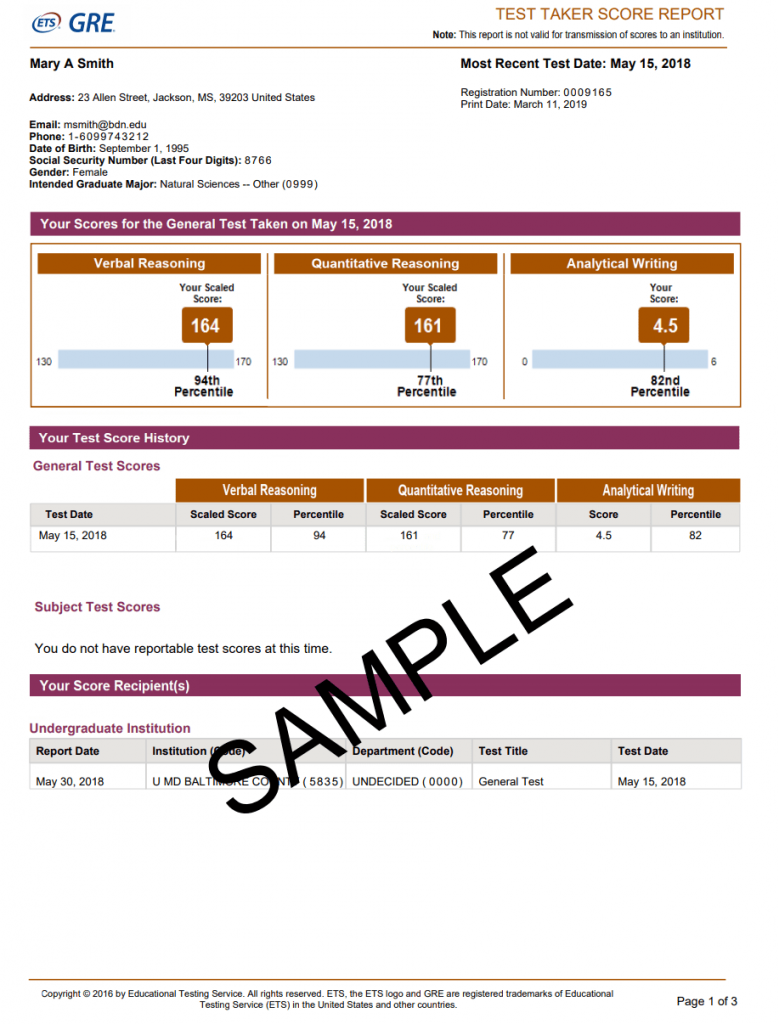
The sample report shows:
- Verbal: 164, 94th percentile
- Quantitative: 161, 77th percentile
- Analytical Writing: 4.5, 82nd percentile
The percentile tells you how a score compares with a reference group of GRE test takers. A 77th percentile Quantitative score means the score was higher than that of roughly 77% of the relevant comparison group. Percentiles can change slightly as ETS updates its reference data, so treat the percentile printed on an actual score report as the relevant one for that report.
A crucial implication follows: a scaled score has meaning within its own measure, not across measures. You should not conclude that a 164 Verbal is simply “three points better” than a 161 Quant. Their percentiles, score distributions, and the applicant populations taking each measure differ substantially.
Understanding Your GRE General Test Scores
Read ETS’s official explanation of how the GRE converts performance into reported scores. This is the authoritative foundation for separating raw scores, scaled scores, adaptive routing, and Analytical Writing scoring.
In the section “How the test is scored,” read the explanation of Verbal and Quant scoring. Focus on the distinction between the number correct and the final scaled score. Then, in the later Analytical Writing paragraph in the same section, read the writing-score overview. Notice that ETS describes this as a holistic judgment of the overall essay, rather than a count of isolated writing errors.
How Verbal and Quantitative scores are produced
Both Verbal and Quantitative Reasoning use section-level adaptivity. In plain terms, your performance in the first scored section of a measure helps determine the difficulty level of the second scored section for that same measure.
For example:
- Your first Verbal section influences the difficulty of your second Verbal section.
- Your first Quant section influences the difficulty of your second Quant section.
- Verbal performance does not determine your Quant section, and vice versa.
This is different from a question-by-question adaptive test. The GRE does not change the next question immediately after each answer. You complete a section, then the system routes you to an appropriate second section.
The score-production logic
For each of Verbal and Quantitative Reasoning, the process is broadly:
- You answer questions in the two operational sections.
- Your raw score is based on the total number answered correctly.
- Your first-section performance affects the level of the second section you receive.
- ETS converts the raw performance into a scaled score from 130 to 170 through a process called equating.
Equating matters because two people may take different versions of the test or receive different second sections. ETS uses equating to make the reported scaled scores comparable despite small differences in test form difficulty and adaptive routing.
Two practical truths matter far more than trying to reverse-engineer the GRE algorithm:
- Every question within a section contributes equally to your raw score. A difficult question is not worth more raw credit than an easier one.
- There is no penalty for guessing. An unanswered question and a wrong answer both earn no credit, so answer every question before time expires.
A strong first section is valuable because it usually gives access to a more difficult second section and therefore a higher scoring opportunity. But there is no useful reason to obsess over supposed exact “score caps” or secret routing thresholds. ETS does not publish a simple formula that lets a test taker reliably convert a number of mistakes into a final score.
How Is the GRE Scored? | Comprehensive Guide to the GRE Algorithm in 2026
Watch these selected excerpts from Target Test Prep GRE’s “How Is the GRE Scored?” for a visual explanation of section-level adaptation, raw scoring, and percentiles. Use it to reinforce the official ETS explanation, not to infer an exact score-conversion formula.
From section adaptivity, focus on why the first section affects the nature of the second section. Then watch raw scoring for the no-penalty-for-guessing rule and equal question weight. Finally, watch percentile interpretation. Pay attention to why the same scaled score can represent a different percentile in Verbal and Quantitative Reasoning.
A useful test-day mindset
The adaptive format rewards consistent accuracy, especially early in each measure, but it does not justify sacrificing easy or moderate questions to chase a single difficult one. Since questions earn equal raw credit, an efficient approach is to secure questions you can solve accurately, make a reasoned guess when needed, and avoid leaving blanks.
Later in the course, you will build specific pacing, skipping, and return rules. For now, retain the central principle:
The GRE rewards the total pattern of correct answers within each measure, adjusted for the difficulty of the sections you received—not heroics on one unusually hard question.
How the Analytical Writing score is produced
The current GRE Analytical Writing measure asks you to write one “Analyze an Issue” essay under timed conditions. Be cautious with old GRE materials: some still refer to a former two-task format that included an “Analyze an Argument” essay. That is no longer the current test format.
Your essay receives one reported Analytical Writing score from 0 to 6 in half-point increments. ETS uses a holistic scoring process: the essay is evaluated for its overall effectiveness rather than awarded points through a simple checklist.
The scoring process incorporates:
- an ETS computerized scoring engine, called e-rater;
- review by trained human evaluators;
- additional quality-control review when the evaluations differ substantially.
At a high level, stronger essays do the following:
- take a clear, defensible position;
- develop that position with relevant reasoning and examples;
- acknowledge complexity or qualification where useful;
- maintain a logical structure;
- use language clearly enough that errors do not interfere with meaning.
Analytical Writing is not primarily a test of literary flair or advanced business knowledge. It tests whether you can construct and communicate a reasoned position under constraints—an ability relevant to case discussions, written assignments, and professional communication.
For MBA admissions, the score is usually less central than Quantitative Reasoning, Verbal Reasoning, work experience, leadership, and career goals. Still, a notably low Analytical Writing result can create an avoidable concern about written communication or analytical organization. A solid score supports the rest of the application; it rarely compensates for weaknesses elsewhere by itself.
How MBA admissions teams use GRE scores
MBA admissions is holistic. The GRE is one component alongside academic record, professional progression, leadership evidence, recommendations, essays, career goals, and interview performance.
Yet “holistic” does not mean “scores do not matter.” Test results help admissions teams answer two practical questions:
- Can this candidate manage the academic demands of the programme?
- How does this candidate compare with others in a competitive applicant pool?
For MBA programmes, Quantitative Reasoning often receives close attention because the curriculum commonly includes statistics, finance, accounting, economics, and data-driven decision-making. Your professional work as a project coordinator and your CSPO certification can support a credible product-management trajectory, but a competitive Quant score can add direct evidence that you are ready to develop the analytical side of that path.
Here is a sensible way to think about each measure.
| GRE measure | What it can signal to MBA admissions | How to interpret it in your situation |
|---|---|---|
| Quantitative Reasoning | Capacity to handle quantitatively demanding coursework | Likely the most important GRE measure to strengthen, because your stated academic history does not itself foreground quantitative study |
| Verbal Reasoning | Ability to read complex material, reason from evidence, and engage with language-heavy work | A potential supporting strength, particularly for an applicant with an advanced humanities background |
| Analytical Writing | Clear, independent analytical communication under time pressure | Important as a credibility check; aim to avoid a score that raises a writing concern |
The Role of GPA and GMAT/GRE Scores | Am I a Competitive MBA Applicant? Part 1
Watch mbaMission’s discussion of academic and test-score evidence in MBA admissions. It provides a useful admissions perspective on why programmes look for quantitative readiness, while also emphasizing that a test score is not the whole application.
Watch quant readiness to understand the academic-risk question admissions teams are trying to answer. Then watch applicant scenarios, focusing on the idea that lower metrics can be mitigated by other evidence but may require a stronger overall case. The examples concern highly selective MBA admissions and should not be treated as universal score cutoffs for UK or European programmes.
Separate scores—not an average—are what matter
A school may publish GRE data in different ways: an average, a median, a range, or occasionally no GRE profile at all. When data are available, compare like with like:
- compare your Quant score with the school’s Quant figure;
- compare your Verbal score with the school’s Verbal figure;
- consider Analytical Writing separately if the school reports it;
- do not average your Verbal and Quant scores to create a number the school has not published.
Published class statistics are descriptive, not guaranteed thresholds. They tell you about a recent incoming class, not the minimum score that earns admission. Applicants below a stated average are admitted; applicants above it are rejected. The more your score falls below a programme’s typical range, however, the more strongly the rest of the application must demonstrate academic readiness, leadership, impact, and fit.
For the UK and European schools you will research later, always rely on each programme’s current official admissions page and class-profile materials. Requirements, accepted tests, reporting practices, and applicant pools can change before your 2027 application cycle.
Reading a score report as an applicant
Return to the sample score report. Its pattern is more informative than its unofficial Verbal-plus-Quant total:
- 164 Verbal / 94th percentile suggests a strong relative Verbal performance.
- 161 Quant / 77th percentile is a good result in absolute terms, but it is less exceptional relative to other GRE Quant test takers than the Verbal score is relative to Verbal test takers.
- 4.5 Analytical Writing / 82nd percentile indicates a solid writing result.
For an MBA applicant, this profile would lead to a targeted question rather than a blanket judgment: is 161 Quant competitive enough for the specific programmes being considered, given the applicant’s academic and professional evidence? If a target school’s typical Quant profile were materially higher, improving Quant would probably be the highest-value testing priority. If it were in line with the school’s profile, the applicant could shift more attention to applications, leadership evidence, and career positioning.
That is the logic you will eventually use with your own diagnostic result:
- Record Verbal, Quantitative, and Analytical Writing separately.
- Note the percentile for each.
- Identify whether Quant is sufficiently strong evidence of quantitative readiness.
- Compare each measure, separately, with the current published data for shortlisted MBA programmes.
- Decide where GRE study time will have the greatest admissions impact.
You do not need a target score today. First, you need a credible baseline obtained under realistic conditions. Setting a target before seeing your starting point encourages vague goals; a diagnostic creates evidence.
Key takeaways
- The GRE reports three distinct scores: Verbal –, Quant –, and Analytical Writing –.
- Verbal and Quant scores come from the number correct across two scored sections, with the second section selected based on first-section performance and the final result equated onto the scaled score range.
- There is no penalty for guessing and no extra raw credit for difficult questions.
- Analytical Writing is a single, holistically scored Issue essay, reported in half-point increments.
- MBA programmes assess GRE results as part of a holistic file, but Quantitative Reasoning is often an important signal of readiness for the numerically demanding MBA curriculum.
- Compare GRE performance measure by measure, not through an unofficial total, and use school-specific current class data rather than universal “safe score” claims.
Next, you will complete an official timed GRE diagnostic under test-day conditions. Its purpose is not to prove readiness on the first attempt—it is to generate the baseline data needed to build an efficient six-hours-per-week plan.
Can't find a good explanation? Sign up and we'll make it for you
Sign up