
Guten Tag! In the previous lesson, you learned that a verb determines the case of its object: jemandem helfen, etwas analysieren, jemandem etwas erklären. Prepositions work on the same governing principle, but the rule is often easier: many prepositions always require one particular case.
This lesson focuses on high-frequency prepositions for university life, formal emails, and academic texts. By the end, you should be able to look at a preposition such as für, mit, wegen, or hinsichtlich and select accusative, dative, or genitive reliably. The next lesson will deal with the separate group of two-way prepositions such as in and auf.
One governing word, one case
In a phrase such as mit dem Dozenten, the noun phrase is not an object governed by the verb. Instead, the preposition mit governs it:
-
Ich spreche mit dem Dozenten.
mit always requires dative. -
Die Universität bietet Kurse für internationale Studierende an.
für always requires accusative. -
Wegen des Streiks findet die Veranstaltung online statt.
wegen requires genitive in standard formal German.
The verb still controls its own objects, while the preposition controls the noun phrase after it. A sentence can contain both:
Die Studentin erklärt dem Dozenten die Situation wegen des Fehlers.
- dem Dozenten is dative because of erklären: jemandem etwas erklären.
- die Situation is accusative because of erklären: etwas erklären.
- wegen des Fehlers is genitive because of wegen.
This distinction prevents a common error: trying to decide the case from the meaning alone. Do not ask whether something sounds like a “recipient,” “place,” or “reason” first. Find the preposition and recall its case pattern.
Read the following short reference from Lingolia before working through the groups below. It establishes the central point: fixed prepositions must be learned as case-governing units.
Prepositions in German Grammar
Read “Prepositions in German Grammar” by Lingolia for a concise overview of how prepositions govern cases, followed by examples of causal prepositions used in formal German.
In the section “Which case to use after German prepositions?”, begin with the paragraph explaining the rule. Read the governing principle, then study the short accusative and dative lists immediately below it. Next, find the subsection “Causal prepositions”. Read the examples with wegen, für, and trotz. Focus on the fact that the meaning may differ—reason, purpose, concession—while each preposition still brings its own fixed case.
Accusative prepositions: a compact core set
The main fixed accusative prepositions are:
| Preposition | Typical meaning | University-related example |
|---|---|---|
| durch | through; by means of | Die Ergebnisse wurden durch eine Umfrage erhoben. |
| für | for | Die Frist gilt für alle Bewerberinnen und Bewerber. |
| gegen | against; approximately | Viele Studierende protestieren gegen den Vorschlag. |
| ohne | without | Ohne einen gültigen Ausweis ist keine Anmeldung möglich. |
| um | around; at; concerning | Ich möchte um eine Verlängerung bitten. |
| bis | until; as far as | Die Anmeldung ist bis nächsten Freitag möglich. |
The most visible forms occur with masculine singular nouns:
- für den Kurs
- ohne einen Termin
- gegen den Beschluss
- durch einen Vergleich
With feminine, neuter, and plural forms, accusative is often identical to nominative:
- für die Prüfung
- ohne das Formular
- gegen die Änderungen
Therefore, do not assume that an invisible ending means that there is no case. The preposition still requires accusative.
Two important academic uses
Für is extremely frequent in applications, presentations, and formal writing:
- Die Informationen sind für die Bewerbung relevant.
- Für einen erfolgreichen Studienbeginn ist eine frühzeitige Planung sinnvoll.
Um often appears in formal requests and administrative communication:
- Ich bitte Sie um eine Rückmeldung.
- Die Studierenden bitten um einen Termin.
- Es handelt sich um ein Missverständnis.
Notice that the verb can also have its own object:
Die Studentin bittet die Mitarbeiterin um eine Auskunft.
Here, die Mitarbeiterin is accusative because bitten takes an accusative object. The phrase um eine Auskunft is also accusative—but for a different reason: um governs it.
For a visual review of these fixed forms and their common meanings, watch the central section of this video.
Alle Akkusativ Präpositionen | All German Accusative Case Prepositions
Watch “Alle Akkusativ Präpositionen” by YourGermanTeacher to consolidate the core accusative prepositions through short, concrete examples.
Watch the examples for für, gegen, ohne, durch, um, and bis. Listen especially for the masculine forms einen Monat, den Plan, and den Park, because they make the accusative visible. Finish with the recap and say the six prepositions aloud without looking at the screen.
A note on bis
Treat bis as an accusative preposition in basic case selection:
- bis nächsten Montag
- bis Ende des Semesters
However, bis often occurs together with another preposition. In that situation, the second preposition determines the visible case:
- bis zum Semesterende
Here, zum is zu dem, and zu requires dative.
Do not try to infer the case only from bis. Look at the entire expression.
Dative prepositions: essential for everyday university German
The most important fixed dative prepositions are:
| Preposition | Typical use | Example |
|---|---|---|
| aus | origin; out of | Die Daten stammen aus einer Befragung. |
| außer | except; besides | Außer dem Haupttext müssen Sie die Quellen angeben. |
| bei | at; during; in the case of | Bei der Anmeldung benötigen Sie Ihren Pass. |
| mit | with; using | Die Gruppe arbeitet mit einer neuen Methode. |
| nach | after; to; according to | Nach der Vorlesung findet eine Beratung statt. |
| seit | since; for a period continuing now | Ich studiere seit einem Jahr in Deutschland. |
| von | from; by | Die E-Mail kam von der Fakultät. |
| zu | to; for | Bitte kommen Sie zu einem Beratungsgespräch. |
Useful additional dative prepositions, particularly in formal texts, include:
- gegenüber: gegenüber dem bisherigen Konzept
- gemäß: gemäß der Prüfungsordnung
- entsprechend: entsprechend den Vorgaben
Recognise the dative forms
Again, masculine and neuter singular forms are most revealing:
| Gender/number | Accusative | Dative |
|---|---|---|
| masculine | für den Kurs | mit dem Kursleiter |
| neuter | ohne das Formular | mit dem Formular |
| feminine | für die Prüfung | nach der Prüfung |
| plural | für die Studierenden | mit den Studierenden |
Remember the additional -n in many dative plural nouns:
- mit den Studenten
- bei den Professoren
- von den Dokumenten
But nouns already ending in -n or -s do not gain another -n:
- mit den Studierenden
- aus den Kursen
- bei den Praktikumsplätzen
Contractions can help—but do not replace grammar
Several frequent dative combinations contract:
| Full form | Contraction | Example |
|---|---|---|
| bei dem | beim | Beim Gespräch wurde die Frist erklärt. |
| mit dem | mit dem | Mit dem Formular reichen Sie den Antrag ein. |
| von dem | vom | Die Bestätigung kommt vom Prüfungsamt. |
| zu dem | zum | Gehen Sie zum Sekretariat. |
| zu der | zur | Ich gehe zur Studienberatung. |
These forms are useful recognition signals: beim, vom, zum, and zur all contain dative. Still, learn the preposition first; contractions are a consequence of the case, not the rule itself.
This video section gives a spoken review of several high-frequency dative prepositions. The examples are mostly everyday situations, but the case patterns transfer directly to formal German.
Master German Prepositions: Top 10 Dative Prepositions You Must Know
Watch “Master German Prepositions: Top 10 Dative Prepositions You Must Know” by YourGermanTeacher to hear common dative prepositions repeatedly in complete sentences.
Watch bei and gegenüber, then continue with mit, nach, seit, and von. If time permits, add zu. Focus less on translating every example and more on noticing that the noun phrase always stays in dative after each preposition.
Genitive prepositions: especially valuable in academic writing
Genitive prepositions occur less often in informal speech, but they appear regularly in academic, administrative, and journalistic writing. Knowing them will improve both your reading accuracy and your formal register.
Start with these high-value patterns:
| Preposition | Function | Formal example |
|---|---|---|
| wegen | because of | Wegen des Bahnstreiks beginnt das Seminar später. |
| trotz | despite | Trotz der knappen Frist wurde der Antrag rechtzeitig eingereicht. |
| während | during | Während des Semesters finden mehrere Prüfungen statt. |
| statt / anstatt | instead of | Statt einer Klausur schreiben die Studierenden eine Hausarbeit. |
| aufgrund | due to; on the basis of | Aufgrund der Ergebnisse wurde die Hypothese angepasst. |
| angesichts | in view of | Angesichts der hohen Kosten ist eine Änderung notwendig. |
| bezüglich | regarding | Bezüglich des Studiengangs habe ich noch eine Frage. |
| hinsichtlich | with regard to | Hinsichtlich der Zulassungsvoraussetzungen gibt es Unterschiede. |
The basic genitive article patterns are:
| Noun type | Example |
|---|---|
| masculine | wegen des Streiks |
| neuter | aufgrund des Ergebnisses |
| feminine | trotz der Frist |
| plural | hinsichtlich der Voraussetzungen |
With masculine and neuter singular nouns, the noun usually takes -s or -es:
- wegen des Termins
- während des Semesters
- aufgrund des Ergebnisses
At this stage, concentrate on recognising and selecting the correct article phrase. You will work systematically on adjective endings in the next lesson, which will make expressions such as trotz der schwierigen Situation and aufgrund eines überzeugenden Arguments much more secure.
The Goethe-Institut overview provides a compact formal-language list and sample phrases.
DEUTSCH ONLINE C1 - Diese Seite steht nicht mehr zur Verfügung.
Read this Goethe-Institut C1 grammar overview to see the three fixed-case groups presented in a formal register similar to academic and professional writing.
Locate the subsection “GRAMMATIK PRÄPOSITIONEN MIT AKKUSATIV, DATIV UND GENITIV”. First read the three lists of prepositions. Then study the example phrases. Identify the article or noun form after each preposition and classify it as accusative, dative, or genitive.
Formal standard versus everyday speech
In everyday spoken German, you may hear dative after wegen, especially when the form is not visibly different:
- spoken: wegen dem Streik
- standard formal writing: wegen des Streiks
For telc C1 Hochschule writing, university emails, and academic texts, use the standard genitive with wegen, trotz, während, aufgrund, angesichts, bezüglich, and hinsichtlich.
This is not merely a rule for sounding formal. It also helps readers see the logical relationship quickly:
- wegen introduces a reason;
- trotz introduces an unexpected contrast;
- aufgrund introduces a reason or basis for a conclusion;
- hinsichtlich / bezüglich introduce the topic being discussed.
A reliable selection routine
When you meet a prepositional phrase in a long sentence, use this short process.
-
Underline the preposition.
In Die Frist wurde aufgrund des Feiertags verlängert, identify aufgrund. -
Decide whether it is fixed or two-way.
For this lesson, the focus is fixed prepositions: aufgrund always takes genitive. -
Recall its stored chunk.
Learn aufgrund + Genitiv, not simply aufgrund. -
Choose the noun phrase.
der Feiertag becomes des Feiertags. -
Read the phrase as one unit.
Say: aufgrund des Feiertags, not individual words separated by an English translation.
A useful notebook format is:
| Chunk | One realistic sentence |
|---|---|
| für + Akkusativ | Ich brauche Informationen für den Zulassungsantrag. |
| mit + Dativ | Ich spreche morgen mit der Studienberatung. |
| nach + Dativ | Nach dem B1+-Kurs wiederhole ich die neuen Wörter. |
| wegen + Genitiv | Wegen des Arbeitsplans lerne ich am Wochenende intensiver. |
| hinsichtlich + Genitiv | Hinsichtlich der Bewerbung muss ich noch Dokumente vorbereiten. |
Because you live in Germany, turn routine encounters into short noticing practice. Read notices at stations, university buildings, offices, and public websites with one question in mind: Which preposition governs this noun phrase? Phrases such as wegen Bauarbeiten, zu Ihrer Information, bei Fragen, and aufgrund technischer Probleme are especially common.
Keep fixed-case and two-way prepositions separate
Do not put in, an, auf, unter, or vor into one of today’s fixed-case lists. These are two-way prepositions. Their case depends on whether the phrase expresses location (Wo?) or a destination/change of position (Wohin?).
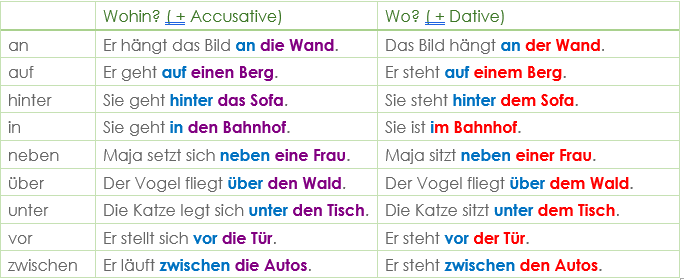
For now, avoid a frequent shortcut: “movement always means accusative.” That statement is only useful for the special two-way group. By contrast, fixed dative prepositions can occur with movement:
-
Ich gehe zu der Bibliothek.
The verb expresses movement, but zu still requires dative. -
Ich fahre nach Berlin.
nach is dative, although the city name has no visible article ending.
The decisive factor is the preposition’s category, not whether the verb describes motion.
Key takeaways
- Prepositions govern the case of the noun phrase that follows them, just as verbs govern their objects.
- Learn prepositions as complete chunks: für + Akkusativ, mit + Dativ, wegen + Genitiv.
- The core accusative group is durch, für, gegen, ohne, um, bis.
- The core dative group is aus, außer, bei, mit, nach, seit, von, zu; formal additions include gegenüber, gemäß, and entsprechend.
- Important academic genitive prepositions include wegen, trotz, während, statt, aufgrund, angesichts, bezüglich, and hinsichtlich.
- In formal C1 writing, prefer standard genitive forms such as wegen des Streiks and trotz der Frist.
- Do not confuse fixed-case prepositions with two-way prepositions. A verb of movement does not automatically require accusative.
Next, you will learn how to choose accusative or dative after two-way prepositions by distinguishing destination and location.
Can't find a good explanation? Sign up and we'll make it for you
Sign up