
Guten Tag! In the previous lesson, you separated fixed-case prepositions such as für + Akkusativ, mit + Dativ, and wegen + Genitiv from the verb’s own objects. This matters now because in, an, and auf do not belong to those fixed groups: they can govern either accusative or dative.
In this lesson, you will learn to choose the case after the nine two-way prepositions (Wechselpräpositionen) by identifying whether a phrase names a location or a destination. This distinction is highly visible in everyday German, but it is also essential when describing campus spaces, research materials, diagrams, and procedures accurately.
The core contrast: position or destination?
The nine two-way prepositions are:
an, auf, hinter, in, neben, über, unter, vor, zwischen
They express a spatial relationship, but the case changes with the meaning of the whole situation:
| Meaning of the prepositional phrase | German question | Case |
|---|---|---|
| A person or object is already at a place | Wo? | Dativ |
| A person or object moves to a destination or is put somewhere | Wohin? | Akkusativ |
Compare these two sentences:
-
Die Studentin arbeitet in der Bibliothek.
She is already there. Wo? In the library. Therefore: dative. -
Die Studentin geht in die Bibliothek.
The library is the destination. Wohin? Into the library. Therefore: accusative.
The preposition remains in. The noun remains die Bibliothek. Only the relationship changes:
- in der Bibliothek
- in die Bibliothek
A useful principle is:
Dativ describes the setting. Akkusativ describes the target position.
Read Deutsche Welle’s compact reference before continuing. It gives the central Wo? and Wohin? distinction and reviews the article forms you need to make the distinction visible.
Lokale Präpositionen (1) | An der Ampel links
Read “Lokale Präpositionen (1)” from Deutsche Welle for a clear grammatical framework. It also reinforces an important point from the previous lesson: not every phrase that answers Wohin? has accusative, because fixed prepositions such as zu still require dative.
In the section “Lokale Präpositionen (1),” first read the opening explanation and the accusative–dative article table. Then read subsection “a) Ortsangabe: Wo …?” and subsection “b) Richtungsangabe: Wohin …?” carefully. Use the location examples to notice the dative forms, then continue to the destination examples. Finally, read the fixed-case contrast: bis zum Bahnhof contains dative because of zu, while in die Hauptstraße is accusative because the street is the destination.
Make the case visible in the article
You already know that German cases are often easiest to recognise through articles. Here are the essential forms after two-way prepositions.
| Noun type | Accusative: destination | Dative: location |
|---|---|---|
| masculine | an den Tisch | an dem Tisch |
| feminine | an die Wand | an der Wand |
| neuter | in das Gebäude | in dem Gebäude |
| plural | zwischen die Gebäude | zwischen den Gebäuden |
Notice two especially important patterns:
-
Masculine and neuter singular: accusative often has den / das, while dative has dem.
- auf den Campus
- auf dem Campus
- in das Seminarhaus
- in dem Seminarhaus
-
Dative plural: the article is usually den, and the noun often receives an additional -n.
- zwischen den Gebäuden
- in den Seminarraum? is accusative singular, but in den Seminarräumen is dative plural.
This is why gender and plural forms should be part of each vocabulary entry. Learn:
- der Campus, die Campus
- der Seminarraum, die Seminarräume
- das Gebäude, die Gebäude
- die Bibliothek, die Bibliotheken
Then the case choice becomes a grammatical decision rather than a guess.
The same campus, two different meanings
Two-way prepositions are best learned in contrast pairs. Read each pair as a small scene: first there is a movement or placement; then there is the resulting position.
| Destination: Akkusativ | Location: Dativ |
|---|---|
| Ich gehe in den Seminarraum. | Ich bin im Seminarraum. |
| Die Dozentin legt die Unterlagen auf den Tisch. | Die Unterlagen liegen auf dem Tisch. |
| Die Studierenden setzen sich an den Tisch. | Die Studierenden sitzen am Tisch. |
| Wir stellen den Stuhl vor die Tür. | Der Stuhl steht vor der Tür. |
| Die neue Cafeteria kommt zwischen die Gebäude. | Die Cafeteria liegt zwischen den Gebäuden. |
| Morgen fahre ich auf den Campus. | Die Beratung findet auf dem Campus statt. |
The rule concerns the location expressed by the prepositional phrase, not simply whether there is an active verb.
For example:
-
Die Studierenden diskutieren in der Mensa.
Discussing is an action, but the Mensa is simply the setting. Therefore: dative. -
Die Studierenden gehen in die Mensa.
The Mensa is the intended destination. Therefore: accusative.
This corrects a common but unreliable shortcut: “movement always means accusative.” Movement is relevant only when it leads to the place named by the two-way preposition.
Compare:
-
Die Studentin läuft auf den Campus.
The campus is her destination: accusative. -
Die Studentin läuft auf dem Campus herum.
She is already on campus and moves around within that setting: dative.
The same distinction appears with in:
- Ich gehe in die Bibliothek, um einen Arbeitsplatz zu finden.
- Ich lerne in der Bibliothek für die Prüfung.
Position verbs and placement verbs
Certain verb pairs make the meaning especially clear. One verb describes an existing position; the other describes putting someone or something into that position.
| Existing position: normally dative | Causing a new position: normally accusative |
|---|---|
| stehen | stellen |
| liegen | legen |
| sitzen | sich setzen |
| hängen | hängen |
Examples:
-
Der Drucker steht neben dem Fenster.
Die Mitarbeiterin stellt den Drucker neben das Fenster. -
Das Buch liegt unter dem Stuhl.
Der Student legt das Buch unter den Stuhl. -
Ich sitze an dem Fenster.
Ich setze mich an das Fenster.
The verb hängen needs particular attention because its present-tense form can look identical:
-
Das Bild hängt an der Wand.
The picture is already there: dative. -
Ich hänge das Bild an die Wand.
I move it and attach it there: accusative.
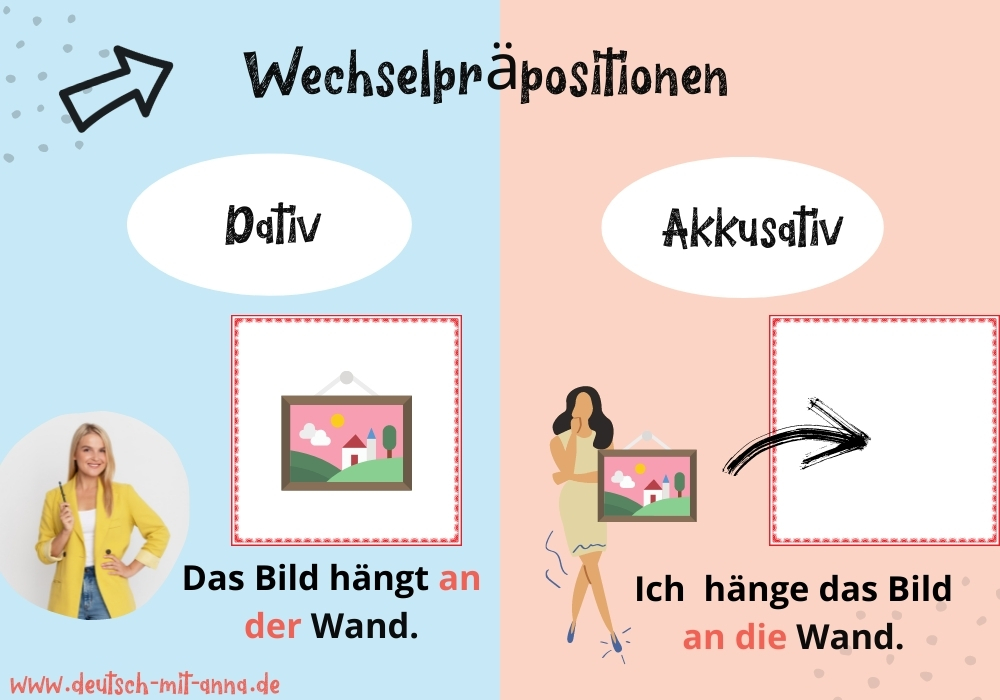
In the perfect tense, standard German often makes this distinction visible:
-
Das Bild hat an der Wand gehangen.
It was hanging there. -
Ich habe das Bild an die Wand gehängt.
I attached it there.
This difference is useful in written descriptions, although the present-tense meaning is usually clear from the context and whether someone actively places the object.
Watch the following parts of the Deutsch1 video to consolidate the contrast visually. The final segment is particularly valuable because it corrects the idea that every verb of motion automatically requires accusative.
"In die Stadt" oder "in der Stadt"? - 🇩🇪 Wechselpräpositionen einfach erklärt
Watch “In die Stadt” oder “in der Stadt”? from Deutsch1. The video provides a visual explanation of all nine prepositions, then examines difficult verb pairs such as stellen/stehen, legen/liegen, and hängen.
Start with the basic framework. Focus on the contrast between in die Stadt and in der Stadt, then listen for the list of all nine two-way prepositions and the contractions ins, im, ans, and am. Next watch the verb pairs; pause after each pair and identify whether the named place is a destination or an existing position. Finish with the destination distinction, which contrasts movement to a place with movement that happens within an already established location.
Contractions: quick case signals
Some preposition–article combinations contract. These forms are frequent in conversation, notices, and university emails.
| Full form | Contraction | Case | Example |
|---|---|---|---|
| in dem | im | dative | im Gebäude |
| an dem | am | dative | am Eingang |
| in das | ins | accusative | ins Labor |
| an das | ans | accusative | ans Fenster |
| auf das | aufs | accusative | aufs Formular |
Thus, contractions can give you a rapid check:
- im Seminarraum contains in dem, so it is dative.
- ins Seminarhaus contains in das, so it is accusative.
- am Schreibtisch contains an dem, so it is dative.
- ans Schwarze Brett contains an das, so it is accusative.
Do not expect contractions with every article:
- in die Mensa
- in der Mensa
- auf den Campus
- auf dem Campus
The case is still there; it is simply not hidden inside a contraction.
A dependable checking routine
When you write or speak, use this short routine before choosing the article.
-
Identify the preposition.
Is it one of the nine two-way prepositions? -
Identify the relevant entity.
Who or what is being located or moved? It may be a person, a book, a chair, a picture, or a campus building. -
Decide whether the named place is a setting or a target.
If the entity is already there, choose dative. If it enters, reaches, or is placed at that position, choose accusative. -
Select the article form.
For example, der Seminarraum becomes im Seminarraum for location and in den Seminarraum for direction. -
Check for dative plural.
If the phrase is plural and dative, check whether the noun needs -n: zwischen den Gebäuden.
Use this routine when you encounter German around you. On a walk through Cologne, silently describe the setting with dative:
- Das Fahrrad steht vor dem Gebäude.
- Die Information ist neben dem Eingang.
- Viele Studierende sitzen in der Mensa.
Then imagine a change of position and reformulate internally with accusative:
- Ich stelle das Fahrrad vor das Gebäude.
- Ich gehe neben den Eingang.
- Die Studierenden gehen in die Mensa.
This kind of brief noticing practice is particularly effective because it connects case forms to visible spaces rather than to isolated translation exercises.
Key takeaways
Two-way prepositions are:
an, auf, hinter, in, neben, über, unter, vor, zwischen
After these prepositions:
-
Use dative for a location or established setting: Wo?
Die Unterlagen liegen auf dem Tisch. -
Use accusative for a destination or newly reached position: Wohin?
Die Dozentin legt die Unterlagen auf den Tisch.
Do not decide based on whether the sentence contains “movement” in general. Ask whether the place named after the preposition is the goal of that movement. A person can move around im Park or auf dem Campus while the phrase still takes dative.
In the next lesson, you will build on these article forms by learning to inflect attributive adjectives correctly after definite articles, indefinite articles, and zero articles.
Can't find a good explanation? Sign up and we'll make it for you
Sign up