
Hello, and welcome to the first lesson in your product-quality ownership roadmap.
This course is designed to help you move from contributing quality evidence to shaping how a product manages quality, risk, release confidence, AI behavior, and security. In this first module, the focus is the change in scope that comes with greater ownership: a QA tester, a quality engineering lead, and a product quality owner all influence quality, but they do so at different levels of responsibility.
By the end of this lesson, you should be able to map these roles across a product lifecycle and explain where responsibility for execution, coordination, and product-risk decisions belongs. Plan for roughly 40 minutes, including the short video and readings.
Quality is not a phase or a single person’s job
A familiar but limiting model treats QA as the team that receives completed work, finds defects, and approves or blocks release. That model creates late feedback: the feature is mostly built before the team discovers whether it meets the real user need, integrates safely, or creates unacceptable operational risk.
In a modern cloud, web, or endpoint product, quality is a shared product capability. Developers build quality into implementation. QA specialists make quality risks visible and testable. Product and engineering leaders decide which risks are acceptable, which must be mitigated, and what evidence is required before release.
This does not mean that everyone is vaguely responsible and no one is accountable. It means each role needs a clear scope.
Quality Assurance in Agile Software
Watch “Quality Assurance in Agile Software” from Modern Software Engineering. Dave Farley gives a useful explanation of why quality work should be embedded in delivery rather than treated as a final release gate.
Begin with built-in quality. Focus on the argument that faster feedback reduces the amount of defective work produced. Then watch the modern QA role, which frames QA as an integrated quality advisor rather than a detached final reviewer. Continue with story kickoff to see how product, engineering, and QA jointly turn a feature into user-centered acceptance scenarios and executable checks.
The important shift is this:
- Testing finds and communicates information about a product.
- Quality engineering leadership establishes the conditions for effective, timely quality feedback.
- Product quality ownership makes quality a product decision, tied to customer impact and business risk.
A defect report is valuable evidence. It is not, on its own, a product-quality decision.
Three roles, three scopes of ownership
Titles differ across organizations. A “QA lead” may be a hands-on senior tester in one company and a people manager in another; a “product quality owner” may be a formal role, a responsibility held by an engineering manager, or a quality leader partnering closely with a product manager.
For this course, treat product quality owner as an operating responsibility: the person accountable for ensuring that product-quality risks, objectives, evidence, and residual-risk decisions are visible and acted upon. It is not a claim that one person personally performs every test or has unilateral authority to deploy.
| Role | Primary scope | Core question | Typical outputs |
|---|---|---|---|
| QA tester / quality engineer | Feature and system evidence | “What happens when real users, data, environments, and failures meet this change?” | Test scenarios, automated checks, exploratory findings, reproducible defects, test evidence |
| Quality engineering lead | Quality system and team effectiveness | “Are we applying the right quality approach, at the right depth, early enough?” | Risk-based test strategy, test approach, quality reporting, automation priorities, team coordination |
| Product quality owner | Product quality outcomes and risk posture | “Given product goals and available evidence, is the remaining risk acceptable?” | Quality objectives, risk decisions, quality investment priorities, release recommendation or documented risk acceptance |
1. QA tester: owns the integrity of quality evidence
The QA tester’s role is not limited to clicking through a completed feature. The tester makes ambiguity, failure modes, usability gaps, integration issues, and operational risks visible early enough to influence the product.
Typical responsibilities include:
- Reviewing stories, acceptance criteria, designs, APIs, and workflows for missing scenarios and unclear behavior.
- Designing and executing manual, exploratory, automated, integration, and regression tests as appropriate.
- Reporting defects with clear reproduction steps, observed behavior, expected behavior, evidence, and risk context.
- Collaborating with developers while work is in progress, rather than waiting for a handoff.
- Maintaining relevant test assets, such as test data, automation suites, environment checks, and traceability where it adds value.
- Investigating production incidents and converting missed scenarios into improved checks or product requirements.
For a cloud-managed endpoint product, a tester might notice that a new device-policy workflow works for one macOS endpoint but behaves poorly when a policy conflicts with an existing configuration. The tester gathers evidence and articulates the risk. They do not independently decide that the organization will accept that behavior for a release.
2. Quality engineering lead: owns the quality system, not every test
A quality engineering lead makes individual QA work add up to a coherent quality approach. This role balances hands-on technical contribution with coordination, coaching, prioritization, and stakeholder communication.
Typical responsibilities include:
- Translating product risk into a test strategy and practical testing priorities.
- Ensuring the team is involved in refinement, design discussions, and development, not only final validation.
- Allocating testing effort across exploratory work, automation, integration coverage, performance checks, and release assurance.
- Improving test environments, CI pipelines, reporting, test data, and feedback loops.
- Tracking quality signals and escalating material risk early.
- Coaching testers and engineers on test design, automation choices, defect communication, and risk thinking.
- Helping coordinate root-cause analysis and improvement after escaped defects or incidents.
The lead should not become a bottleneck who must approve every test case or personally run every critical check. A strong lead creates a system in which the team can repeatedly produce trustworthy evidence.
3. Product quality owner: owns the product-quality conversation and its consequences
The product quality owner works at the boundary between technical evidence and product decisions. Their concern is not simply whether there are open defects. They need to understand which user journeys are affected, how severe the failure would be, what protections exist, and whether the remaining risk is aligned with the product’s goals.
Typical responsibilities include:
- Clarifying what “good enough” means for critical product outcomes before implementation begins.
- Making sure reliability, performance, security, accessibility, usability, compatibility, and supportability receive attention where they matter.
- Ensuring significant quality risks have named owners, mitigation plans, and visible status.
- Challenging false confidence, such as a high automated pass rate that does not cover the riskiest customer workflow.
- Prioritizing quality investment alongside feature work and technical debt.
- Making or facilitating an evidence-based release recommendation.
- Ensuring any accepted risk has an accountable decision-maker, rationale, mitigation, and review point.
A product quality owner does not replace the product manager’s responsibility for market outcomes, the engineering lead’s responsibility for technical delivery, or the release authority’s formal deployment approval. Instead, this role ensures that quality is represented explicitly in all of those decisions.
Map the roles across the lifecycle
The lifecycle is iterative, especially in Agile teams. A release generates customer feedback and operational data, which should reshape the next planning cycle.
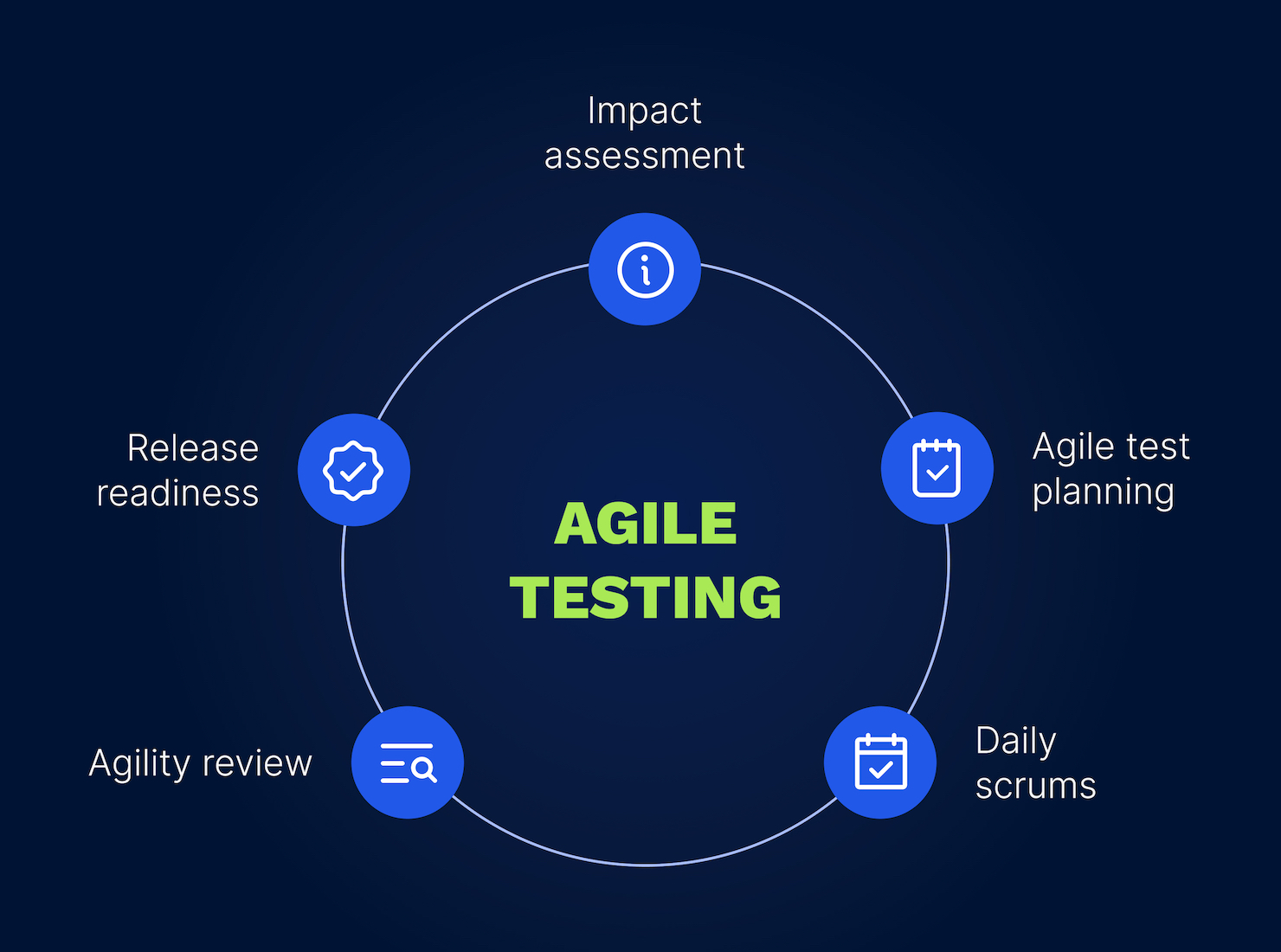
The following map adds a broader product view, beginning before a story enters development and continuing after release.
QA Role in Software Development: Key Responsibilities & Skills
Read the lifecycle overview from testomat.io before studying the role map below. It provides a practical baseline for why QA contributes from early product definition through post-release learning.
In the section “QA Tester Role at Each Stage of the SDLC,” read the five lifecycle subsections in order. Start with Conceptual Blueprinting. Notice that requirements, acceptance criteria, and risk identification are already quality work. Continue with Build Execution and Quality Validation. Finish with Solution Launch and Operational Assurance. Focus on how production feedback should update future test coverage rather than being treated as an isolated support problem.
Role map
| Lifecycle moment | QA tester / quality engineer | Quality engineering lead | Product quality owner |
|---|---|---|---|
| Discover and shape | Challenges ambiguous requirements; identifies user, data, platform, and failure scenarios; raises testability concerns. | Highlights likely quality risks, dependencies, skills, and environments needed to test them. | Connects product goals to quality expectations; identifies unacceptable failure modes and critical customer journeys. |
| Plan and design | Develops examples, acceptance scenarios, test data needs, and test ideas; reviews designs for observable behavior. | Defines the risk-based test approach; plans automation, exploratory testing, environment needs, and team capacity. | Confirms priority quality attributes and makes quality investment trade-offs visible. |
| Build and integrate | Pairs with developers; writes or contributes to automated checks; performs targeted exploratory testing as increments become available. | Removes quality-system blockers; monitors coverage of high-risk work; improves feedback loops and coordination. | Keeps top risks visible; checks that scope changes have not silently changed the quality or risk profile. |
| Validate and learn before release | Executes focused testing; investigates failures; provides accurate, contextual evidence. | Consolidates quality signals; coordinates triage; assesses whether planned coverage and release criteria were met. | Evaluates residual risk against customer and business impact; facilitates recommendation, escalation, or risk acceptance. |
| Release and operate | Performs appropriate smoke checks; investigates incidents and user-reported failures; adds regression protection for misses. | Leads root-cause learning, quality reporting, and process improvement; identifies systemic gaps. | Reviews outcome signals, customer impact, and recurring risks; prioritizes remediation and prevention work. |
This table is not a permission to create handoffs. During a high-risk change, the tester, lead, product manager, developers, security specialist, and operations representative may all need to work together. The table instead clarifies what each role contributes to the shared decision.
What changes between a traditional and iterative delivery model?
The role boundaries remain useful across delivery models, but the timing changes.
In a sequential model, testing may be planned around explicit phases and milestones. A quality lead may prepare a detailed test plan early, and final system testing may occur after a substantial build is available.
In Scrum or continuous delivery, the same quality responsibilities occur more frequently and closer to implementation:
- Risk analysis happens during roadmap, backlog, and story discussions.
- Acceptance scenarios are clarified before coding and refined during development.
- Automated checks run continuously in CI.
- Exploratory testing focuses on new, uncertain, or high-risk behavior.
- Quality reporting needs to be current enough to influence the next decision, not merely describe the previous release.
Certified Tester Advanced Level Test Management Syllabus
Read these selected passages from the ISTQB syllabus to distinguish the testing role from the test-management role, then see how test management changes between sequential and iterative delivery.
In Section 0.11, “What are the Fundamental Assumptions of this Syllabus?”, locate the paragraphs defining the two roles. Read test management, then read the testing role. Focus on the distinction between executing and evaluating tests versus planning, monitoring, reporting, and managing test risk. Next, in Section 1.2.4, “Test Management Activities for Various Software Development Lifecycle Models,” read the introductory paragraph and the comparison table. Pay particular attention to the shifts in estimation, testware, automation, monitoring, and reporting under Scrum.
The product quality owner’s responsibility is especially important in iterative delivery because speed can obscure risk. A team may deploy frequently and still make poor quality decisions if it lacks a shared view of customer impact, coverage gaps, production signals, and risk tolerance.
Frequent releases are not evidence of quality by themselves. They are only valuable when the team can detect problems quickly, limit their impact, and learn from them.
A concrete example: a high-impact endpoint workflow
Consider a feature in a cloud-managed endpoint product: an administrator can apply a new compliance policy to a fleet of managed macOS devices.
The product goal might be to help administrators improve compliance without manual device-by-device configuration. The quality implications include authorization, policy correctness, endpoint compatibility, rollback behavior, auditability, scale, and clarity of admin feedback.
Here is how the three roles should work together during story kickoff:
QA tester / quality engineer
- Asks what happens when a device is offline, has an older agent version, receives conflicting policies, or fails halfway through application.
- Turns these into acceptance examples and focused test scenarios.
- Identifies which tests are suitable for API-level automation, endpoint integration checks, and exploratory investigation.
Quality engineering lead
- Determines that policy correctness and rollback are high-risk areas requiring reliable automated regression coverage.
- Ensures appropriate test environments and representative endpoint versions exist.
- Aligns developers, QA, and operations on signals needed to validate the feature during rollout.
- Makes sure the test scope reflects the risk rather than merely the number of user stories.
Product quality owner
- Clarifies which failures are unacceptable, such as a policy silently reporting success while leaving endpoints in an unknown state.
- Ensures the team has a release plan appropriate to risk, perhaps beginning with a limited rollout and explicit monitoring.
- Reviews quality evidence in terms of customer consequences: “Can an administrator trust the status shown? Can they recover safely if the policy fails?”
- Ensures any remaining known limitation is intentionally accepted, communicated, or removed from scope.
Notice the difference in language:
- The tester says: “This failure occurs under these conditions; here is the evidence.”
- The lead says: “This risk is insufficiently covered; here is the testing and engineering work needed.”
- The product quality owner says: “This residual risk affects a critical administrative workflow; we need mitigation, a reduced rollout, or an explicit accountable decision.”
That progression is a practical model for vertical growth. You retain technical credibility by understanding the evidence, but gain influence by connecting it to product outcomes and decisions.
A simple diagnostic for your current role
When you encounter a quality issue, observe where your current contribution sits:
- Evidence level: Can you reliably describe the behavior, reproduce it, and show its impact?
- System level: Can you explain whether the team’s approach, automation, environments, or planning allowed the issue to escape?
- Product level: Can you explain the customer and business consequence, the residual risk, and the decision required?
All three levels matter. Moving toward quality ownership does not mean abandoning hands-on testing. It means being able to connect a failing test, a gap in the delivery system, and a product-risk decision without losing the distinctions between them.
For a brief practical artifact, choose one current or recent feature and create a three-column note:
| QA tester contribution | Quality engineering lead contribution | Product quality owner contribution |
|---|---|---|
| Evidence and scenarios needed | System, strategy, and coordination needed | Quality objective, risk decision, and stakeholder action needed |
Keep it concrete. Use the actual user workflow, the relevant environments, and the real release constraints rather than generic statements such as “test thoroughly.”
Key takeaways
- Quality is shared across product, engineering, QA, operations, and users, but roles still need distinct scopes.
- The QA tester produces trustworthy quality evidence and provides rapid feedback throughout delivery.
- The quality engineering lead owns the effectiveness of the quality approach: risk-based strategy, team coordination, feedback systems, and improvement.
- The product quality owner ensures that quality is treated as a product outcome and that residual risks lead to explicit, accountable decisions.
- Across an iterative lifecycle, the roles repeat their contributions continuously; QA should not be a final release gate.
Next, you will identify the stakeholders for a sample product and clarify who should have decision rights over quality, risk, and release questions.
Can't find a good explanation? Sign up and we'll make it for you
Sign up