
Welcome back. In the previous lesson, you separated three scopes of work: the QA tester produces reliable evidence, the quality engineering lead improves the quality system, and the product quality owner connects that evidence to customer and business-risk decisions.
This lesson moves from roles to the people and groups around a product. Quality ownership becomes practical only when the team can answer two questions clearly:
- Who needs to be involved because product quality affects them or they affect it?
- Who has the right to recommend, coordinate, approve, constrain, or merely receive a decision?
You will use a sample cloud-managed endpoint product throughout. Plan for about 40 minutes, including two short resources.
A stakeholder is more than a meeting attendee
A quality stakeholder is any person or group with a direct or indirect interest in the product’s quality. That definition is intentionally broad: a stakeholder may use the product, build it, support it, operate it, pay for it, regulate it, or bear the consequences when it fails.
Consider a sample product:
FleetGuard is a cloud service that lets IT administrators apply security and compliance policies to Linux and macOS endpoints. A new feature allows administrators to roll out a removable-media restriction policy gradually, monitor device status, and roll back a failed policy.
A narrow testing view might identify QA, developers, and the product manager. A product-quality view is wider:
- An IT administrator needs the policy status to be accurate; a false success result can leave devices non-compliant.
- An endpoint user can lose access to legitimate workflows if the policy is too restrictive.
- Support needs understandable error states, known limitations, and a recovery path when customers call.
- Operations or SRE needs safe rollout, monitoring, rollback, and an acceptable on-call burden.
- Security and privacy specialists care whether the policy, telemetry, and exception process meet required controls.
- A product manager needs to balance customer value, release timing, and the consequences of known limitations.
- An engineering lead needs technical feasibility, maintainability, and a realistic remediation plan.
- QA and developers need testability, representative devices, evidence, and fast feedback.
The key point is that stakeholder analysis is not an invitation to put everyone in every meeting. It is a way to identify whose knowledge, authority, or exposure must shape specific decisions.
Certified Tester Advanced Level Test Management Syllabus
Read the relevant stakeholder guidance from the ISTQB Certified Tester Advanced Level Test Management Syllabus. It provides a useful baseline list of product-quality stakeholders and introduces a power-interest matrix for deciding how closely to engage them.
In Section 1.2.1, “Test Stakeholders” (pp. 21–22), read the stakeholder roles, noting the distinct interests of product, development, test, operations, customers, and users. Then read Section 1.2.2, “Importance of Stakeholders’ Knowledge in Test Management,” beginning with the power-interest matrix. Focus on how influence and interest change the appropriate level of engagement.
Use power and interest, not job title alone
A stakeholder’s interest is how strongly a decision affects their work, users, or objectives. Their influence is their ability to change scope, allocate people or budget, set policy, approve a release, or escalate a decision.
For FleetGuard, a first-pass map could look like this:
| Stakeholder | Likely interest and influence | What they contribute to quality decisions |
|---|---|---|
| Product manager | High interest, high influence | Customer value, priority, release scope, commercial impact |
| Engineering lead | High interest, high influence | Technical feasibility, remediation cost, delivery and reliability trade-offs |
| Quality engineering lead | High interest, often high influence | Risk-based evidence, test strategy, coverage gaps, quality-system constraints |
| QA tester / quality engineer | High interest, variable formal influence | Reproducible evidence, edge cases, user-journey risks, testability insight |
| Security specialist | High interest and influence for security-sensitive changes | Control requirements, threat insight, policy compliance, security-risk assessment |
| Operations / SRE | High interest, moderate to high influence | Observability, rollback, operational readiness, incident impact |
| Customer administrator | High interest, usually lower formal influence | Workflow reality, usability, compatibility, acceptance feedback |
| Support / customer success | High interest, moderate influence | Likely support load, customer communications, recurring pain points |
| Executive sponsor | Variable daily interest, high influence | Funding, risk appetite, escalation decisions |
The categories can change with the decision. A security specialist may be a contributor for a routine UI change but have binding authority over a proposed exception to a mandatory security baseline. Likewise, an executive sponsor may be merely informed about normal releases but become the accountable risk acceptor when a high-revenue launch carries substantial customer impact.
This is why a stakeholder map should be decision-specific, not a static organization chart.
For quality ownership, make two distinctions especially carefully:
- Users are not the same as buyers. A procurement sponsor may choose the product, while an endpoint administrator experiences whether it is trustworthy and operable.
- Security is not a late testing activity. Security expertise helps the product team define safe behavior early; it does not remove the product team’s ownership of the outcome.

Decision rights: participation is not authority
A common failure mode is saying that “QA, Product, Engineering, Security, and Operations all own quality.” That may communicate shared commitment, but it does not tell anyone who can decide:
- whether a known defect is fixed now or deferred;
- whether a release is limited to a pilot group;
- whether an exception to a security policy is allowed;
- whether a rollback capability is sufficient;
- which quality risk receives engineering investment.
These are decision rights: explicitly assigned authority to make or shape a decision.
A useful vocabulary separates five kinds of involvement:
| Kind of involvement | Meaning |
|---|---|
| Execution | Performs the work or produces evidence. |
| Recommendation | Supplies analysis, options, risks, or a proposed course of action. |
| Coordination | Defines the decision, gathers evidence, convenes the right people, and keeps the decision moving. |
| Approval | Makes the final decision and accepts accountability for its consequences. |
| Constraint authority | Determines whether a mandatory policy, regulatory condition, or safety requirement has been met, or whether a formal exception is valid. |
The last category matters. Do not disguise a mandatory security, privacy, legal, or operational condition as ordinary consultation. If a policy requires security approval for an exception, make that a separate, explicit decision with the appropriate authority.
This does not mean every specialist needs a release veto. It means the organization should state which conditions are mandatory, who interprets them, and how exceptions are approved.
RACI explained its simple yet powerful - The most watched RACI matrix video on YouTube
Watch “RACI explained its simple yet powerful” from the RACI channel for a concise explanation of responsibility, accountability, consultation, and information flow. Use it as vocabulary for spotting unclear ownership, rather than as a rigid organizational model.
Start with responsibility and accountability, which distinguishes performing work from holding ultimate authority. Then watch the RACI definitions. Finish with building and checking a matrix, focusing on the warning signs: no accountable owner, more than one accountable owner, excessive consultation, or no one responsible for execution.
RACI and DACI solve related but different problems
You will create a formal RACI matrix later in the course. For now, use this distinction:
- RACI is useful for recurring work. It clarifies who is Responsible, Accountable, Consulted, and Informed for an activity.
- DACI is useful for a bounded, consequential decision. It clarifies who drives the decision process, who makes the final call, who contributes expertise, and who needs the outcome.
In RACI, Accountable means the person ultimately answerable for the activity or outcome. In DACI, Approver is the single person who makes the decision. The meanings are closely related, but do not assume that the letters transfer mechanically between frameworks.
DACI: A Decision-Making Framework - Team Playbook - Atlassian
Read Atlassian’s DACI playbook to see how a team can assign decision rights without turning every stakeholder into an approver. This is particularly useful for release-risk, quality-investment, and defect-deferral discussions.
In “What is the DACI decision-making framework?”, read the role definitions. Pay close attention to the difference between a Driver, who moves the process forward, and an Approver, who makes the decision. Then read the steps “Assign a Driver,” “Assign both Approvers and Contributors,” and “Assign who needs to be Informed,” from the assignment guidance.
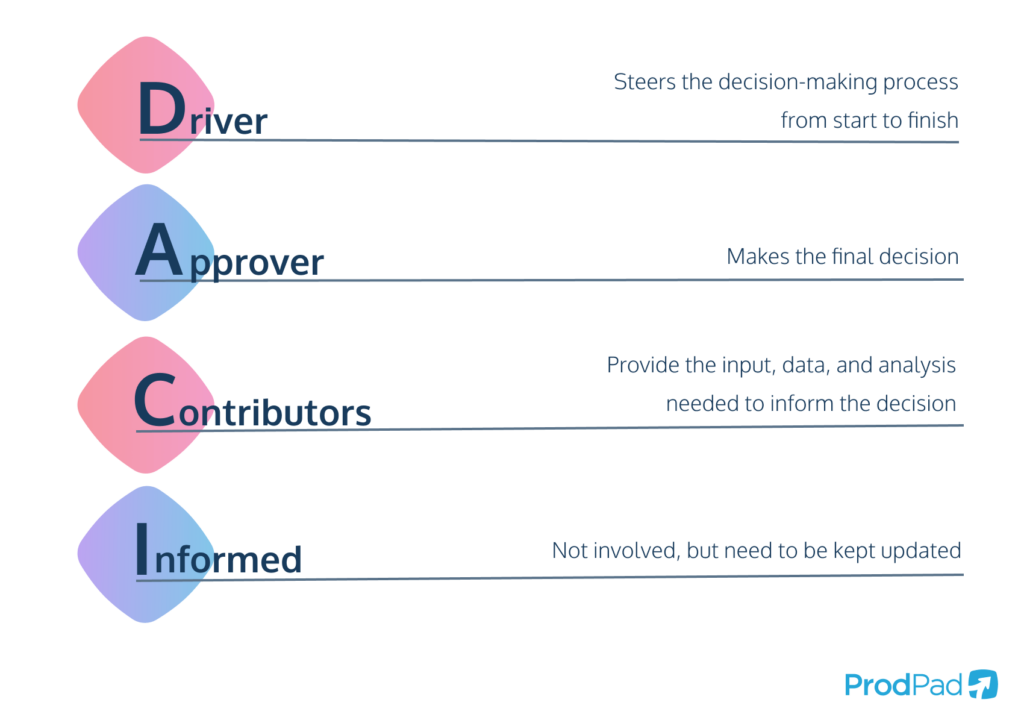
The Driver role is a strong place to grow toward product-quality ownership. Driving a decision means making its scope precise, collecting relevant evidence, exposing uncertainty, and ensuring an accountable person decides by a known date. It does not mean quietly becoming the decision-maker without delegated authority.
Apply DACI to product-quality decisions
The phrase “approve the release” is usually too broad. It bundles multiple decisions that may have different accountable owners.
For FleetGuard, separate the decisions first.
| Decision | Driver | Approver | Contributors | Informed |
|---|---|---|---|---|
| Define acceptable behavior for policy rollout, failure status, and rollback | Product quality owner or quality lead | Product manager | QA, engineering lead, customer administrator, support, security | Delivery team, customer success |
| Decide whether a reported defect is fixed, deferred, or accepted for this release | Product manager | Product manager | QA, engineering lead, quality lead, support | Affected stakeholders and release team |
| Decide whether a security-policy exception is allowed | Security lead or designated security engineer | Security authority named by policy | Product manager, engineering lead, QA, privacy or legal where relevant | Release coordinator, operations, support |
| Decide whether to launch a limited customer rollout after all mandatory conditions are met | Product quality owner or release coordinator | Product manager or designated release authority | QA, engineering lead, SRE, security, support | Sales, customer success, affected customers, leadership |
This is an example, not a universal template. Your organization may give the engineering manager, release manager, or product manager the launch decision. What matters is that the authority is named before the pressure of release day.
Notice what QA contributes to the defect-deferral decision:
- accurate reproduction;
- affected platforms and environments;
- user and operational impact;
- scope of regression risk;
- current coverage and uncertainty;
- evidence that a workaround does or does not work.
QA may strongly recommend “do not release,” but a tester should not be expected to silently absorb the business consequences of a decision they do not have authority to make. Conversely, the final approver should not dismiss evidence without owning the resulting risk.
Split decisions when there appears to be more than one approver
Suppose FleetGuard has a high-severity issue: the new policy may block approved USB-based recovery media on a subset of macOS devices. The product manager wants to meet a customer commitment. Security says the intended policy is necessary. Operations says rollback has not been validated at scale.
It may feel as though Product, Security, and Operations must all approve one decision. Instead, split it:
-
Does the proposed configuration meet the required security baseline?
The relevant security authority decides this, including any formal exception. -
Is rollback and monitoring operationally ready for the proposed rollout size?
The person accountable for operational readiness decides this according to agreed criteria. -
Given those constraints, should the product launch to a defined customer segment on this date?
The named product or release authority decides this business and customer-risk trade-off.
Splitting the decision prevents a vague “everyone must agree” process. It also makes escalation honest: if a constraint is not met, the product launch decision is not a matter of optimism or persuasion alone.
A practical decision record for quality work
For a material quality decision, use a lightweight record. It can live in a ticket, release document, or decision log.
| Field | Example for FleetGuard |
|---|---|
| Decision statement | Decide whether to release the removable-media policy to 10% of eligible customers. |
| Decision date | Tuesday, before the planned rollout window. |
| Driver | Product quality owner. |
| Approver | Product manager, after mandatory security and operational conditions are confirmed. |
| Contributors | QA, engineering lead, SRE, security engineer, support lead. |
| Informed | Customer success, sales, leadership, pilot customers. |
| Evidence required | Endpoint compatibility results, rollback test evidence, open-defect assessment, monitoring readiness, security review result. |
| Constraints and escalation | No rollout if rollback is unverified or a mandatory security control is unmet; exceptions require the designated authority. |
| Outcome | Release, reduce scope, defer, or release with documented risk acceptance and review date. |
The record transforms a subjective discussion such as “testing looks okay” into a decision with evidence, ownership, and a visible consequence.
A quality owner can drive this conversation using direct language:
- “The decision is whether we launch to 10% of customers, not whether the feature is generally finished.”
- “The current evidence covers macOS versions A and B; version C remains unverified.”
- “Rollback was validated on ten devices, not at the intended production scale.”
- “The remaining risk is customer lockout during recovery. The approver needs to choose between mitigation, reduced scope, or documented acceptance.”
That is a shift from reporting test status to enabling a responsible product decision.
Audit the map before relying on it
Before accepting a stakeholder and decision-rights map, check for predictable weaknesses:
- More than one final approver. This creates deadlock or hidden power struggles. Split the decision if distinct authorities are involved.
- No identified Driver. The decision may drift until release pressure forces a rushed answer.
- QA listed as accountable merely because QA found the issue. Evidence ownership is not automatically business-risk ownership.
- Security, privacy, or operations invited only at the end. Late involvement turns essential constraints into expensive surprises.
- Customers and support omitted. The team may technically ship a feature that creates confusing, costly, or unworkable customer outcomes.
- Too many Contributors. Consultation should bring expertise, not create a standing committee for every decision.
- No escalation path. A team needs to know what happens when evidence is incomplete or when a mandatory condition is disputed.
- No review date for accepted risk. A temporary exception can otherwise become an invisible permanent weakness.
For a current feature at work, a useful 15-minute preparation activity is to write one decision statement, list the stakeholders, and assign DACI roles. Keep the decision narrow enough that one person can genuinely approve it. Add the evidence required and any mandatory constraints before discussing release status.
Key takeaways
- Quality stakeholders include everyone who affects product quality or experiences its consequences: users, customers, product, engineering, QA, operations, support, security, and sometimes legal or executive leadership.
- A power-interest view helps determine who should collaborate closely, whose expertise is needed for particular decisions, and who mainly needs timely communication.
- Shared quality ownership does not mean shared final authority. Decision rights must distinguish execution, recommendation, coordination, approval, and mandatory constraints.
- Use DACI for a consequential, bounded decision: one Driver coordinates, one Approver decides, Contributors provide expertise, and Informed stakeholders receive the outcome.
- The product quality owner often adds the most value as a Driver: turning vague quality status into a clear decision, evidence set, risk statement, and accountable outcome.
Next, you will connect product strategy to quality ownership by translating product goals into measurable quality objectives.
Can't find a good explanation? Sign up and we'll make it for you
Sign up