
Hello, and welcome. This course is about making memorisation faster by replacing study habits that feel productive with retrieval methods that reveal—and strengthen—what you can actually produce under test conditions.
This first module focuses on a foundational distinction: material can feel familiar when you see it, yet still be unavailable when you need to explain it from a blank page. In this lesson, you will test the same English or psychology material twice: first with cues, then with no cues. The difference is useful data, not a verdict on your ability.
By the end, you should be able to identify whether a task tests recognition, cued recall, or unaided recall, and use that distinction to judge what you genuinely know.
Familiarity is not retrieval
Suppose you read this psychology sentence:
Recognition occurs when you identify information you have encountered before.
A few minutes later, you see:
Recognition occurs when you ______ information you have encountered before.
You can probably supply identify. That is cued recall: you still have to generate the answer, but the sentence structure and surrounding words guide you.
Now consider this:
What is recognition in memory research?
Answering it requires unaided recall. You must locate and produce the idea with little or no help. This is closer to what happens in an essay question, a spoken explanation, or the moment you need evidence for an English paragraph and your notes are unavailable.
Finally, consider a multiple-choice question:
Which term means identifying information encountered previously?
A. Recognition
B. Rehearsal
C. Encoding
D. Interference
This is recognition. The correct term is present in front of you; your job is to identify it among alternatives.
The three formats demand different things:
| Test format | What is provided? | What you must do | Typical example |
|---|---|---|---|
| Recognition | The answer itself, among options | Identify the studied/correct item | Multiple choice; matching |
| Cued recall | A prompt or partial clue | Produce the answer | Flashcard question; sentence completion |
| Unaided recall (or free recall) | No meaningful prompt beyond the broad topic | Generate material independently | Blank-page plan; essay response |
Recognition is not useless. It can tell you that an idea is familiar. But it is a weak check of whether you can independently deploy that idea in an exam answer. The practical error is treating “I knew it when I saw it” as equivalent to “I could produce it when I needed it.”
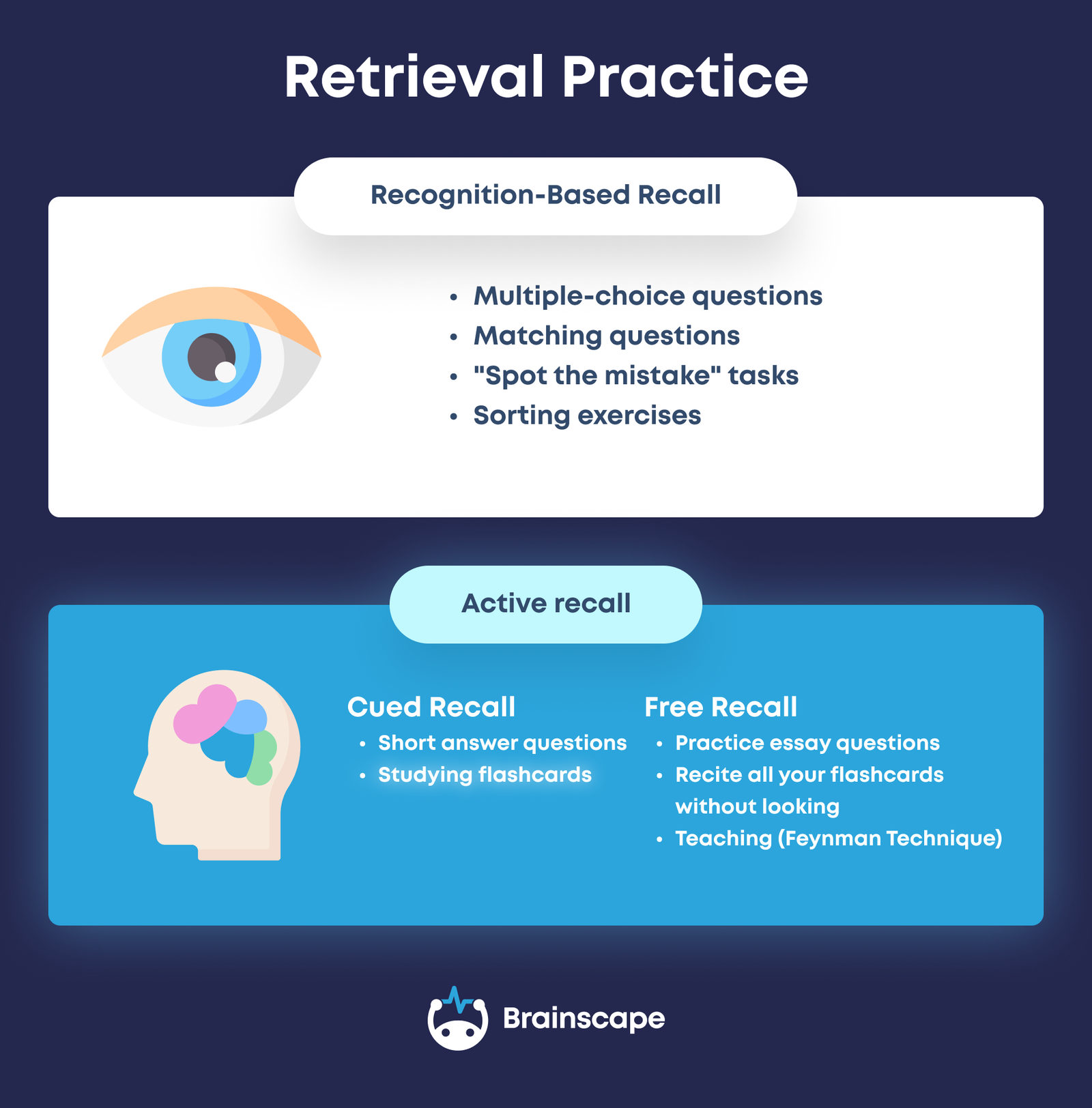
A short conceptual anchor
The language used in psychology is quite precise: retrieval means bringing stored information back into conscious awareness. Recall and recognition are two ways of doing that, but they make different demands on memory.
Retrieval: Free recall, cued recall, and recognition | MCAT | Khan Academy
Watch “Retrieval: Free recall, cued recall, and recognition” by khanacademymedicine. It gives a compact demonstration of the three formats and why performance usually rises as cues become more complete.
Watch the overview for the three retrieval methods. Then watch free recall, noticing that the learner must generate studied items with no hints. Continue through cued recall and recognition. Focus less on the word-list details and more on what each format gives the learner: no clue, a partial clue, or the full answer.
A useful rule is:
The more of the answer the question displays, the less you learn about your ability to produce it unaided.
This does not mean every study session should begin with the hardest possible test. Cues can be helpful while building memory. It means you should not use an easy, cue-rich performance as proof that you are ready for a cue-poor task.
For English, a quote on a revision sheet may be instantly recognisable, while recalling its exact wording, speaker, scene, and analytical use may be much harder. For psychology, seeing “encoding specificity” in a glossary may feel obvious, while defining it accurately and applying it to an example may expose a gap. Those gaps tell you exactly what needs practice.
Retrieval – General Psychology
Read “Retrieval – General Psychology,” which defines recall and recognition in a way that maps directly onto common assessment formats.
In the section “Types of Retrieval,” read the retrieval distinction. Begin with the brief explanation of why cues work, then follow the definitions through the essay-test and multiple-choice examples. Keep one question in mind: in each example, is the answer absent and being produced, or already visible and being identified?
The paired-test method: test the same material two ways
You now need a method that produces a fair comparison. Do this with a small, recent piece of material—not a whole chapter. Choose one of the following:
- an English paragraph containing a claim, quotation, and analysis;
- a psychology subsection containing three to five connected ideas;
- a set of class notes about one concept or study.
Aim for five to eight testable facts or ideas. For example, a psychology passage might contain:
- A definition of recall
- A definition of recognition
- An essay-test example
- A multiple-choice example
- One reason recognition may feel easier
An English passage might contain:
- A central claim about a character or theme
- A short quotation
- The speaker or context
- A language feature
- The interpretation of that feature
Before testing, spend a few minutes studying the material normally. Then close the source. The comparison works only if you test the same target information in both conditions.
Round 1: a cue-rich test
Use questions that show you much of the pathway to the answer. Examples:
Psychology
- Recall means accessing information without ______.
- Which test primarily uses recognition: essay or multiple choice?
- Recognition involves identifying information after ______ it again.
English
- Complete the quotation: “_____ is a ...”
- Who says this quotation: Character A, B, or C?
- Match the quotation to its theme: ambition, isolation, or conflict.
Record each response using a simple code:
- C — correct and specific
- P — partly correct, vague, or incomplete
- I — incorrect, guessed, or blank
Do not count a lucky multiple-choice guess as secure knowledge. Mark it as P unless you can state why the correct option is right and why your choice was not merely a guess.
Round 2: an unaided-recall test
Put away the cue-rich questions as well as the source. Set a timer for three to five minutes. At the top of a blank page, write only the broad topic, such as:
- “Retrieval: recall versus recognition”
- “Lady Macbeth: ambition”
- “Attachment theory: key claims”
Then write everything relevant that you can produce: definitions, quotations, contexts, claims, studies, analytical links, examples, or distinctions. Do not pause to make it elegant. This is a memory test, not a writing-quality test.
The key condition is that the page gives you no prompts such as headings, sentence stems, answer options, or first letters. If you use “definition,” “example,” and “comparison” as headings, that becomes a cued brain dump—not fully unaided recall. That can still be useful later, but label it honestly.
Here is what a compact comparison might look like:
| Target | Cue-rich test | Unaided recall | Diagnosis |
|---|---|---|---|
| Definition of recognition | C | C | Secure |
| Essay test uses recall | C | P | Familiar, but not yet fluent |
| Multiple-choice uses recognition | C | I | Recognition was masking a gap |
| Why recognition feels easier | P | I | Needs relearning and retrieval practice |
| English quotation | C | P | Partial retrieval; exact wording unstable |
This table is more valuable than a single score. It identifies what kind of help your memory needed.
How to interpret the gap
Most people will score better with cues than without them. That result is expected. The important question is the size and pattern of the gap.
Small gap: the material is available
If you can produce most ideas unaided and your wording is reasonably accurate, you have a usable memory. You may still improve speed and precision, but the material is already accessible.
Large gap: familiarity is doing most of the work
If you can complete stems, recognise quotations, or choose correct options, but produce little from a blank page, the information is not yet ready for a cue-poor assessment. Your next study move should be active retrieval, not another long reread.
For example, if you can recognise a quotation once shown but cannot recall it when planning an essay, turn it into a small retrieval target:
- Prompt: What quotation supports the claim that Lady Macbeth initially treats cruelty as necessary for power?
- Answer: The exact quotation, plus speaker, context, and a one-sentence analytical use.
That is better than a card saying “Lady Macbeth quotation?” because it specifies what you are trying to retrieve and how you will use it.
Selective gaps: improve the missing component
Sometimes you know the fact but not its application. For instance, you may define recognition perfectly but fail to explain why multiple-choice questions can create overconfidence. Treat those as different targets:
- Define recognition.
- Identify an assessment that relies on recognition.
- Explain why recognition can overstate preparedness for an essay.
A memory feels solid only when you can retrieve the level of detail your task requires.
Why the harder test is often the more useful one
Recognition tends to feel smooth because the material itself acts as a strong cue. A familiar phrase, a familiar face, or one correct option among distractors can trigger a feeling of knowing. That feeling is genuine familiarity, but it does not guarantee you can generate the information independently.
Active recall feels slower and more effortful because it forces you to search for the answer. The effort is not automatically good—staring blankly for ten minutes is rarely efficient—but a brief, serious attempt before checking is productive. It reveals whether the route to the information exists without external support.
How to Do ACTIVE RECALL Effectively (Study Less, Remember More)
Watch “How to Do ACTIVE RECALL Effectively (Study Less, Remember More)” by simple, actually. Use it as a reminder of the practical distinction between seeing an answer and trying to retrieve it before looking.
Watch active recall for the central contrast between reviewing and pulling an answer from memory. Then watch the familiarity trap, followed by productive effort. Apply the point narrowly: some difficulty during unaided recall is informative; it is not evidence that you should immediately reveal the answer.
Keep the distinction nuanced. Cued recall, such as ordinary flashcards, is already much more demanding than simple recognition because you must generate an answer. It is often the practical bridge between rereading and blank-page recall. For your goal of memorising faster, use it deliberately:
- Learn a small unit.
- Try unaided recall briefly.
- Use a cue if stuck.
- Retrieve again after checking.
- Return later with fewer cues.
That sequence avoids two inefficient extremes: repeatedly rereading material that only feels known, or testing yourself so broadly that you cannot identify the missing piece.
A 12-minute routine to use this week
Use this routine once for a current English or psychology topic. It is deliberately short; the goal is diagnosis and practice, not exhaustion.
-
Study for 3 minutes. Read a small passage or a compact group of notes. Identify five to eight targets you might need in an answer.
-
Take a cue-rich test for 2 minutes. Use sentence stems, multiple-choice questions, matching, or a question card. Record C, P, or I beside each target.
-
Clear all cues. Close the source and remove your questions. On a blank page, write only the topic.
-
Brain-dump for 4 minutes. Produce everything you can recall without looking. Use fragments if necessary; accuracy and coverage matter more than polish.
-
Check and classify for 3 minutes. Compare your page with the source. Mark each target C, P, or I. Circle targets that were correct with cues but partial or absent without them: these are your highest-priority retrieval targets.
After source checking, write one precise next prompt for each circled item. For instance:
- “Define encoding specificity and give one example.”
- “Recall the quotation, speaker, and analytical meaning.”
- “State the study’s finding and why it supports the theory.”
Do not simply highlight the missing sentence. Convert the gap into something you will later have to produce.
Key takeaways
Recognition means identifying something when it is shown to you, as in multiple-choice or matching tasks. Unaided recall means producing information with no meaningful cue, as in a blank-page brain dump or many essay tasks. Cued recall lies between them: a prompt helps, but you still generate the answer.
A better score with cues is normal. The difference between your cue-rich and no-cue performances shows where familiarity is masking a retrieval gap. For faster memorisation, spend less time asking, “Does this look familiar?” and more time asking, “Can I produce this before I look?”
Next, you will use a closed-book brain dump more systematically: checking it against the source to identify precise gaps rather than just concluding that you “need to revise more.”
Can't find a good explanation? Sign up and we'll make it for you
Sign up