
Hello again. In the previous lesson, you separated recognition (“I know it when I see it”) from unaided recall (“I can produce it from a blank page”). A closed-book brain dump is a practical unaided-recall test. Its value, however, comes from what happens after the dump: a careful comparison with the source that turns a vague feeling of “I need to revise” into a short list of precise memory gaps.
In this lesson, you will learn a repeatable cycle: recall from a blank page, check against the original material, classify what was missing or weak, and turn each gap into a specific next retrieval task. This is how brain dumps become a fast diagnostic tool rather than just messy notes.
The brain dump is only half the method
A brain dump means writing or sketching everything you can retrieve about one topic with your materials fully closed. It is deliberately rough. You are not producing an essay, and you are not trying to make beautiful notes. You are making your current memory visible.
The important rule is:
Recall first; check second; repair third.
Checking too early changes the task. Once you glance at a heading, a keyword, or a quotation, the source begins supplying retrieval cues. That may help learning later, but it prevents you from seeing what you could produce independently.
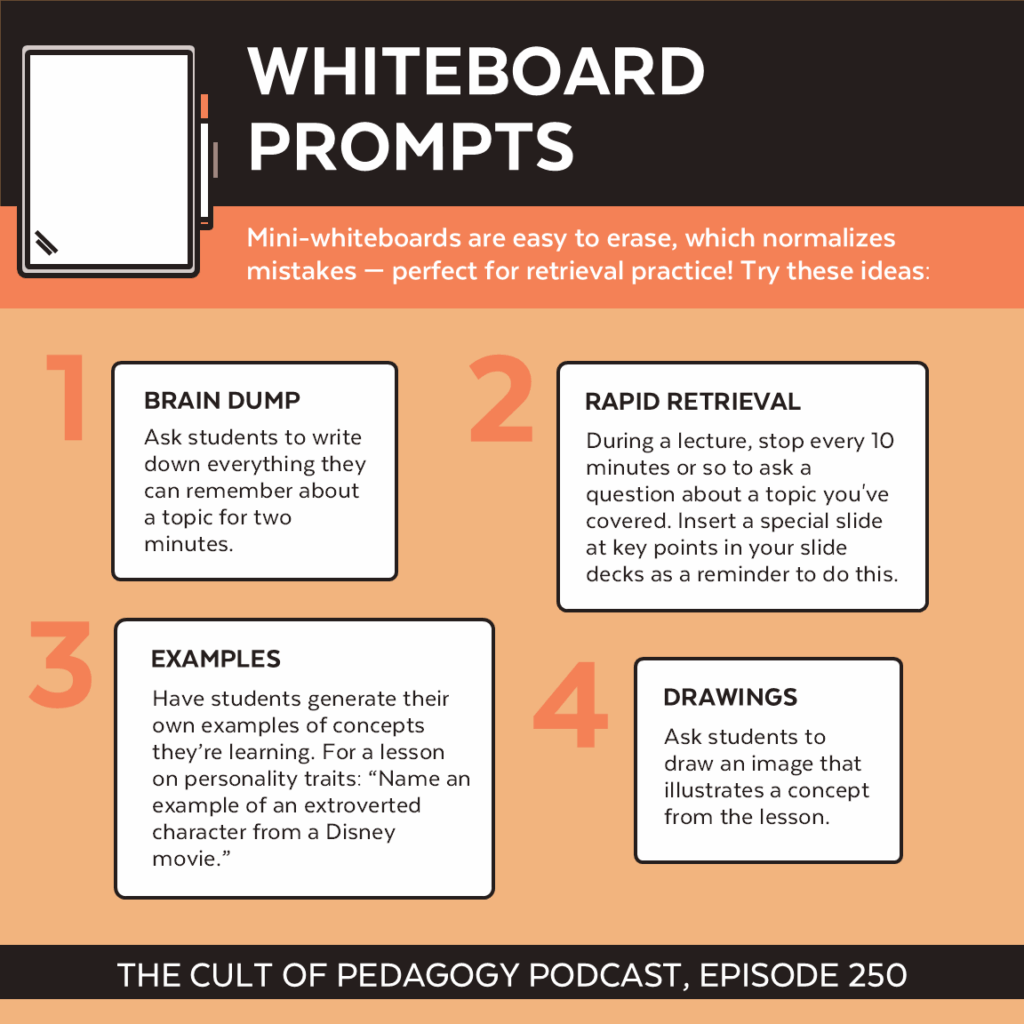
The Learning Scientists’ short explanation gives the whole basic cycle clearly: put materials away, write or draw from memory, then reopen the source to verify what you recalled and locate what needs more work.
Retrieval Practice: A video for Students
Watch “Retrieval Practice: A video for Students” by The Learning Scientists for a concise model of why the materials must be closed and why checking afterward matters.
Watch the core cycle to see the closed-book recall and checking sequence. Continue through the no-notes rule, which explains why notes act as a prop during retrieval. If you have time, watch deeper retrieval and notice that a brain dump can include explanations, examples, and applications—not only definitions.
A low score on a brain dump is not evidence that you are “bad at memorising.” It is information: it tells you what your memory cannot yet supply under the conditions you care about.
Set up a dump that gives useful information
Choose a small, coherent topic. A whole chapter is usually too broad, especially at first. Aim for material you studied recently and that contains roughly five to eight important ideas.
Good choices include:
- one psychology concept, study, or theory;
- one English paragraph, character, theme, or quotation cluster;
- one short textbook subsection;
- one group of class notes from a single lesson.
Before you close the source, decide what counts as a complete answer for that topic. Do this mentally or on a separate checklist that you put away with the source. Do not leave the checklist visible during the dump.
For a psychology topic, your hidden checklist might include:
| Type of knowledge | Example target |
|---|---|
| Definition | What does the term mean? |
| Mechanism | How or why does it work? |
| Evidence | What study, finding, or observation supports it? |
| Example | What is a concrete case? |
| Application or evaluation | When does it matter, or what is a limitation? |
For an English topic, it might include:
| Type of knowledge | Example target |
|---|---|
| Main claim | What point could the paragraph argue? |
| Evidence | Which short quotation supports it? |
| Context | Who says it, when, and in what situation? |
| Method | What language or structural feature matters? |
| Analysis | How does that evidence support the claim? |
This hidden checklist matters because it prevents a common mistake: judging a dump only by how much you wrote. A page full of loosely related facts may look impressive, yet still omit the one quotation, study result, or analytical link you would need in an assessment.
Run the closed-book dump
Use a timer. For a small topic, four to six minutes is enough. A time limit keeps the task focused and makes it easier to repeat later.
- Put away the book, slides, notes, flashcards, and checklist.
- On a blank page, write only the broad topic at the top—for example, “Memory retrieval,” “Attachment theory,” or “Macbeth: ambition.”
- Write, sketch, or map everything you can retrieve.
- If you cannot remember an item, leave a blank or write a question mark. Do not open the source.
- Keep going until the timer ends or you have genuinely exhausted what you can bring to mind.
Use fragments. Write imperfectly. Draw small links between ideas if connections occur to you. The point is to retrieve, not to edit.
If you remember “recognition is easier” but cannot explain why, write exactly that partial idea. Do not wait until you have an elegant sentence. Partial recall is valuable evidence: it often shows that a memory exists but lacks enough detail or structure to be useful.
The Duke Academic Resource Center makes the same point: retrieval should be followed by feedback and a closer look at the material that still needs strengthening.
Retrieval Practice – Academic Resource Center
Read the “Why it Matters” and “How It Works: Self-Quizzing” portions of Duke Academic Resource Center’s “Retrieval Practice.” They explain why checking errors is part of retrieval practice rather than an optional extra.
In “Why it Matters,” begin at the feedback explanation. Then read the next sentence about mistakes as well. Continue to “How It Works,” subsection “Self-Quizzing,” and read from the instruction to set notes aside through the instruction to notice what you know, do not know, and are unsure about. Focus on the idea that checking tells you where to direct your next study effort.
Source checking: compare, do not merely reread
Now open the source and compare it with your dump. The tempting approach is to reread the whole page and think, “Oh yes, I knew that.” Resist that. Your task is to identify the exact difference between what the source requires and what you produced unaided.
Use a pen of a different colour, or make marks in the margin. Keep your original dump visible; do not erase it or rewrite it into polished notes. You need an honest record of the first attempt.
Make three passes.
Pass 1: Coverage
Ask: What important items are absent?
Compare your dump with the hidden checklist and source headings. Add a small circle beside each omitted idea in the source or write it in a “missing” margin.
For example:
- You recalled that a study supported a theory but could not name the researcher.
- You recalled a character’s argument but no quotation.
- You recalled the definition of interference but not the example that proves you understand it.
An omission is more specific than “I forgot the topic.” It tells you exactly what your next retrieval prompt should test.
Pass 2: Accuracy
Ask: What did I state incorrectly or confuse with something else?
Mark these with an . Accuracy matters because an incorrect answer, repeated without correction, can become more familiar over time.
Typical accuracy problems include:
- mixing up two psychologists or studies;
- reversing cause and effect;
- attributing a quotation to the wrong speaker;
- using a correct term with an inaccurate definition;
- remembering numbers, dates, or findings approximately when precision is required.
Correct the item beside your original version, but preserve what you originally wrote. For instance:
Dump: Recognition means recalling information without cues.
Check: Recognition means identifying previously encountered information; recall requires generating it.
The correction is brief because its job is to make the contrast visible.
Pass 3: Completeness and usable detail
Ask: Is my answer technically correct but too thin for the task?
This is the most easily missed category. You may remember a headline but not enough to use it.
Consider these examples:
| What you wrote | Source-check diagnosis | What is still missing? |
|---|---|---|
| “Recognition is easier than recall.” | Partly correct | An explanation: the item itself supplies a strong cue. |
| “Bowlby said attachment is important.” | Too vague | The claim, mechanism, evidence, or implications required by the course. |
| “Lady Macbeth is ambitious.” | Too vague | A quotation, method, and analysis connecting ambition to the argument. |
| “The study supported conformity.” | Incomplete | The procedure, finding, and precise link to conformity. |
Mark these with a triangle, , for partial. A partial answer needs a different repair from a total blank. You are not starting from zero; you need to add the missing component.
Turn gaps into a repair list
Once you have checked the source, do not make a huge list entitled “revise everything.” Extract only the gaps that matter most.
Use this simple format:
| Gap type | Specific gap | Repair prompt |
|---|---|---|
| Omitted | Could not recall the study’s finding | “What did the study find, and what does that finding show?” |
| Incorrect | Mixed up recall and recognition | “Define recall and recognition; give one assessment example of each.” |
| Partial | Knew a quotation but not its use | “What does this quotation reveal, and which word or technique supports that reading?” |
| Disconnected | Knew a fact but could not link it to the main claim | “How does this evidence support the thesis?” |
A good repair prompt has a clear answer and requires you to produce it. “Revise attachment” is not a prompt. “State Bowlby’s central claim and one piece of supporting evidence” is.
Prioritise gaps in this order:
- Incorrect ideas that could cost marks or create confusion.
- Omitted core ideas needed for your assessment.
- Partial answers that need precision, evidence, or explanation.
- Minor details that are useful but not currently essential.
This prevents a brain dump from becoming an excuse to copy every missed word. The goal is not perfect transcription; it is a targeted plan for strengthening memory.
A worked example: psychology
Imagine you have studied a short section on retrieval. Your closed-book brain dump says:
“Recall is bringing memories back. Recognition is easier. Essays test recall and multiple choice tests recognition. Cues help you remember.”
Source checking reveals four different outcomes:
| Your recalled idea | Check | Diagnosis | Next action |
|---|---|---|---|
| “Essays test recall.” | Accurate | Secure | Review later, not immediately |
| “Recognition is easier.” | Partly correct | Explanation missing | Retrieve why recognition provides more cues |
| “Cues help you remember.” | Too vague | Principle unnamed and unapplied | Define encoding specificity and give an example |
| No mention of relearning | Omitted | Missing concept | Create a prompt defining relearning and contrasting it with recall |
Notice how this produces a compact repair list—not a demand to reread the whole chapter.
A useful distinction is between an absence and a failure to access. If you never understood encoding specificity, you need to reread a small section, explain it in your own words, and then retrieve it. If you understood it yesterday but could not produce it today, begin with retrieval practice. In both cases, the brain dump tells you what the next move should be.
A worked example: English
Suppose your topic is “Lady Macbeth and ambition.” You write:
“Lady Macbeth wants power. She persuades Macbeth. She says something about being unsexed.”
Source checking might show:
| Category | Diagnosis | Precise gap |
|---|---|---|
| Claim | Present but broad | Ambition needs a more arguable interpretation |
| Quotation | Partial | You remember the cue but not the wording |
| Context | Omitted | You cannot place the speech in the scene |
| Analysis | Omitted | You have not explained what “unsex me here” suggests |
| Connection | Weak | You have not linked the quotation back to Shakespeare’s presentation of ambition |
Your repair prompts could be:
- “Recall the key wording of Lady Macbeth’s ‘unsex me here’ speech.”
- “What does ‘unsex’ suggest about gender and power?”
- “How does this speech develop an argument about ambition?”
Those are much more efficient targets than rereading every scene involving Lady Macbeth.
Your 15-minute brain-dump cycle
Use the following routine on one current topic today or this week.
1. Brief preparation — 2 minutes
Study a small source section. Decide which five to eight ideas would matter most. Put the source and any checklist away.
2. Closed-book dump — 5 minutes
Write or sketch everything you can retrieve. Keep only the broad topic visible. Include facts, claims, examples, explanations, and links between ideas.
3. Source check — 5 minutes
Compare your dump against the source in three passes:
- coverage: what is missing?
- accuracy: what is wrong or confused?
- completeness: what is too vague to use?
Mark secure points, partial points, errors, and omissions distinctly.
4. Repair list — 3 minutes
Write two to four precise retrieval prompts based on your highest-priority gaps. Then close the source again and try answering one of those prompts immediately.
This final retrieval attempt is important. Checking supplies the correct information; retrieving it again begins to make it available without the source.
When the brain dump feels blank
A nearly blank page is frustrating, but it still gives useful information. Do not extend the timer indefinitely. After about five minutes, check the source and reduce the material into smaller targets.
For example, instead of trying to recall an entire theory, work through:
- the central definition;
- one mechanism;
- one example or study;
- one application or evaluation point.
Then return to a broader brain dump later. A brain dump should be challenging enough to reveal gaps, but small enough that checking produces a manageable repair list.
It is also normal for one recalled detail to trigger another. Let that happen. Memory is often organised through connections: recalling a quotation may prompt the scene, which may prompt an interpretation. The page does not need to be neat because you are training access, not presentation.
Key takeaways
A closed-book brain dump tests what you can retrieve without the support of notes, headings, answer options, or familiar wording. Its real strength lies in the source check that follows.
When checking, distinguish among:
- omitted information you did not produce;
- incorrect information you confused or misstated;
- partial information that is true but too vague or incomplete to use;
- secure information you can recall accurately and sufficiently.
Turn each important gap into a narrow retrieval prompt. That converts “I need to revise this topic” into an efficient plan for your next few minutes of study.
In the next module, you will make those repair prompts even more efficient by converting notes into atomic flashcards: cards that test one clear, recallable answer at a time.
Can't find a good explanation? Sign up and we'll make it for you
Sign up