
Hello! Welcome back.
In our last few lessons, we've built a powerful analytical chain. You learned how to take a component with complex external loads, determine the combined stress state () at any point, and then calculate the principal stresses () from that state.
Today, we complete that chain by answering the most critical engineering question: "Is it safe?" This lesson addresses the learning outcome: Apply failure theories (e.g., Maximum Shear Stress, von Mises) to predict material failure under combined stress. We will learn how to take the principal stresses we've found and compare them to a material's known strength (like its yield strength, ) to predict whether it will fail. This is the final step in assessing a design's structural integrity under static loads.
1. What is "Failure" and Why Do We Need Theories?
First, let's be precise about "failure." For an engineer, it doesn't always mean a part breaking into two pieces.
- For ductile materials (like steel and aluminum, common in aerospace), failure is typically defined as the onset of yielding—permanent, plastic deformation. A bent wing spar is a failure, even if it hasn't snapped.
- For brittle materials (like cast iron or ceramics), failure is fracture—a sudden break with little to no warning.
We can easily test a material's strength by pulling on a sample in one direction (a uniaxial tensile test) to find its yield strength () or ultimate strength (). But real-world parts, like an aircraft landing gear strut, experience complex, multi-axial stress states. How do we compare this complex state to our simple test data? This is where failure theories come in.
Understanding Failure Theories (Tresca, von Mises etc...)
To start, watch this short introduction from The Efficient Engineer. It clearly explains why we need different failure theories for complex stress states and distinguishes between failure in ductile and brittle materials.
Watch the video from the beginning until 02:07. Focus on the core problem that failure theories are designed to solve.
As the video explains, a failure theory provides a mathematical rule to reduce a complex stress state (described by principal stresses ) into a single equivalent stress value. This equivalent stress can then be directly compared to the material's yield or ultimate strength from a simple tensile test.
2. Failure Theories for Ductile Materials
Most aerospace structures are built with ductile materials, so we'll focus on the two most common theories used for them: Tresca and von Mises. These theories apply when we want to prevent yielding.
a) Maximum Shear Stress (Tresca) Theory
The Tresca theory, also known as the Maximum Shear Stress theory, is based on the observation that yielding in ductile materials is caused by slip along shear planes.
- Principle: Yielding occurs when the maximum shear stress, , in a part becomes equal to the maximum shear stress found in a uniaxial tensile test at the point of yielding.
- Derivation: In a simple tensile test, at yield, the principal stresses are , and . The maximum shear stress is . The general maximum shear stress in any 3D state is . Equating these gives us the failure criterion.
- The Formula: Failure is predicted if the equivalent Tresca stress equals or exceeds the yield strength.
(Here, it is crucial that the principal stresses are ordered: ). - Characteristic: The Tresca theory is conservative, meaning it often predicts failure at lower stress levels than what might be observed experimentally. This provides an inherent safety margin. It is also simpler to calculate by hand.
b) Distortion Energy (von Mises) Theory
The von Mises theory, also known as the Maximum Distortion Energy theory, is a more refined model. It's based on the idea that yielding occurs not just from any stress, but from stresses that change the shape of a material element (distortion), as opposed to stresses that only change its volume (hydrostatic).
- Principle: Yielding occurs when the distortion energy per unit volume in the actual stress state equals the distortion energy in a uniaxial tensile test at the point of yielding.
- The Formula: Failure is predicted if the equivalent von Mises stress () equals or exceeds the yield strength. In terms of principal stresses, the formula is:
For the common case of plane stress (where ), this simplifies to:
- Characteristic: The von Mises theory generally provides a more accurate prediction of yielding for ductile materials compared to experimental data. It is the standard for most computer-aided engineering (CAE) and Finite Element Analysis (FEA) software.
c) Comparing Tresca and von Mises
The relationship between the two theories is best visualized by plotting their "yield surfaces." A yield surface is a graph in principal stress space (e.g., plotting vs ). Any stress state inside the boundary is safe; any state on or outside the boundary has failed.
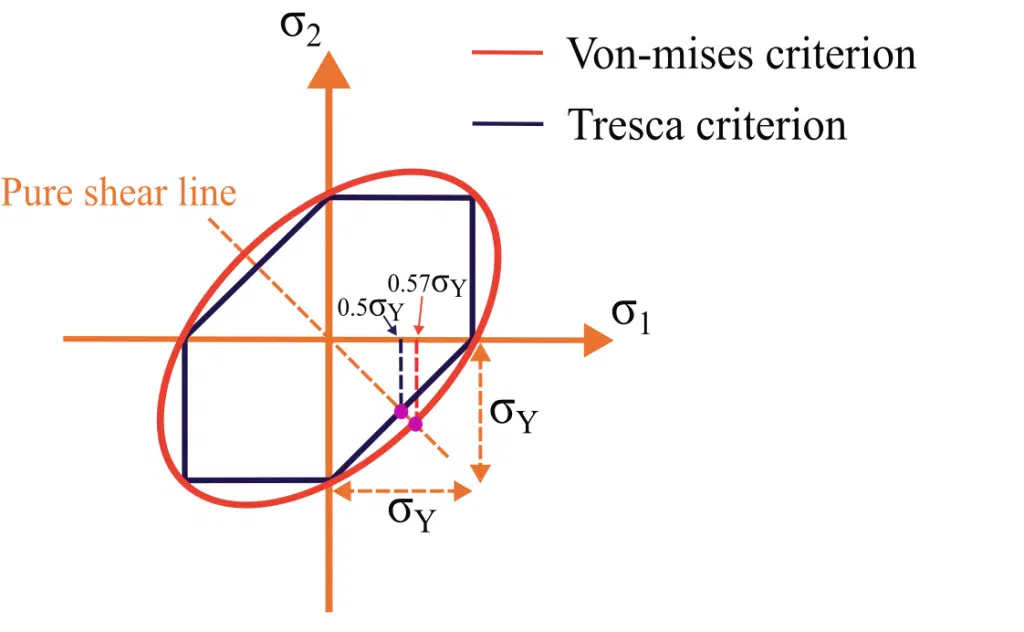
As you can see, the Tresca theory always predicts failure at or before the von Mises theory does. The largest difference between them occurs under pure shear, where Tresca predicts yielding when the shear stress reaches , while von Mises predicts it at .
Understanding Tresca and von Mises Elastic Failure
For a more detailed, yet clear, explanation of these two theories, including their formulas and the underlying concepts of shear stress and distortion energy, this article from EngineeringSkills.com is excellent.
Read sections 4 and 5 of the article. Focus on the boxed formulas for the reduced (equivalent) stress for both Tresca and von Mises, and the bulleted lists summarizing their key characteristics.
3. Worked Example: Applying the Theories
Now let's see how this works in practice. We'll analyze a component under combined loading, find its principal stresses, and then apply both Tresca and von Mises theories to see if failure is predicted.
This video from Jeff Hanson works through a problem that directly connects to our previous lessons. A steel specimen is subjected to both compression and torsion. He calculates the stress state, finds the principal stresses using Mohr's circle, and then applies both failure theories.
Mechanics of Materials: Lesson 55 - Tresca, Von Mises, and Rankine Failure Theories Explained
This example will solidify your understanding. It shows how to apply the failure theory formulas to a practical combined loading problem and highlights the difference in their predictions.
Watch the second example in the video, starting from 19:55 and continuing to the end (32:06). Pay close attention to: How the principal stresses \sigma_1 and \sigma_2 are calculated. Which version of the Tresca formula is used (since \sigma_1 and \sigma_2 have different signs). How the von Mises formula is applied. The final comparison of the results from both theories.
In the video's example, the final results were:
- Tresca Theory: Predicted stress (38.2 ksi) > Yield Strength (36 ksi) FAILURE
- Von Mises Theory: Predicted stress (34.43 ksi) < Yield Strength (36 ksi) SAFE
This is a perfect illustration of Tresca's conservatism. An engineer using the Tresca criterion would reject this design, while one using the more accurate von Mises criterion might accept it (though, as the instructor notes, it's dangerously close to the limit!).
Test your understanding!
A point on an aircraft fuselage skin is under a plane stress condition where the principal stresses are found to be MPa and MPa. The skin is made from an aluminum alloy with a yield strength of MPa. Will the material yield according to the Tresca and von Mises theories?
Show answer
Given: MPa, MPa, (plane stress), MPa.
-
Tresca (Maximum Shear Stress) Theory:
The principal stresses are ordered .
The equivalent stress is MPa.
We compare this to the yield strength: .
Conclusion: According to Tresca theory, the material will not yield. -
Von Mises (Distortion Energy) Theory:
For plane stress, the equivalent stress is .
MPa.
We compare this to the yield strength: .
Conclusion: According to von Mises theory, the material will not yield.
In this case, both theories agree the design is safe.
4. Application in Aerospace: Margin of Safety
In aerospace engineering, the results of these failure theories are used to calculate a Margin of Safety (MS). This formalizes the "how safe is it?" question. As described in NASA's guidelines, the MS is a standard way to report structural integrity.
The general formula is:
- Allowable Stress: This is the material's strength, like .
- Applied Stress: This is the equivalent stress we just calculated, e.g., .
- SF: A prescribed Factor of Safety (often 1.25 or 1.5 in aerospace, depending on the application and uncertainty).
A positive Margin of Safety () means the design is safe. A negative margin means it is predicted to fail. Your goal as an engineer is to ensure all parts have a positive margin of safety under all expected load conditions.
Conclusion
You have now reached the end of the analysis chain for statically loaded components. You can go from a physical part with forces on it all the way to a clear "safe" or "unsafe" prediction.
Key Takeaways:
- Failure theories bridge the gap between complex, multi-axial stress states and simple, uniaxial material test data.
- For ductile materials, failure usually means yielding.
- The Maximum Shear Stress (Tresca) theory is conservative and simple to compute ().
- The Distortion Energy (von Mises) theory is more accurate and is the industry standard in FEA software ().
- The output of these theories is an equivalent stress that is used in aerospace to calculate a Margin of Safety.
Next Lesson Preview:
With this lesson, we conclude our module on advanced mechanics of materials and our broader study of Statics. We've focused on bodies that are in equilibrium. We will now shift gears completely and begin the study of Dynamics, starting with the fundamentals of motion. In the next lesson, we will begin Module 5: Dynamics: Particle Kinematics and Kinetics, starting with the learning outcome: Apply kinematic equations to solve problems of rectilinear and curvilinear motion for a particle. We'll leave stress and strain behind for a while and dive into the world of velocity and acceleration.
Can't find a good explanation? Sign up and we'll make it for you
Sign up