
Hello! Welcome to your next lesson in the module on Stress Analysis.
In our previous lesson, we explored how to calculate the deflection of beams using standard formulas and the principle of superposition. That analysis was crucial for understanding a beam's stiffness. The stresses we considered—bending stress () and shear stress ()—were calculated on planes that were either perpendicular or parallel to the beam's axis.
However, a material's failure isn't dictated by our choice of coordinate system. Maximum stress, which governs failure, can occur on planes oriented at an angle to the main axes. This is especially critical in aerospace applications, where components made of composites or joined by welds must be analyzed for stress in all directions.
Today's lesson addresses the learning outcome: Apply stress transformation equations to determine stresses on inclined planes. We will learn the mathematical tools to determine the normal and shear stresses on any plane within a material, given a known state of stress. This is the foundational step for finding the absolute maximum stresses a component will experience.
1. The Stress Element and Why Transformation is Necessary
To analyze stress at a point, we imagine isolating an infinitesimally small cube of material, called a stress element. For a 2D or plane stress scenario (where stresses in the third dimension are zero, common on the surface of a body), this element shows the stresses acting on its faces.
The key insight is that the values of normal and shear stress depend on the orientation of the plane you're looking at. A piece of material under simple tension in the x-direction has zero shear stress on its vertical face, but if you "cut" it at a 45° angle, you will find both normal and shear stresses acting on that inclined face.
The following video introduces the concept of the stress element and explains why the stress values change as we rotate our point of view.
Mechanics of Materials: Lesson 48 - Stress Transformations Using the Equation Method
This video from Jeff Hanson provides an excellent conceptual introduction to the stress element and the directional nature of stress, using a practical example of a welded tank.
Watch from 0:32 to 6:20. Focus on understanding what a stress element represents and the core idea that stresses change when the element is rotated.
2. Defining Plane Stress and Sign Conventions
For a 2D plane stress element, we need to define three stress components:
- : The normal stress acting on the faces perpendicular to the x-axis.
- : The normal stress acting on the faces perpendicular to the y-axis.
- : The shear stress acting on the x and y faces.
Consistent sign conventions are critical for using the transformation equations correctly.
- Normal Stress (): Tension is positive (+), and compression is negative (-).
- Shear Stress (): A common convention is that shear stress is positive if it points into the top-right corner of the element (causing counter-clockwise rotation of that corner).
- Angle of Rotation (): Counter-clockwise (CCW) rotation is positive (+), and clockwise (CW) rotation is negative (-).
To get a clear and concise explanation of these conventions, please watch the following segments.
Mechanics of Materials - 2D Plane stress transformation equations
This video from Engineering Deciphered clearly defines the components of plane stress and, most importantly, the sign conventions you'll need to apply.
Watch the segments from 0:01 to 3:02 and 13:01 to 15:42. The first part introduces the stress components. The second part is very important as it explains the sign conventions for normal stress, shear stress, and the angle of rotation, heta.
3. The Stress Transformation Equations
Now, we get to the core of today's lesson: the formulas. If we know the initial stress state (, , ), we can find the normal stress () and shear stress () on a new plane rotated by an angle .
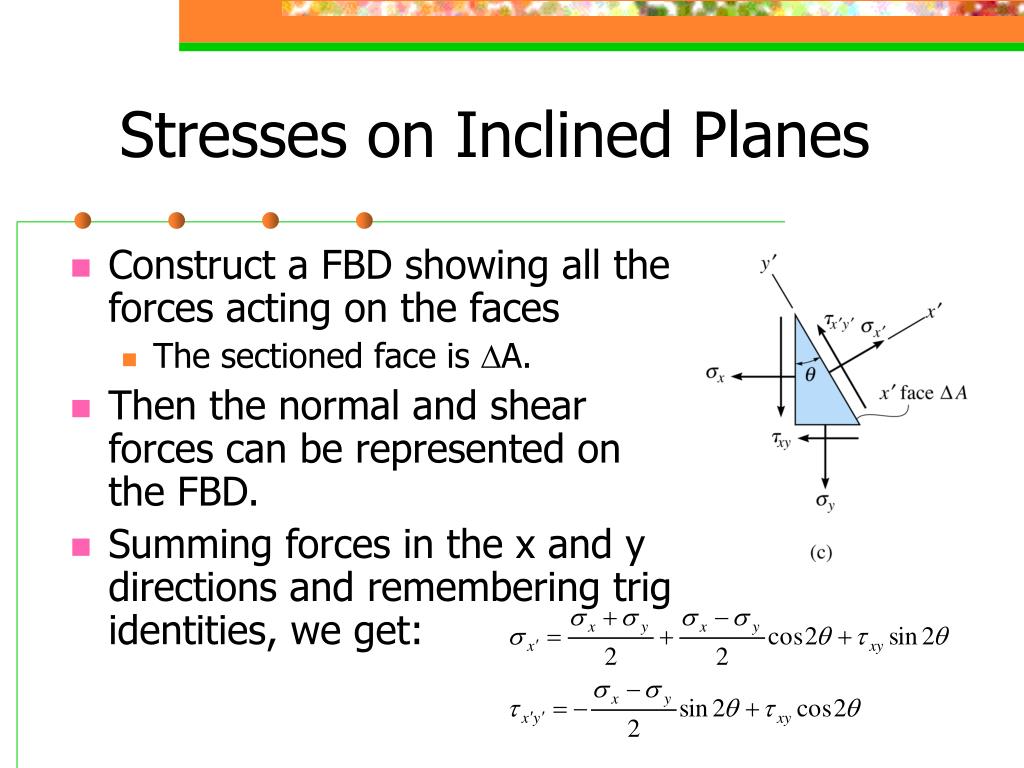
These equations are derived from the equilibrium of forces on a wedge-shaped segment of the stress element. As you prefer a formula-based approach, we will not perform the derivation, but focus on the resulting equations. The following resource, written in an aerospace context, presents these equations clearly.
Aircraft Stress Analysis and Structural Design
The following reading from 'Aircraft Stress Analysis and Structural Design' shows how the transformation equations are developed.
Read the section titled 'Circle of Mohr' (pages 25-27), focusing on the text leading up to and including Equation 4.3. This shows how force equilibrium on a small element leads to the stress transformation equations. Don't worry about memorizing the derivation; concentrate on understanding what the final equations (4.3) represent. Note that they use \sigma_ heta and au_ heta for the transformed normal and shear stress, which are equivalent to the \sigma_{x'} and au_{x'y'} we will use.
To summarize and standardize our notation, the key stress transformation equations are:
Normal Stress on the rotated x'-face:
Shear Stress on the rotated x'-face:
An important property is that the sum of the normal stresses is an invariant, meaning it does not change with rotation:
This can be a useful check for your calculations.
4. Applying the Equations: A Worked Example
The best way to understand these equations is to see them in action. The following video provides a clear, step-by-step example of calculating the transformed stresses for a given element and rotation.
Mechanics of Materials: Lesson 48 - Stress Transformations Using the Equation Method
Let's return to Jeff Hanson's instruction to see a practical application of these formulas. This detailed example will solidify your understanding of the calculation process.
Watch from 10:57 to 19:02. The instructor solves for the transformed stresses on an element rotated 60 degrees clockwise. Pay close attention to how he handles the signs, especially noting that a clockwise rotation corresponds to a negative angle ( heta = -60^\circ) in the formulas.
This example highlights the importance of being methodical:
- Identify the initial stresses () and their signs.
- Determine the angle of rotation and its sign (CCW is positive).
- Carefully substitute these values into the transformation equations. Remember to use .
- Calculate the resulting and .
Test your understanding!
Consider a point in a state of plane stress represented by the following components:
- MPa (Compression)
- MPa (Tension)
- MPa (acting away from the top-right corner)
Determine the normal and shear stresses acting on an element that is oriented 30° clockwise with respect to the original element.
Show answer
First, define the input values with their correct signs:
- MPa
- MPa
- MPa
- (clockwise rotation is negative)
Now, apply the transformation equations:
Normal Stress :
Shear Stress :
So, on the plane rotated 30° clockwise, the normal stress is 25.85 MPa in compression, and the shear stress is 68.79 MPa.
Conclusion
In this lesson, you've learned how to quantify the state of stress on any inclined plane within a body. This is a fundamental skill in solid mechanics that moves us beyond simple, axis-aligned analysis and toward a more complete understanding of how materials behave under complex loads.
Key Takeaways:
- Stress at a point is directional; its normal and shear components change depending on the orientation of the plane being analyzed.
- A stress element is a visual tool representing the state of plane stress (, , ) at a point.
- Stress transformation equations are the mathematical tools used to calculate the new stresses (, ) after rotating the element by an angle .
- Correctly applying the sign conventions for stress components and the angle of rotation is essential for accurate results.
Next Lesson Preview:
While today's equations allow us to find the stress on any plane, we are often most interested in finding the planes of maximum and minimum stress. These are called the principal stresses. In the next lesson, we will learn how to calculate these principal stresses and the maximum in-plane shear stress. We will also introduce a powerful graphical method called Mohr's Circle, which provides an intuitive, visual way to solve the same transformation problems we tackled with equations today.
Can't find a good explanation? Sign up and we'll make it for you
Sign up