
Hello! Welcome back to our course on asyncio.
Introduction
In our last lesson, we focused on the await keyword. We saw how it pauses a coroutine, voluntarily yielding control and enabling cooperative multitasking. We repeatedly used the phrase "yields control back to the event loop."
Today, we will demystify this central component. The learning outcome for this lesson is to describe the role of the asyncio event loop in orchestrating coroutine execution. We will define what the event loop is, break down its operational cycle, and visualize how it manages multiple tasks to achieve concurrency on a single thread. Understanding the event loop is crucial, as it is the heart and scheduler of any asyncio application.
1. The Event Loop: A Conceptual Model
At its core, the asyncio event loop is a scheduler that runs in a single thread. Its primary responsibility is to run asynchronous tasks and callbacks, handle network I/O, and run subprocesses.
Think of it as a specialized, user-space operating system scheduler. However, unlike a pre-emptive OS scheduler that can interrupt a running process at any time, the asyncio event loop relies on cooperative multitasking. It only switches tasks when a task explicitly yields control with await.
Delving Deep into Asyncio Coroutines, Event Loops, and ...
To start with a formal definition, let's turn to the article 'Delving Deep into Asyncio...' which provides a clear and concise explanation of the event loop's role.
Please read the 'Core Concepts Explained' section. Focus on the definition provided for the 'Event Loop'.
The diagram below offers a simple visual metaphor. Multiple routines exist, but they all yield control to a central event loop, which then decides what to execute next.
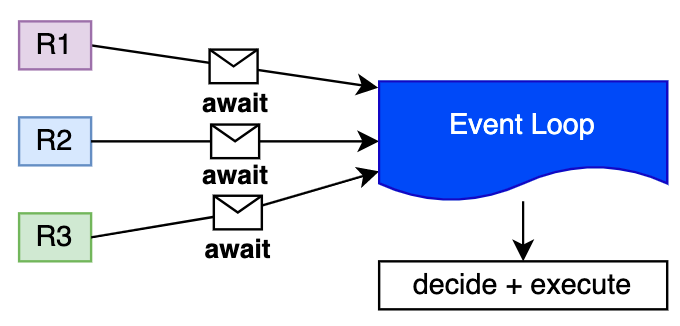
To solidify the "why" behind this model, the following text provides the classic chess master analogy, which is an excellent way to think about the efficiency gains from this style of task management.
Python's asyncio: A Hands-On Walkthrough
The article 'Python's asyncio: A Hands-On Walkthrough' from Real Python explains the benefits of the asynchronous model with a powerful analogy.
Read the section 'Async I/O Explained' for the Judit Polgár chess exhibition analogy. This perfectly illustrates how a single 'worker' (the chess master, or our single thread) can handle many tasks concurrently by switching between them during their idle periods.
2. The Execution Cycle of the Event Loop
So, what does the event loop actually do? It runs a continuous cycle that can be broken down into these fundamental steps:
- Maintain a queue of "ready" tasks. These are coroutines that are not currently waiting for anything and are ready to run.
- Select a task from the ready queue (often in a first-in, first-out manner).
- Run the task's code until it either completes or hits an
awaitexpression. - If the task
awaits an operation (likeasyncio.sleep()or a network read), the task is suspended. The event loop registers the I/O operation with the underlying operating system and moves on. The task is no longer in the "ready" queue. - Poll the OS for completed events. The loop checks if any of the registered I/O operations have completed, or if any timers have expired.
- Move tasks back to "ready". For any completed events, the corresponding suspended task is moved back into the "ready" queue.
- Repeat. The loop goes back to step 2, picking the next ready task.
This cycle continues until all tasks are complete. The following reading and diagram provide a more detailed look at this process.
Delving Deep into Asyncio Coroutines, Event Loops, and ...
The 'Delving Deep into Asyncio...' article also contains an excellent breakdown of this cycle.
Please read the section titled 'The Role of the Event Loop'. It clearly outlines the sequence of events that occurs when you call asyncio.run() and the loop begins its execution cycle.
The sequence diagram below visualizes this interaction, including the crucial hand-off to the operating system for I/O operations.

3. Visualizing the Orchestration
In the last lesson, we saw animations of how sequential await calls lead to sequential execution. Now, let's see how the event loop orchestrates true concurrency when tasks are scheduled correctly.
The key is to tell the event loop about all the tasks you want to run before you start waiting for them to finish. We'll cover the function asyncio.create_task() in detail in the next module, but for now, just know that it's the way you schedule a coroutine to run on the event loop.
Python Tutorial: AsyncIO - Complete Guide to Asynchronous Programming with Animations
Corey Schafer's animated guide provides the clearest possible visualization of the event loop in action.
Watch the segment from 27:15 to 31:13. This is a critical visualization. Observe how: create_task adds tasks to the event loop's 'ready' queue. When main awaits the first task, it suspends, and the event loop is free to run other ready tasks. The loop switches between fetch_data_1 and fetch_data_2 as they each await their respective sleep calls, achieving concurrency.
An important nuance of the event loop is that while await guarantees an operation is complete before the function proceeds, you do not control the fine-grained order in which the event loop runs ready tasks. The loop typically uses a simple queue and runs whatever is ready.
Python Tutorial: AsyncIO - Complete Guide to Asynchronous Programming with Animations
This next segment from the same video explores what happens when you change the order of your await calls.
Watch from 35:40 to 38:42. The key insight here is that the event loop has its own scheduling logic (like a FIFO queue). Even if you await task2 first, the loop might start running task1 if it was scheduled first and is ready. Your await simply pauses the current coroutine (main) until its specific dependency is met.
4. The Event Loop, the GIL, and asyncio.run()
A crucial point is that the event loop and all its coroutines run on a single thread. This might seem like a limitation, but for I/O-bound workloads, it's a major advantage in Python. It completely sidesteps the complexities of Python's Global Interpreter Lock (GIL), which prevents multiple threads from executing Python bytecode simultaneously. Since asyncio doesn't use multiple threads for concurrency, the GIL is not a bottleneck.
AsyncIO and the Event Loop Explained
ArjanCodes provides a succinct explanation of why asyncio is performant in Python despite the GIL.
Watch the clip from 08:09 to 09:06. He explains that asyncio enables concurrent execution without multi-threading, making it highly efficient for I/O-bound tasks.
Finally, how do we start this whole process? In modern Python, you rarely need to create or manage the event loop manually. The asyncio.run() function serves as the main entry point for an asyncio program. It is responsible for creating a new event loop, running the coroutine you pass to it until it's complete, and then closing the loop and cleaning up resources.
Conclusion
In this lesson, we've pulled back the curtain on the asyncio event loop, the engine that powers asynchronous programming in Python.
Key Takeaways:
- The event loop is a single-threaded scheduler that orchestrates the execution of coroutines.
- It operates on a principle of cooperative multitasking: it only switches tasks when a coroutine explicitly
awaits. - Its core cycle involves running ready tasks, suspending them on
await, monitoring I/O with the OS, and resuming tasks when their awaited operations complete. - By running on a single thread,
asyncioavoids the Python GIL, making it highly efficient for I/O-bound concurrency.
Preview of the Next Lesson:
We've mentioned asyncio.run() as the high-level function that manages the event loop's lifecycle. In our next lesson, we will focus on it specifically, understanding its role as the primary entry point for an asyncio program and how it simplifies what used to be a more manual process.
Can't find a good explanation? Sign up and we'll make it for you
Sign up