
Welcome to your first German lesson. Over the next module, you will build the sound system and basic interaction skills needed for everyday university life: introducing yourself, understanding simple questions, and communicating clearly with classmates and staff.
Today’s goal is not to sound perfectly native. It is to hear, recognize, and produce six German sounds that carry meaning and appear constantly in beginner German: ä, ö, ü, ß, ch, and r. Careful attention now will make later vocabulary—such as München, Köln, Straße, and sprechen—much easier to learn and understand.
A useful principle: dots and letter combinations matter
German spelling is fairly consistent, but small visual differences can represent real sound differences. The two dots in ä, ö, ü are not decoration: they change the vowel. Likewise, ß is a letter in its own right, and ch is not pronounced like English church.
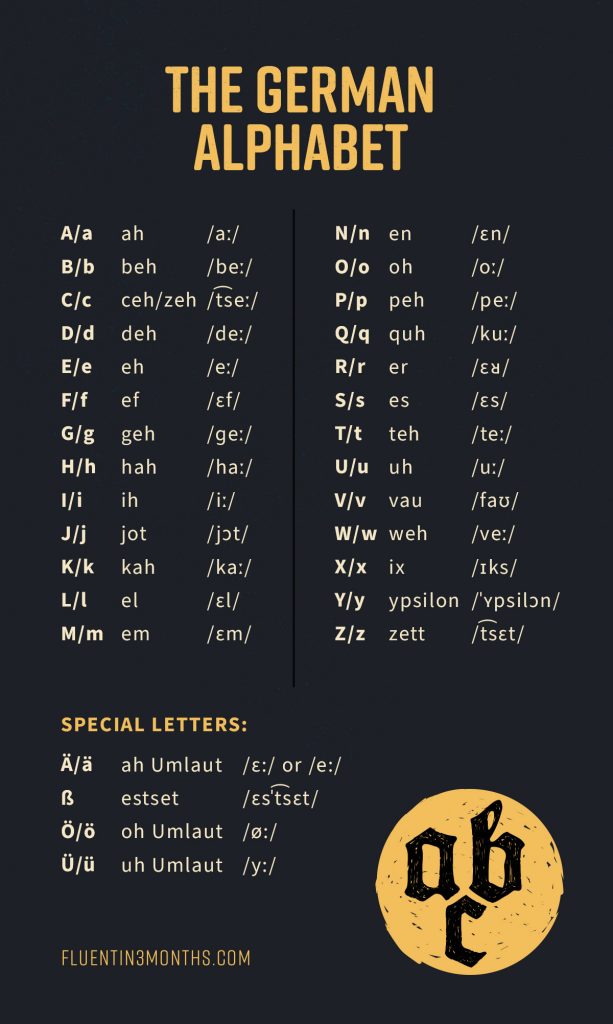
For now, focus on producing a sound clearly enough that a listener can distinguish it. Keep your voice relaxed, say each example slowly, and repeat it several times rather than forcing a loud or exaggerated sound.
The Umlauts: ä, ö, and ü
An Umlaut changes both the tongue position and, for ö and ü, the lip position. These three sounds may be unfamiliar, but they become manageable when you separate what your tongue does from what your lips do.
German Umlaute | Super Easy German (86)
Watch “German Umlaute | Super Easy German (86)” from Easy German for close demonstrations of the three Umlaut vowels. The speakers contrast similar words, which helps train your ear as well as your mouth.
Watch ä for the difference between short and long ä. Then watch ö, paying attention to the instruction to keep rounded lips while making an e-like sound. Finish with ü; pause after each example and imitate it aloud, especially the contrasts Bruder/Brüder and Fuß/Füße.
Ä ä: an e-like sound, sometimes more open
In many common words, short ä sounds very close to German short e. For a first approximation, use the vowel in English bed.
- Männer — men
- ändern — to change
- spät — late
A longer ä can be more open, somewhat like the vowel in American English man. You do not need to master every distinction immediately. The essential beginner habit is this: when you see ä, do not pronounce it as ordinary German a.
Compare:
- Mann — man
- Männer — men
Say each word slowly. In Mann, the mouth is more open and the vowel is an a. In Männer, the tongue comes farther forward and the vowel shifts toward e.
Ö ö: rounded lips, e-like tongue position
To make ö, begin with your lips rounded as if you are going to say o. Keep that lip shape, but try to say a short e sound. The result is ö.
A reasonable English reference, for many accents, is the vowel in word or heard, but do not rely on that comparison if it does not match your accent. The mouth-position method is more reliable.
- Köln — Cologne
- schön — beautiful
- möchte — would like
Contrast:
- schon — already
- schön — beautiful
The dots make these different words. Saying schon when you mean schön will often still be understood from context, but the distinction is worth hearing from the beginning.
Ü ü: rounded lips, i-like tongue position
For ü, make a long ee sound as in see. Without moving your tongue much, round and push your lips forward as if you are going to whistle. Keep the sound going while you change only your lips.
- München — Munich
- fünf — five
- für — for
- Tür — door
Contrast:
-
Bruder — brother
-
Brüder — brothers
-
Fuß — foot
-
Füße — feet
A common mistake is to replace ü with u. If the two sound the same when you say them, slow down: first hold ee, then add the rounded lips.
A short Umlaut drill
Use this sequence for two minutes:
- Say a – ä: Mann – Männer.
- Say o – ö: schon – schön.
- Say u – ü: Bruder – Brüder and Fuß – Füße.
- Say the city name München in three parts: Mün / chen, then combine it.
Your aim is contrast, not speed. If the pairs sound noticeably different to you, you are making progress.
ß: the sharp s
The character ß is called Eszett or scharfes S (“sharp s”). In ordinary modern German, it represents the voiceless s sound, like the s in English see. It is not a b, even though it may resemble one at first glance.
- Straße — street
- heißen — to be called
- groß — big
Listen for the clean, unvoiced hiss at the end of groß: grohs. Do not turn it into the English buzzing sound in zoo.
At this stage, treat ß as a reliable reading rule:
When you see ß, say s.
Later you will learn spelling conventions that distinguish ß from ss. For speaking, the immediate point is simply to recognize the character and pronounce its sound.
Ch: two throat sounds, not English “ch”
German ch has two main pronunciations. Neither is the English ch in chair. It is also not normally the sh of ship.
The useful question is: What sound comes before ch?
German Pronunciation For Beginners A1 (Step by Step Guide)
In “German Pronunciation For Beginners A1 (Step by Step Guide)” by Max Yoko, this short segment introduces the two core ch sounds with clear examples. Use it to hear the change in where the sound is made.
Watch both ch sounds. First imitate the light, hissing sound in ich; then repeat Buch, Dach, and noch with the deeper sound. Notice that your tongue moves farther back for the second group.
The light ch: as in ich
After e, i, ä, ö, ü, and after many consonants, ch is usually a light, soft, hissing sound. Linguists write it as .
- ich — I
- nicht — not
- München — Munich
- möchte — would like
- Milch — milk
To produce it:
- Raise the middle of your tongue toward the hard part of the roof of your mouth.
- Keep the tongue from fully touching the roof.
- Let air pass through the narrow gap, gently and continuously.
A helpful image is a quiet “hiss,” like air escaping from a balloon. Avoid adding a k sound or a t sound. Ich is one flowing syllable, not “ik” and not “itch.”
The deeper ch: as in Bach
After a, o, u, and often after au, ch is made farther back in the throat. Linguists write it as .
- Bach — stream
- Buch — book
- Dach — roof
- machen — to make
- auch — also
For this version, bring the back of the tongue toward the soft back part of the roof of your mouth. Let air pass with a gentle friction sound. It can feel similar to a very soft gargle, but should not sound harsh or strained.
| Before ch | Usual sound | Examples |
|---|---|---|
| light, forward | ich, München, möchte | |
| deep, back | Bach, Buch, auch |
The pattern will cover many beginner words. For now, train your ear with pairs that make the physical difference clear:
- ich: tongue relatively forward
- Buch: tongue farther back
- München: light ch after ü
- machen: deep ch after a
German r: aim for clarity, not a forced roll
The German r varies across Germany, Austria, and Switzerland. A rolled tongue-tip r is used in some regions, but you do not need to roll your r’s to speak understandable Standard German.
A common Standard German r at the beginning of a word is made in the back of the mouth or throat. It is often written . It may resemble a soft gargle, but it should be light and voiced—not an aggressive throat-clearing sound.
German Pronunciation For Beginners A1 (Step by Step Guide)
Return to Max Yoko’s pronunciation guide for a practical introduction to German r in different word positions. The most important message is that a natural, understandable r is better than forcing a trill.
Watch German r. Focus first on the stronger r at the beginning of words such as rot. Then listen for the weaker ending in words such as besser, where the r is often barely audible as a vowel-like sound.
R at the start of a word or syllable
Practice a gentle back-of-the-throat r in these words:
- rot — red
- Reise — journey
- Restaurant — restaurant
- sprechen — to speak
- Freund — friend
For rot, begin voicing lightly in the throat and then move directly into the vowel. If you produce an English r, communication will still work; do not let this sound stop you from speaking. Gradually move it farther back as your listening improves.
R after a vowel or at the end of a word
In many everyday words, especially in unstressed -er, German r becomes weak and vowel-like. Rather than a strong r, it often sounds close to a short neutral vowel, written approximately .
- besser — better
- Computer — computer
- Lehrer — teacher
- Mutter — mother
So besser is closer to “bess-uh” than to a strongly pronounced English “bess-er.” You may still pronounce the r more clearly at first; the key listening skill is not to expect a strong English r every time it is written.
This variation is normal:
| Position of r | Practical beginner target | Example |
|---|---|---|
| Beginning of a word | light back-of-throat r | rot, Reise |
| After a consonant | usually a noticeable r | sprechen, Freund |
| Unstressed -er ending | weak, vowel-like ending | besser, Lehrer |
Put the sounds into useful beginner words
These are words you will meet soon in introductions, directions, and student life. Read each word aloud once slowly, then once at a natural pace.
| Sound | Word | Meaning | Focus |
|---|---|---|---|
| ä | spät | late | Do not use plain a. |
| ö | schön | beautiful | Round the lips. |
| ü | München | Munich | Keep lips rounded for ü. |
| ß | Straße | street | Make a clear unvoiced s. |
| light ch | ich | I | Soft, forward hissing sound. |
| deep ch | Buch | book | Friction at the back of the mouth. |
| beginning r | Restaurant | restaurant | Gentle back r. |
| ending r | Computer | computer | Weak final -er. |
A compact pronunciation routine for the next few days:
- Read the table aloud once.
- Repeat schon / schön, Bruder / Brüder, and ich / Buch three times each.
- Record yourself saying: Ich bin Studentin or Ich bin Student. Listen once, then repeat it more slowly, keeping the ich sound soft.
- When you encounter an unfamiliar German word, first identify special letters and combinations before trying to say the whole word.
Key takeaways
The six spelling patterns from this lesson give you a strong starting point for German pronunciation:
- ä is often e-like; it is not ordinary a.
- ö uses rounded lips with an e-like vowel.
- ü combines an ee-like tongue position with rounded lips.
- ß is always a crisp, unvoiced s sound.
- German ch has a light sound after front vowels and a deeper sound after a, o, u, au.
- Standard German r is often made farther back than English r and becomes weak in many -er endings.
Next, you will use the German alphabet to spell your name and email address—a practical skill for registrations, introductions, and university administration.
Can't find a good explanation? Sign up and we'll make it for you
Sign up