
Guten Tag! Last lesson, you learned how German spelling patterns such as ä, ö, ü, ß, ch, and r affect pronunciation. Now you will use that foundation for a practical university-survival skill: spelling your name and email address clearly when someone cannot read them—for example, at a registration desk, on the phone, or when speaking to university staff.
Today, the priority is not memorizing every German word connected with the alphabet. It is being able to say the names of the letters, recognize the few that differ from English, and organize an email address so another person can write it correctly.
The German alphabet: letter names matter
German uses the same 26 basic letters as English, plus ä, ö, ü, and ß. When you spell something aloud, you say the German name of each letter, not the sound that letter happens to make inside a word.
For example, the word Berlin is spelled:
B – E – R – L – I – N
Beh – eh – err – ell – ee – enn
The image below is a useful visual reference. Its pronunciation hints are English approximations, so use them as memory aids rather than as exact German phonetics.
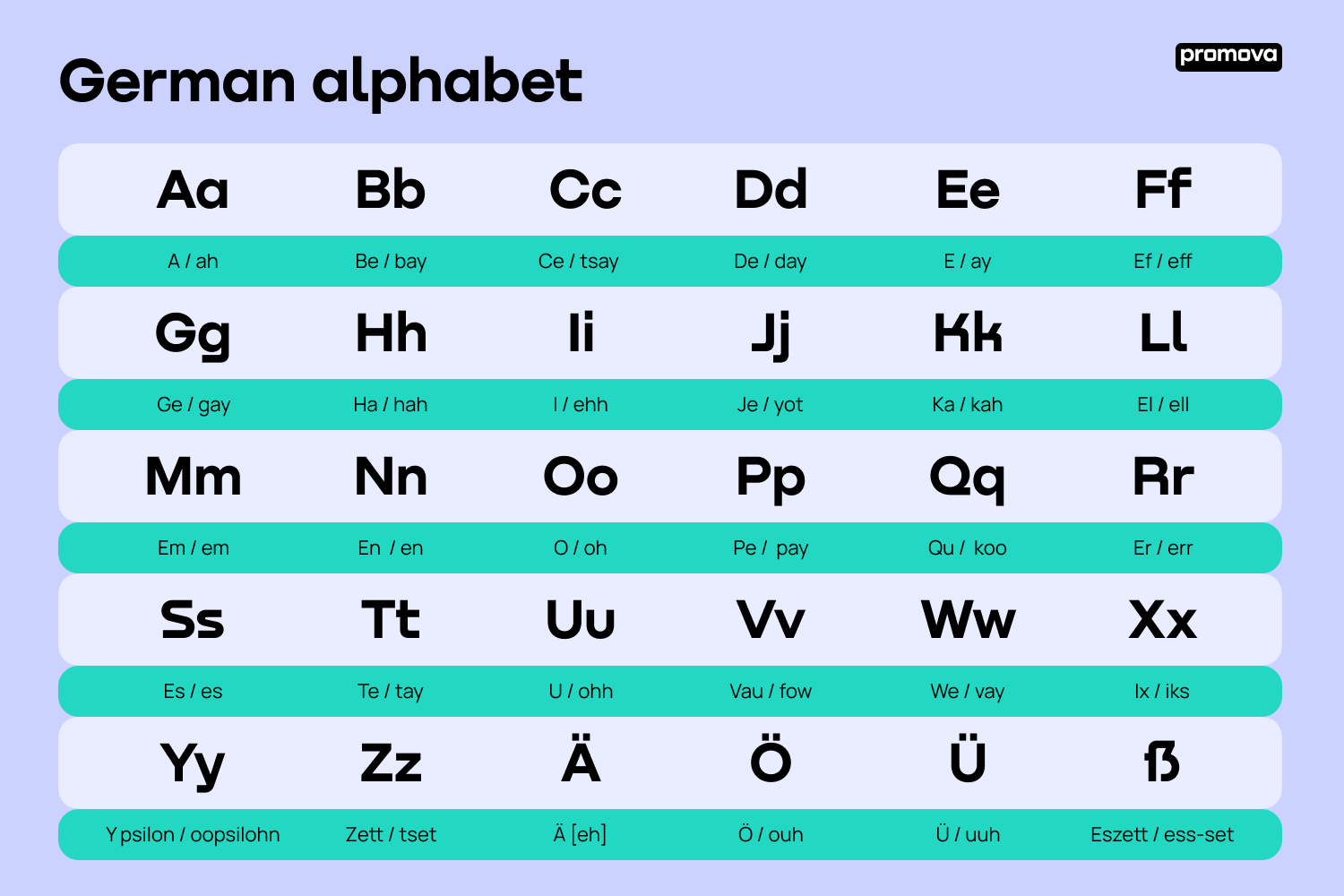
The following are the key letter names. The bold syllables approximate what you should say aloud.
| Letter | German letter name | Important note |
|---|---|---|
| A | ah | Not English “ay.” |
| B | beh | Contrast with P, peh. |
| C | tseh | Begins with a ts sound. |
| D | deh | Contrast with T, teh. |
| E | eh | Not English “ee.” |
| F | eff | |
| G | geh | Contrast with K, kah. |
| H | hah | |
| I | ee | Like the vowel in see. |
| J | yot | Not English “jay.” |
| K | kah | |
| L | ell | |
| M | emm | |
| N | enn | |
| O | oh | |
| P | peh | |
| Q | koo | |
| R | err | Use the light German r you practiced previously. |
| S | ess | |
| T | teh | |
| U | oo | |
| V | fau | The letter name begins with an f sound. |
| W | veh | The letter name begins with a v sound. |
| X | iks | |
| Y | Ypsilon | Often sounds approximately like “üp-si-lon.” |
| Z | tset | Not English “zee” or “zed.” |
The special characters have names too:
| Character | Say | What to remember |
|---|---|---|
| Ä / ä | äh | An A with an umlaut |
| Ö / ö | öh | An O with an umlaut |
| Ü / ü | üh | A U with an umlaut |
| ß | Eszett or scharfes S | The character represents an s sound |
The most useful contrasts for listening are:
- B / P: beh / peh
- D / T: deh / teh
- G / K: geh / kah
- E / I: eh / ee
- V / W: fau / veh
- J / Y: yot / Ypsilon
- S / Z: ess / tset
Do not rush these pairs. On a telephone line, the difference between beh and peh may determine whether a staff member records your name accurately.
GERMAN PRONUNCIATION 1: The German Alphabet 🔠🔠🔠
Watch “GERMAN PRONUNCIATION 1: The German Alphabet” by Learn German with Anja for a clear first pass through the alphabet and two spelling demonstrations.
Watch A through P, repeating each letter after the presenter. Continue with Q through Z, paying particular attention to R, V, W, Y, and Z. Then watch the spelling examples; pause before the presenter reveals each spelling and say the letters yourself.
From alphabet knowledge to real spelling
To spell in German, say one letter at a time with a short pause. You do not need to translate your name into German. Your name stays your name; only the letter names change.
Imagine your name is Lina:
L – I – N – A
ell – ee – enn – ah
If your name is Mira, say:
M – I – R – A
emm – ee – err – ah
If your name contains an umlaut, say the special letter itself. For example, Özdemir begins:
Ö – Z – D – E – M – I – R
öh – tset – deh – eh – emm – ee – err
The earlier pronunciation lesson helps here: ö is not an ordinary o, and Z is tset, not English “zee.”
Here are three fixed phrases worth learning as complete communication tools. You will study the grammar in more detail later.
| German phrase | Meaning | When to use it |
|---|---|---|
| Wie schreibt man Ihren Namen? | How do you spell your name? | Formal university interaction |
| Können Sie Ihren Namen bitte buchstabieren? | Can you spell your name, please? | Polite request to a staff member or new contact |
| Mein Name ist … | My name is … | Beginning your response |
| Bitte langsam. | Please, slowly. | When letters are too fast |
| Noch einmal, bitte. | Once again, please. | When you need repetition |
A short formal exchange can sound like this:
A: Können Sie Ihren Namen bitte buchstabieren?
B: Ja. Lina Weber: L – I – N – A, W – E – B – E – R.
A: Danke.
At this point, learn Sie in these phrases as the polite form used with staff, instructors, and people you do not know. A later lesson will explain when to choose du or Sie more systematically.
Your guide to the German alphabet - Duolingo Blog
Read the relevant parts of Duolingo Blog’s “Your guide to the German alphabet” to consolidate the basic alphabet, special characters, and the purpose of spelling things aloud.
In the section “What is the German alphabet?”, read the alphabet overview. Focus on the three umlauts and Eszett, including the important warning not to replace an umlaut with an ordinary vowel. Then go to “How to use the German alphabet” and read the spelling section. Notice the city-name system, but do not try to memorize it yet; saying individual letter names clearly is the essential A1 skill.
How to say an email address
An email address is usually easier to understand when you say it in chunks, then spell the difficult part carefully. A useful structure has three parts:
- The part before @, often a name or username.
- The @ sign.
- The domain, ending in something such as .de or .com.
In everyday German, use these words:
| Written symbol | Say in German | Meaning |
|---|---|---|
@ | at | at sign |
. | Punkt | dot / full stop |
- | Bindestrich | hyphen |
_ | Unterstrich | underscore |
For most university email addresses, write what you hear exactly. Do not automatically change a name with an umlaut into ae, oe, or ue. Some email addresses do use those letter combinations, while others may use a different official form. Follow the address supplied by the university.
Consider this fictional address:
lina.mueller-24@uni-beispiel.de
A clear way to communicate it is:
Lina Punkt Mueller Bindestrich zwei vier at Uni Bindestrich Beispiel Punkt de.
If the listener needs every character, spell it more slowly:
L – I – N – A, Punkt, M – U – E – L – L – E – R, Bindestrich, 2 – 4, at, U – N – I, Bindestrich, B – E – I – S – P – I – E – L, Punkt, D – E.
Notice two important choices:
- The address contains mueller, not müller. Here, u-e is literally part of the email address, so you spell U – E.
- The word Punkt is spoken aloud. Otherwise, the listener may hear lina mueller but not know where one part ends and the next begins.
For an email such as aisha.khan@stud.uni.de, avoid saying all characters as one fast stream. Give the listener a structure first:
Aisha Punkt Khan, at stud Punkt uni Punkt de.
Then spell any part that may be unclear:
Aisha: A – I – S – H – A. Khan: K – H – A – N.
Capital letters: when should you announce them?
German names normally begin with a capital letter in writing. However, email addresses are normally written in lowercase, and you generally do not need to say großes L (“capital L”) when giving an ordinary email address.
Use these terms only when capitalization genuinely matters:
- großes A — capital A
- kleines a — lowercase a
- alles klein — all lowercase
For example:
Die E-Mail-Adresse ist alles klein.
The email address is all lowercase.
A listening and writing routine
Spelling is partly a listening skill. You need to turn a stream of letter names into written characters accurately, especially when someone spells quickly.
Use this short routine:
- Prepare a note page with spaces for a first name, surname, and email address.
- Listen once without writing if the speaker is very fast; identify the beginning, any digits, and the domain ending.
- Listen a second time and write each letter, punctuation word, and number.
- Read the result back in German letter names to confirm it.
- Ask for repair immediately with Bitte langsam or Noch einmal, bitte if one letter is uncertain.
Letters such as B/P, D/T, and E/I deserve extra attention. When writing an email address, also listen specifically for Punkt, Bindestrich, and at. They are not optional words; each represents a character you must write.
Master The German Alphabet With Spelling Practice - A1 German Vocabulary
Use “Master The German Alphabet With Spelling Practice” by Learn German with Herr Antrim as a short dictation activity. It develops the listening side of spelling rather than only memorizing the alphabet in order.
Watch the spelling practice. Keep paper or a notes app open. Each time the instructor begins spelling a word, pause before the solution appears, write the letters you hear, then compare your result with the reveal. For this lesson, prioritize accurate recognition of letter names and capitalization signals rather than trying to understand every vocabulary item.
Build a personal script
Finish by making a compact script for your own name and the email address you expect to use in Germany. For privacy, use a fictional address in any public recording or shared document.
Write these three lines:
Mein Name ist: [your name].
[Your name]: [spell each letter with German letter names].
Meine E-Mail-Adresse: [say it in chunks, including Punkt, Bindestrich, and at where needed].
Read the script aloud twice:
- First, slowly enough that someone can write every character.
- Then at a calm, natural pace, leaving a slight pause after each part of the email address.
If a letter in your name is uncommon in German—such as Q, X, Y, or Z—repeat that letter separately several times. They are not difficult once their German names become familiar, but they are easy to confuse at speed.
Key takeaways
You can now spell a name and email address in a way that is useful for German university life:
- German spelling uses letter names, which differ from English in several key cases: J, V, W, Y, and Z.
- The most important listening contrasts include B/P, D/T, E/I, G/K, and V/W.
- Say äh, öh, üh, and Eszett for the special characters when they occur.
- In an email address, say at, Punkt, Bindestrich, and Unterstrich when needed.
- Give addresses in meaningful chunks, then spell the uncertain parts letter by letter.
- Use Bitte langsam and Noch einmal, bitte whenever you need clarification.
Next, you will learn how to choose a suitable greeting and farewell for formal and informal situations—an essential companion to giving your details confidently.
Can't find a good explanation? Sign up and we'll make it for you
Sign up