
Welcome back. In the previous lesson, you practised the same introductory questions in two versions: Wie heißt du? and Wie heißen Sie?, Woher kommst du? and Woher kommen Sie?. Now the focus is the decision behind those forms: which version fits the person and setting?
This matters immediately in Germany: you will speak casually with fellow students, but you will also need to communicate politely with lecturers, university offices, and people you do not yet know. By the end of this lesson, you should be able to choose du or Sie confidently in simple social and campus interactions.
Two forms of “you,” two social relationships
English uses you for nearly everyone. German asks you to signal the relationship more clearly.
- du is informal “you” for one person.
- Sie is formal, polite “you” for one person or more than one person.
The difference is not about whether someone is “important” or “better.” Both forms can be respectful. Instead, the choice expresses the level of familiarity and the setting.
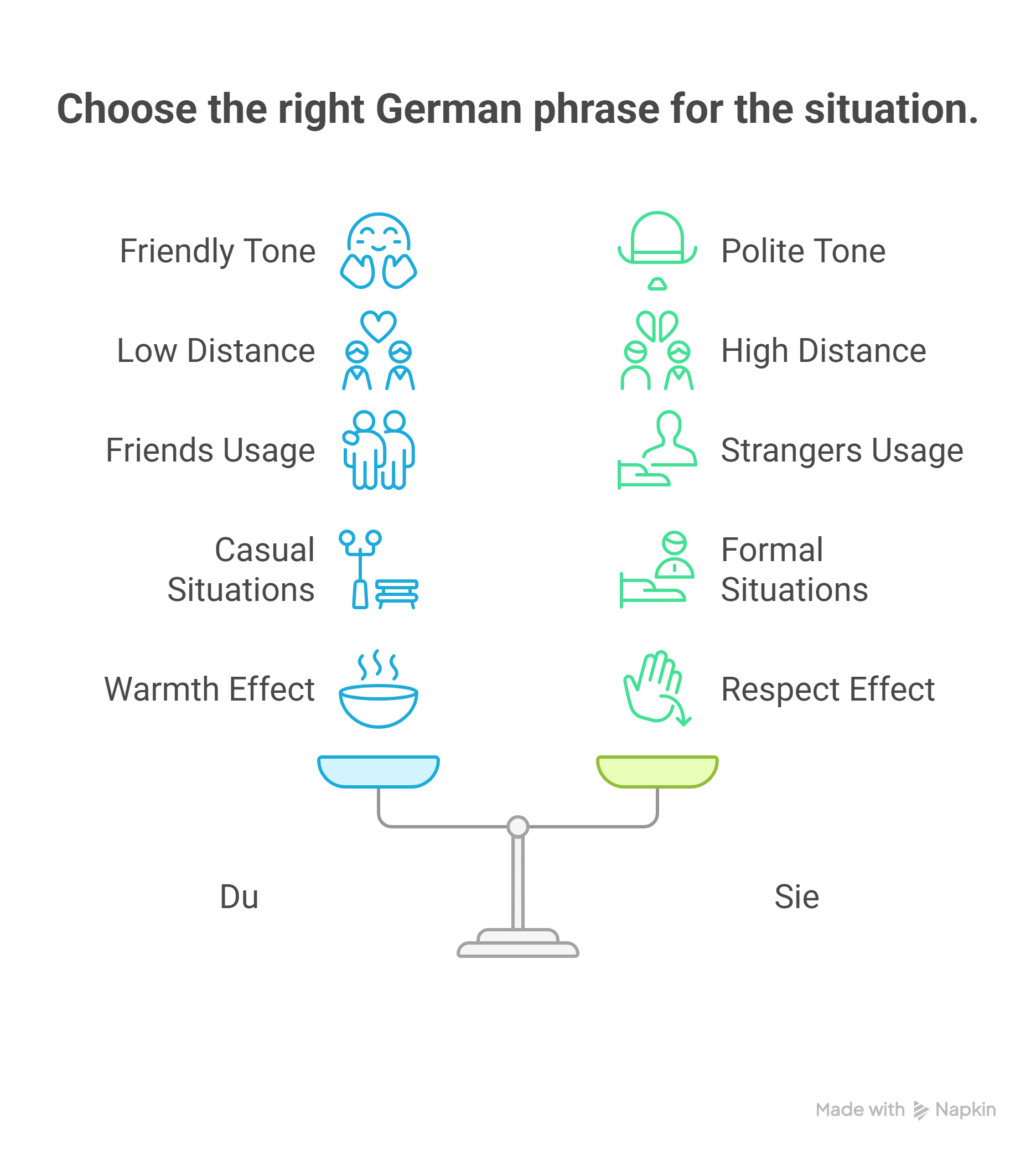
Think of this as a practical starting point:
| Usually use du | Usually use Sie |
|---|---|
| friends and family | university staff |
| fellow students and classmates | lecturers and professors |
| children and teenagers | strangers in official situations |
| people who have invited you to use du | employees in an office or public service setting |
| informal study groups and social events | formal emails and professional contacts |
At a German university, du is very common among students. If you meet another student during orientation, in a language class, or in a study group, du is normally the natural choice.
With a lecturer, a university administrator, or an employee at an information desk, begin with Sie. Some lecturers or workplaces may use du with everyone, but let them establish that norm or invite you to switch. Starting too formally is normally safer than becoming too familiar too soon.
Hear the choice in realistic contexts
The selected excerpt from Addressing people in German (DO THIS CORRECTLY!) | Du vs. Sie by Speak Fluent German gives a concise explanation of the social distinction, then connects it to the verb forms you have already encountered.
Addressing people in German (DO THIS CORRECTLY!) | Du vs. Sie | German lesson for beginners
Watch this short selection to hear when speakers use du and Sie, why formal Sie is a safe default in unfamiliar or professional situations, and how the verb form helps you recognise each choice.
Start with informal du for typical familiar contexts. Continue with formal Sie, focusing on strangers, professional settings, and customer service. Then watch verb clues to connect du with forms such as kommst and Sie with kommen. Finish with a safe default: begin with Sie when you are unsure, and listen for an invitation to use du.
A useful detail from the video is that Sie is not simply for people wearing formal clothes or people who are older than you. A casually dressed person at the university office is still likely to be addressed with Sie, because the interaction is official and you do not know each other.
Match the pronoun and the verb
The pronoun choice changes the verb. You already saw this in last lesson’s questions:
| Informal | Formal |
|---|---|
| Wie heißt du? | Wie heißen Sie? |
| Woher kommst du? | Woher kommen Sie? |
| Welche Sprachen sprichst du? | Welche Sprachen sprechen Sie? |
| Wie geht’s dir? | Wie geht es Ihnen? |
For many regular verbs, the informal du form has an ending like -st, while formal Sie uses the same -en ending as the dictionary form:
| Verb | With du | With Sie |
|---|---|---|
| kommen | Du kommst aus Indien. | Sie kommen aus Indien. |
| sprechen | Du sprichst Englisch. | Sie sprechen Englisch. |
| heißen | Du heißt Sofia. | Sie heißen Sofia. |
For now, do not try to create every form from a grammar rule. Learn the question pairs as complete useful phrases. The important point is that you cannot combine the pronoun from one column with the verb from the other.
Not correct:
Wie heißen du?
Woher kommst Sie?
Correct:
Wie heißt du?
Woher kommen Sie?
Notice also the spelling in writing:
- Formal Sie is capitalised: Sprechen Sie Englisch?
- The informal pronoun is normally lower-case: Sprichst du Englisch?
German also has sie, meaning “she” or “they.” At this level, context will usually make the meaning clear. In the middle of a sentence, capital Sie is a helpful sign that someone is being addressed formally.
The university survival default
Imagine your first week on campus. You will move between two kinds of interaction.
1. Fellow student: use du
You are waiting outside a classroom and meet another new student.
Du: Hallo! Wie heißt du?
Student: Ich heiße Elena. Und du?
Du: Ich heiße [dein Name]. Woher kommst du?
Student: Ich komme aus Spanien.
This is a peer interaction. The informal form helps create a relaxed, equal conversation.
2. Information desk or university office: use Sie
You need help finding an office or checking whether someone speaks English.
Du: Guten Tag. Entschuldigung, sprechen Sie Englisch?
Mitarbeiter: Ja, ein bisschen.
Du: Danke.
Here Sie is appropriate because the employee is not yet part of your personal circle and the interaction is official.
3. Lecturer: begin with Sie
You arrive early for class and need to ask a lecturer a simple question. Until you hear otherwise, use Sie.
Du: Guten Morgen, Frau Weber. Sprechen Sie Englisch?
Dozentin: Ja, ein bisschen.
Du: Danke.
The title Frau Weber is a polite form of address for a woman. You will meet additional titles and email conventions later in the course. For now, the key choice is Sprechen Sie ...?, not Sprichst du ...?
A lecturer may later say something such as Wir können uns duzen: “We can use du with each other.” In many student groups, a teacher may use du from the beginning. Follow the language they use and the local norm; do not assume that every university works exactly the same way.
Switching from Sie to du
Moving from formal Sie to informal du is called duzen. It is usually a mutual change, not something you impose on the other person.
You may hear:
Wir können uns duzen.
We can use informal du with each other.
A simple response is:
Gerne.
Gladly.
If a lecturer, supervisor, or colleague offers du, it is usually fine to accept with Gerne, danke.
In a formal environment, do not rush to offer the change yourself. Traditionally, the older person or the person with more seniority proposes it. Modern workplaces can be less formal, but the safest beginner strategy remains:
- Start with Sie in official or unfamiliar interactions.
- Notice what the other person uses.
- Switch to du when they explicitly invite it or when the group clearly uses it.
This strategy is especially useful when you begin professional internships or communicate with supply-chain staff later: workplace cultures differ, while polite caution is widely understood.
A short speaking routine
Read these pairs aloud twice: first slowly, then at a natural conversational speed.
| Situation | Say |
|---|---|
| You meet a student in your class. | Hallo! Wie heißt du? |
| You ask an employee whether they speak English. | Entschuldigung, sprechen Sie Englisch? |
| You ask a new study partner about their languages. | Welche Sprachen sprichst du? |
| You ask a lecturer about their languages. | Welche Sprachen sprechen Sie? |
| A classmate asks how you are. | Danke, gut. Und dir? |
| A university employee asks how you are. | Danke, gut. Und Ihnen? |
For a final rehearsal, picture yourself entering three places: a student orientation event, a university information desk, and your first class. Say one greeting and one question for each place. Your goal is not to say many sentences; it is to make the du/Sie choice automatically.
Key takeaways
- Use du for one person in familiar, informal settings, especially with fellow students, friends, and people who invite you to use it.
- Use Sie for one or more people in formal, official, professional, or unfamiliar situations.
- At university, du is usually appropriate with students; Sie is the safe starting point with lecturers and staff.
- Match the verb to the pronoun: du kommst, but Sie kommen.
- Formal Sie is capitalised in writing.
- When uncertain, begin with Sie and follow the other person’s lead.
Next, you will learn the numbers from 0 to 100, so you can understand and give phone numbers, addresses, room numbers, and student identification numbers.
Can't find a good explanation? Sign up and we'll make it for you
Sign up