
Hello again. In the previous lesson, you learned to choose du with fellow students and Sie in formal university interactions. Numbers now make those conversations practical: a staff member may ask for a telephone number, an address includes a house number and postal code, and enrolment documents may contain a student ID.
By the end of this lesson, you will be able to say any number from 0 to 100, recognize the common number patterns, and choose the clearest way to give numbers that function as identifiers rather than quantities. Plan for about 30 minutes for the core lesson, plus a short optional listening drill.
The essential numbers: 0 to 20
Begin by learning the first twenty as sound patterns, not merely as a written list. Numbers from 1 to 10 are the building blocks for almost everything else.
| Number | German | Number | German |
|---|---|---|---|
| 0 | null | 11 | elf |
| 1 | eins | 12 | zwölf |
| 2 | zwei | 13 | dreizehn |
| 3 | drei | 14 | vierzehn |
| 4 | vier | 15 | fünfzehn |
| 5 | fünf | 16 | sechzehn |
| 6 | sechs | 17 | siebzehn |
| 7 | sieben | 18 | achtzehn |
| 8 | acht | 19 | neunzehn |
| 9 | neun | 20 | zwanzig |
| 10 | zehn |
A few pronunciation reminders connect directly to the sounds you learned earlier:
- German z begins with a ts sound: zwei, zehn, zwanzig.
- German v sounds like English f: vier.
- The spelling ei sounds like the vowel in eye: eins, zwei, drei.
- The spelling eu sounds like oy: neun.
- In fünf, keep the rounded ü sound.
- In acht, use the back-of-the-throat ch sound. But in sechs, the ending chs is pronounced like ks, not like the sound in acht.
- In dreißig later in the lesson, ß represents an ss sound.
The numbers 11 and 12 are special:
- elf = 11
- zwölf = 12
From 13 to 19, you can usually recognize the smaller number plus -zehn (“ten”):
- drei-zehn = thirteen
- vier-zehn = fourteen
- fünf-zehn = fifteen
Two forms shorten slightly:
- 16 is sechzehn, not sechszehn.
- 17 is siebzehn, not siebenzehn.
Read the sequence aloud in three small groups rather than trying to memorize a long list at once:
null, eins, zwei, drei, vier, fünf
sechs, sieben, acht, neun, zehn
elf, zwölf, dreizehn, vierzehn, fünfzehn
Hear the rhythm of German counting
The video Counting in German from 1–100 from Easy German is useful mainly as a pronunciation and listening model. It is largely in German, so listen for the repeated number words, pause when needed, and repeat them aloud.
Counting in German from 1 - 100 | Super Easy German 178
Watch Counting in German from 1 - 100 by Easy German to hear the basic numbers, the teens, the tens, and the distinctive word order of larger German numbers.
Start with one to ten; repeat each number once after the speakers. Continue with teens and tens, paying particular attention to elf, zwölf, sechzehn, siebzehn, and zwanzig. Then watch combined numbers to hear why German says the final digit before the tens digit.
Tens, then the German “reversal”
First, learn the full tens:
| Number | German |
|---|---|
| 20 | zwanzig |
| 30 | dreißig |
| 40 | vierzig |
| 50 | fünfzig |
| 60 | sechzig |
| 70 | siebzig |
| 80 | achtzig |
| 90 | neunzig |
| 100 | einhundert or hundert |
Notice three shortened forms again:
- 60: sechzig, not sechszig
- 70: siebzig, not siebenzig
- 30: dreißig, with ß
Now comes the pattern that can initially feel unfamiliar. For numbers from 21 to 99 that are not exact tens, German says:
The smaller number comes first in speech and writing.
| Number | Literal structure | German |
|---|---|---|
| 21 | one-and-twenty | einundzwanzig |
| 24 | four-and-twenty | vierundzwanzig |
| 32 | two-and-thirty | zweiunddreißig |
| 46 | six-and-forty | sechsundvierzig |
| 58 | eight-and-fifty | achtundfünfzig |
| 73 | three-and-seventy | dreiundsiebzig |
| 89 | nine-and-eighty | neunundachtzig |
| 99 | nine-and-ninety | neunundneunzig |
Two details matter:
- These numbers are written as one word: vierundzwanzig, not vier und zwanzig.
- In a compound number, 21 uses ein rather than eins: einundzwanzig. When you say the single digit 1 by itself, especially in a phone number, use eins.
The number chart below is a quick reference for all numbers through 100. Use it to locate a number, say it aloud, then cover the German word and try to reconstruct it from the pattern.

A useful mental check is to look at the last digit first. For 68, identify acht and sechzig, then combine them as achtundsechzig. For 41, combine ein and vierzig: einundvierzig.
Quantities versus identifiers
The same written digits can be spoken in different ways depending on what they represent.
If the number is a quantity, price, room number, or house number, it is usually natural to say it as a whole number:
Hausnummer vierundzwanzig.
House number 24.
Raum siebenunddreißig.
Room 37.
But a phone number, postal code, or student ID is not really a quantity. It is an identifier: a sequence of digits. For maximum clarity, say each digit separately.
| Written information | Clear spoken German |
|---|---|
| 0176 482 09 31 | null eins sieben sechs, vier acht zwei, null neun drei eins |
| 04109 | null vier eins null neun |
| 093152 | null neun drei eins fünf zwei |
People sometimes group telephone digits differently, and you may occasionally hear a pair said as a whole number. However, for a beginner giving important information, individual digits are the safest choice. The listener can write each digit immediately, without needing to reverse the German word order in a number such as vierunddreißig.
This distinction is especially important for university administration. If a form or staff member asks for your Matrikelnummer (student ID number), give it digit by digit unless they clearly ask for another format.
Phone numbers and addresses in Germany
The German telephone-number format in the visual below helps you recognize the parts of a number. It uses a sample number, not a number you need to memorize.
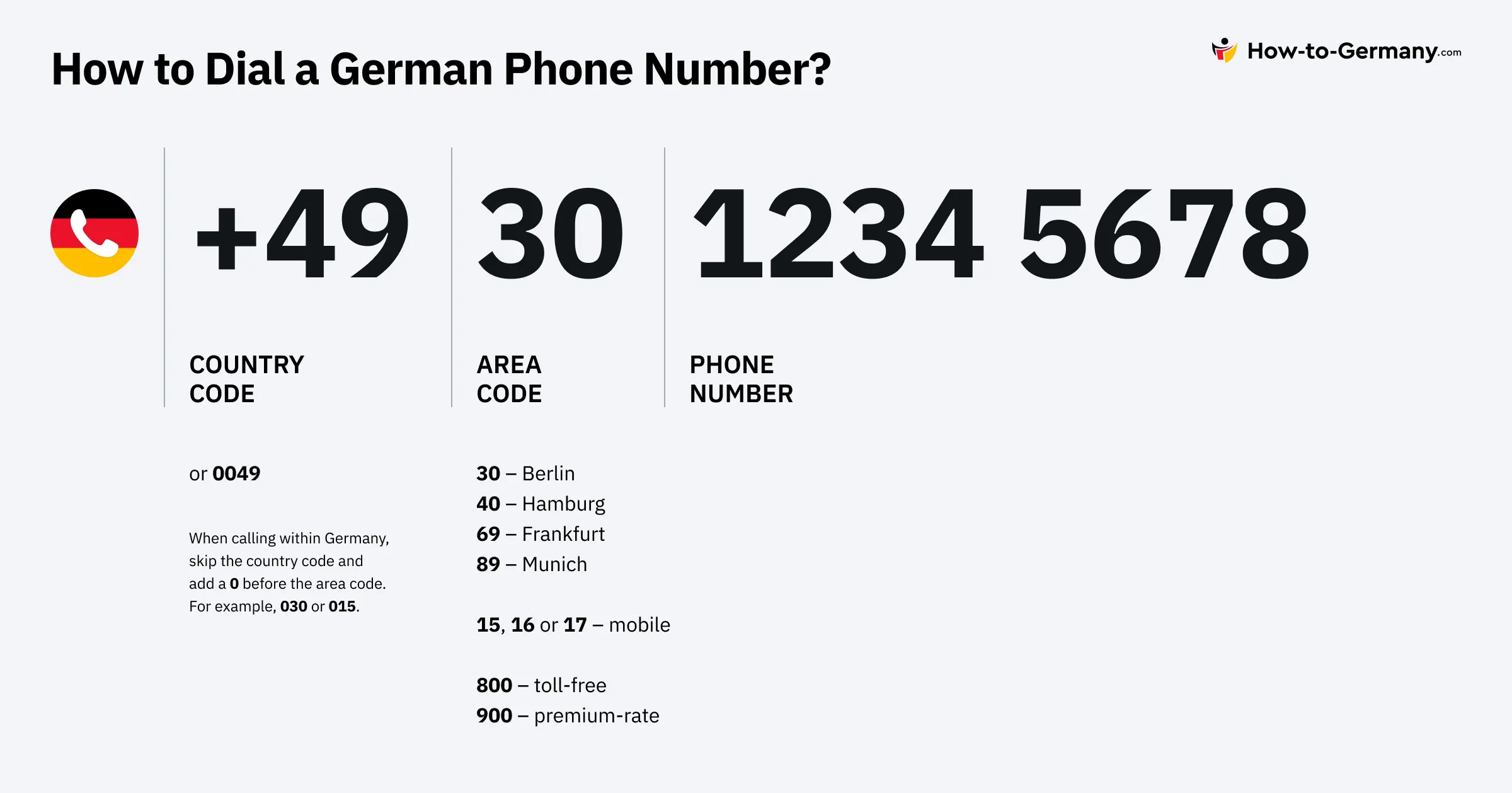
When calling a German number from outside Germany, the country code is +49 or 0049. The initial domestic 0 is omitted after the country code:
+49 30 1234 5678
Within Germany, the same example begins with the domestic 0:
030 1234 5678
For this course, the main goal is not to memorize German area codes. It is to hear and state the digits accurately. Practise the sample international format as:
plus vier neun, drei null, eins zwei drei vier, fünf sechs sieben acht
For an address, you may need two different number styles in the same sentence:
Meine Adresse ist Bahnhofstraße vierundzwanzig.
My address is Bahnhofstraße 24.
Die Postleitzahl ist null vier eins null neun.
The postal code is 04109.
Here, 24 is a house number and can be said as vierundzwanzig. The five-digit postal code is best given as five separate digits.
Useful formal phrases, using Sie as in the previous lesson, are:
Wie lautet Ihre Telefonnummer?
What is your telephone number?
Meine Telefonnummer ist null eins sieben sechs, vier acht zwei, null neun drei eins.
My telephone number is 0176 482 0931.
Meine Matrikelnummer ist null neun drei eins fünf zwei.
My student ID number is 093152.
If the other person speaks too quickly, a simple survival phrase is:
Entschuldigung, bitte langsam.
Excuse me, slowly please.
Train your ear with digit dictation
Listening is the part that turns memorized number words into a useful skill. Before playing the next resource, take a sheet of paper and write five blank rows. Your job is to write digits, not German words. Pause after each dictated number if necessary; accuracy matters more than speed.
German Listening Exercise - Phone Numbers (A1)
Use German Listening Exercise - Phone Numbers (A1) by Indogermanguide as a short dictation drill. It models phone numbers spoken digit by digit, which is the clearest format for contact details and student identifiers.
Listen to five phone numbers. Write each sequence of digits as you hear it, replaying individual parts when needed. Then use the answer screen to check your transcription. For any missed digit, replay only that number and say the sequence aloud before trying again.
For a short daily routine, choose three numbers from your real life without saying private information aloud in public:
- A two-digit room or house number, said as one full number.
- A five-digit imaginary postal code, said digit by digit.
- A six- to eight-digit imaginary student ID, said digit by digit.
This trains the key decision: whole number for a quantity or location; individual digits for an identifier.
Key takeaways
- Learn null through zwanzig securely; they form the foundation for all numbers up to 100.
- Numbers from 21 to 99 use the pattern ones + und + tens: vierundzwanzig is 24.
- Remember the shortened forms sechzehn, siebzehn, sechzig, and siebzig.
- Say eins when 1 stands alone, but ein in compounds such as einundzwanzig.
- Say house and room numbers naturally as whole numbers, such as vierundzwanzig.
- Give phone numbers, postal codes, and student IDs digit by digit: null vier eins null neun.
- In formal university interactions, you can ask: Wie lautet Ihre Telefonnummer?
Next, you will begin building basic German sentences by learning that nouns have grammatical gender and are normally learned with a dictionary form such as der, die, or das.
Can't find a good explanation? Sign up and we'll make it for you
Sign up