
Hello. This first module builds the core skeletal knowledge needed for your test. Since you already feel confident recognising the skeleton diagram, the priority here is being able to explain what the skeleton does, using accurate examples rather than only listing facts.
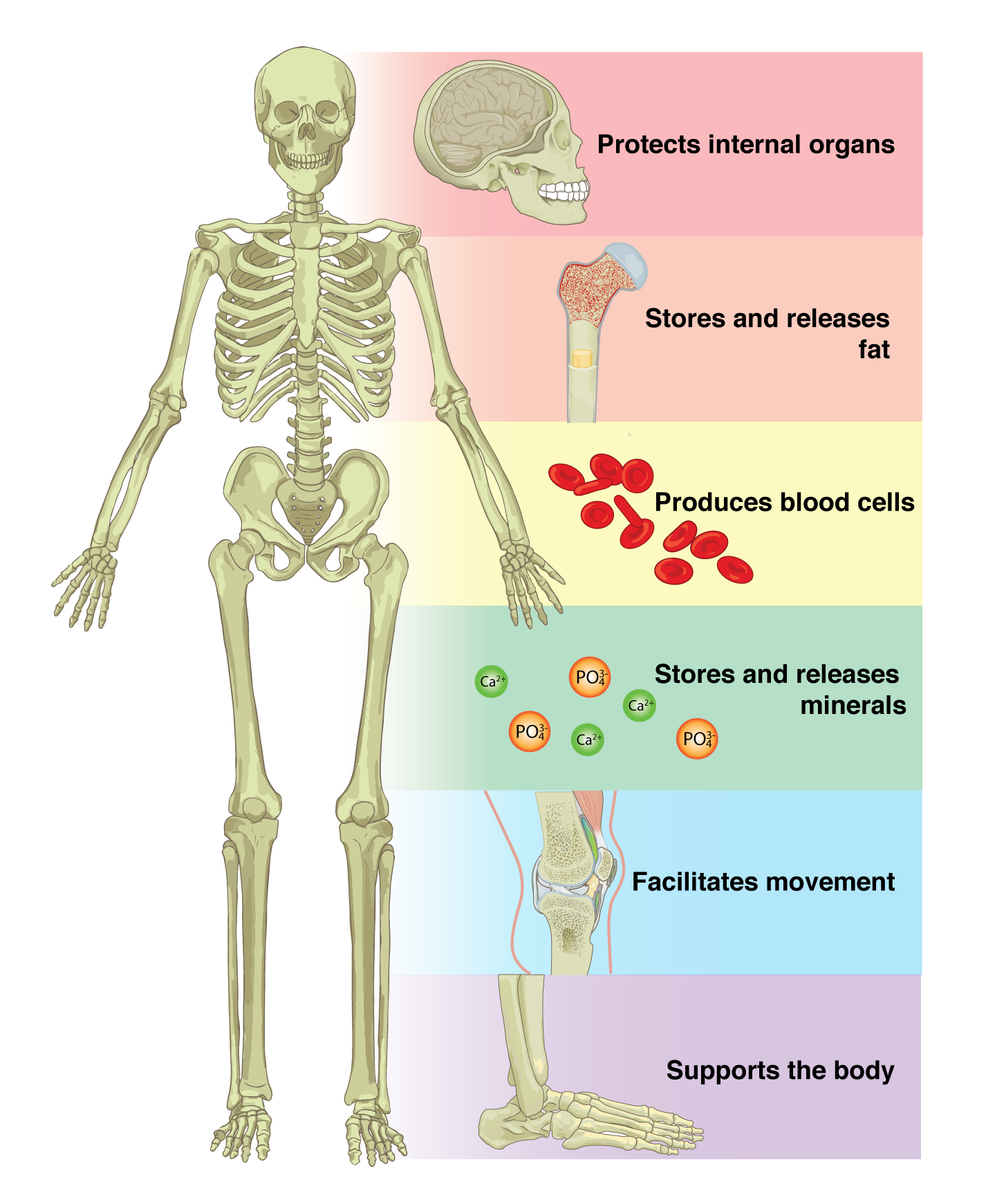
Your course groups the skeletal system’s roles into five major functions: support, protection, movement, storage, and blood-cell formation. By the end, you should be able to write a short, mark-ready explanation for each.
The five-function rule
Learn these five headings in this order:
- Support
- Protection
- Movement
- Storage
- Blood-cell formation
A small source of confusion: some diagrams show six functions because they list mineral storage and fat storage separately. For this course, treat them together under storage. Likewise, “shape” is usually included within support.
GCSE PE- Structure and Functions of the Skeleton
Watch the short “GCSE PE- Structure and Functions of the Skeleton” segment from Planet PE for a quick sport-focused overview. It is useful for hearing the functions connected to posture, movement, and body protection.
Watch support through movement, focusing on the difference between bones providing a framework and muscles pulling bones to create movement. Then watch storage and blood cells. The video mentions structural shape and muscle attachment as separate ideas; in your five-function version, include shape under support and attachment under movement.
Function, mechanism, and body example
In a test, do more than name a function. Use this reliable pattern:
Function + what the skeleton does + a specific body example
| Function | What it means | One strong body example |
|---|---|---|
| Support | Bones form a rigid framework that supports body weight, gives the body shape, and helps maintain posture. | The vertebral column supports the head and trunk when standing upright. |
| Protection | Bones surround or cover delicate organs, reducing injury from impact. | The cranium (skull) protects the brain. |
| Movement | Bones provide attachment points for muscles and act as levers at joints; muscles pull bones to make movement happen. | At the knee, thigh muscles pull on the lower-leg bones to straighten the leg. |
| Storage | Bone stores minerals, especially calcium and phosphorus, and marrow can store fat for energy. | The femur stores minerals in its bone tissue and contains yellow marrow that stores fat. |
| Blood-cell formation | Red bone marrow produces important blood cells. | Red marrow in bones such as the pelvis produces red blood cells, white blood cells, and platelets. |
The wording matters:
- Do not write “the skeleton makes movement.” Bones cannot contract or pull.
- Write that muscles pull on bones, with joints allowing the bones to move.
- Do not write only “bones store calcium.” Add that calcium can be released into the blood when needed.
- For blood-cell formation, mention red bone marrow, not simply “bone.”
The less visible functions: marrow and mineral storage
Support, protection, and movement are easy to observe. Storage and blood-cell formation happen inside bone tissue, so they are often forgotten in tests.
6.1 The Functions of the Skeletal System – Anatomy & Physiology 2e
Read this Oregon State Anatomy & Physiology section to reinforce the five functions with clear explanations of support, organ protection, marrow, minerals, and fat storage.
In the section “Support, Movement, and Protection,” read the explanation of the visible functions. Focus on the idea that bones are a body framework, sites where muscles attach, and protection around organs. Then read the full section “Mineral and Fat Storage, Blood Cell Formation,” beginning with the storage and marrow explanation. Notice the contrast: yellow marrow stores fat, while red marrow forms blood cells.
Storage
Bone is a mineral reserve. The key minerals are calcium and phosphorus, which give bones much of their strength. Calcium is also needed elsewhere in the body, including for normal muscle contraction and nerve signalling. If blood calcium levels need maintaining, minerals can be released from bone tissue.
Bones also contain yellow bone marrow, which contains stored fat. That fat is an energy reserve. For this lesson, both mineral storage and fat storage belong under the one heading storage.
A concise test sentence is:
Bones store calcium and phosphorus, and yellow marrow stores fat; for example, the femur contains mineralised bone tissue and yellow marrow.
Blood-cell formation
Red bone marrow is the site of blood-cell production. It makes:
- Red blood cells, which carry oxygen.
- White blood cells, which help defend against infection.
- Platelets, which help blood clot after injury.
A good example is the pelvis, which contains red marrow. You do not need to memorise every blood-producing bone for this outcome; knowing that blood cells are made in red marrow inside bones is the central point.
Turn the facts into test answers
Here is a full five-function response at the level you can adapt in a test:
The skeletal system supports the body by providing a firm framework; for example, the vertebral column helps keep the body upright. It protects vital organs, such as the skull protecting the brain. It facilitates movement because muscles pull on bones at joints, for example when the knee straightens. Bones also store minerals such as calcium and phosphorus, while yellow marrow stores fat, such as in the femur. Finally, red bone marrow produces blood cells; for example, marrow in the pelvis produces red and white blood cells and platelets.
For a shorter-answer question, use one precise sentence per function. Do not spend time listing lots of examples: one correct example for each function is enough.
A fast revision routine
Before moving on, cover the table and reproduce the five headings from memory: support, protection, movement, storage, blood-cell formation. Then attach these anchor examples:
- Vertebral column: support
- Skull: protection
- Knee: movement
- Femur: storage
- Pelvis/red marrow: blood-cell formation
This gives you a ready-made set of examples even when you are under time pressure.
Key takeaways
The skeleton is not just a set of bones to label. It:
- supports and shapes the body;
- protects organs;
- works with muscles and joints to enable movement;
- stores minerals and fat;
- forms blood cells in red marrow.
For high marks, always connect the function to a mechanism and a body example.
Next, you will move from whole-skeleton functions to the structure of a long bone, including how to identify the growth plate in a child’s bone and the epiphyseal line in an adult’s bone.
Can't find a good explanation? Sign up and we'll make it for you
Sign up