
Hello again. Last lesson focused on what the skeleton does: support, protection, movement, storage, and blood-cell formation. This lesson changes the question from function to classification: when you see a named bone, can you give its bone type and say whether it belongs to the axial or appendicular skeleton?
For your test, the key is to remember that these are two separate ways of classifying the same bone. For example, the femur is a long bone and it is part of the appendicular skeleton.
Two labels for every bone
Think of classification as answering two different questions:
| Question | Possible answers | Example: femur |
|---|---|---|
| What shape/type is it? | Long, short, flat, irregular, sesamoid | Long bone |
| Which region is it in? | Axial or appendicular | Appendicular skeleton |
Do not mix these categories up. Axial and appendicular describe a bone’s position in the skeleton. Long, short, and so on describe its shape.
A useful test-answer pattern is:
The ___ is a [bone type] and belongs to the [axial/appendicular] skeleton.
For example:
The patella is a sesamoid bone and belongs to the appendicular skeleton.
Axial versus appendicular: location first
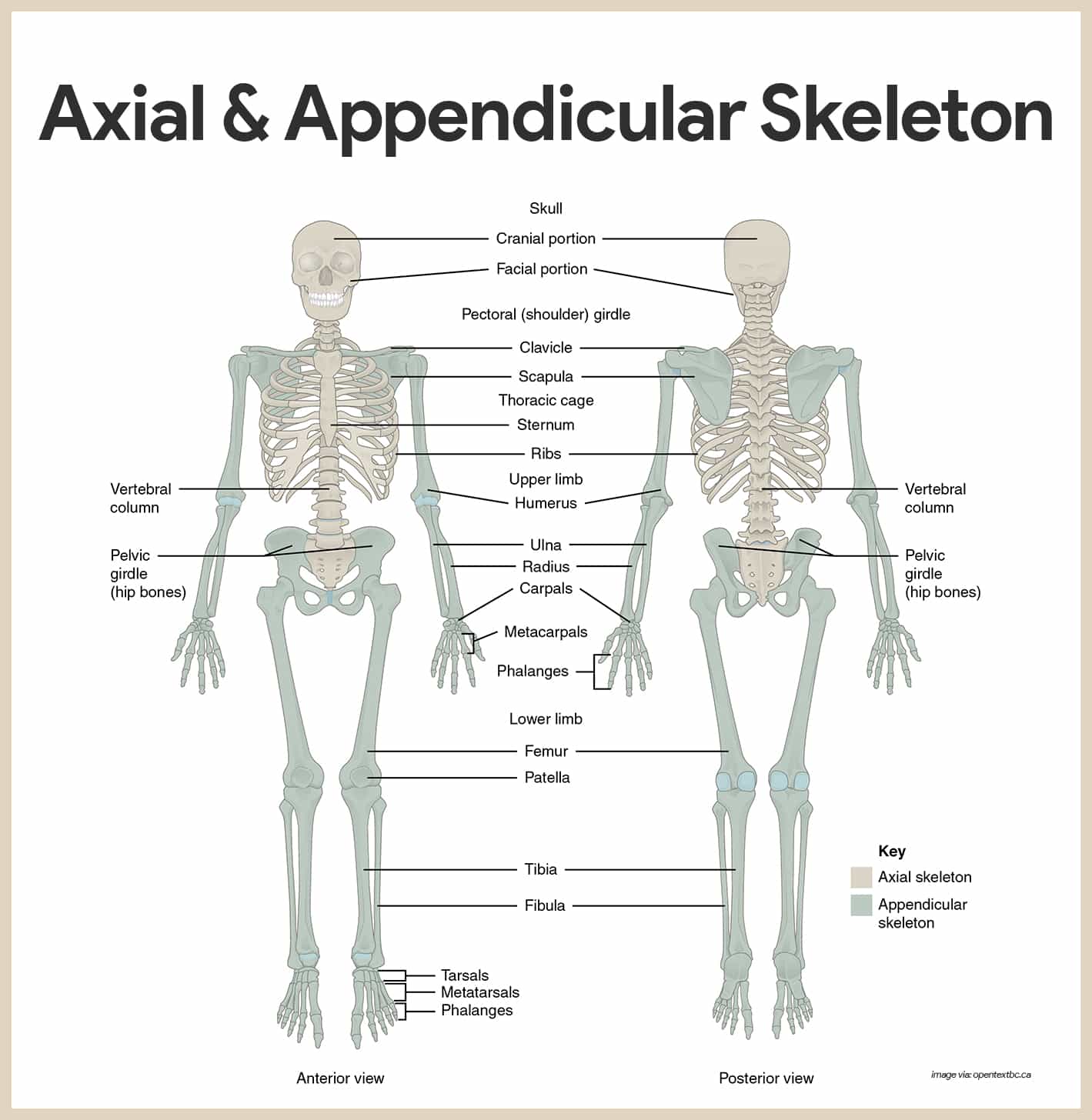
The axial skeleton forms the central axis of the body. Its main bones are the skull, vertebral column, ribs, sternum, sacrum, and coccyx.
The appendicular skeleton includes the limbs and the structures that attach them to the central skeleton: the shoulder girdle, arms, hands, pelvic girdle, legs, and feet.
The fast memory rule
- Axial: “axis” means the body’s central line. Think skull, spine, ribs, sternum.
- Appendicular: “appendages” means attached limbs. Think arms, legs, hands, feet, shoulders, hips.
One common trap is the shoulder girdle. The clavicle and scapula are close to the chest, but they attach and support the arms, so they are appendicular.
Another common trap is the pelvis:
- The sacrum, at the base of the spine, is axial.
- The paired hip bones/pelvic girdle are appendicular.
Watch “Types of Bones” by Dr Matt & Dr Mike for a quick visual overview of the two skeleton regions, followed by the five bone-shape categories.
Watch the two regions first. Focus on the distinction between the body’s central framework and the limbs plus their girdles; the exact bone totals are not essential for your test. Then watch the shape types, pausing mentally at each example: sternum, humerus, vertebrae, carpals, and patella.
The five bone types
Bone type is based mainly on shape, not simply on whether a bone is large or small.
1. Long bones
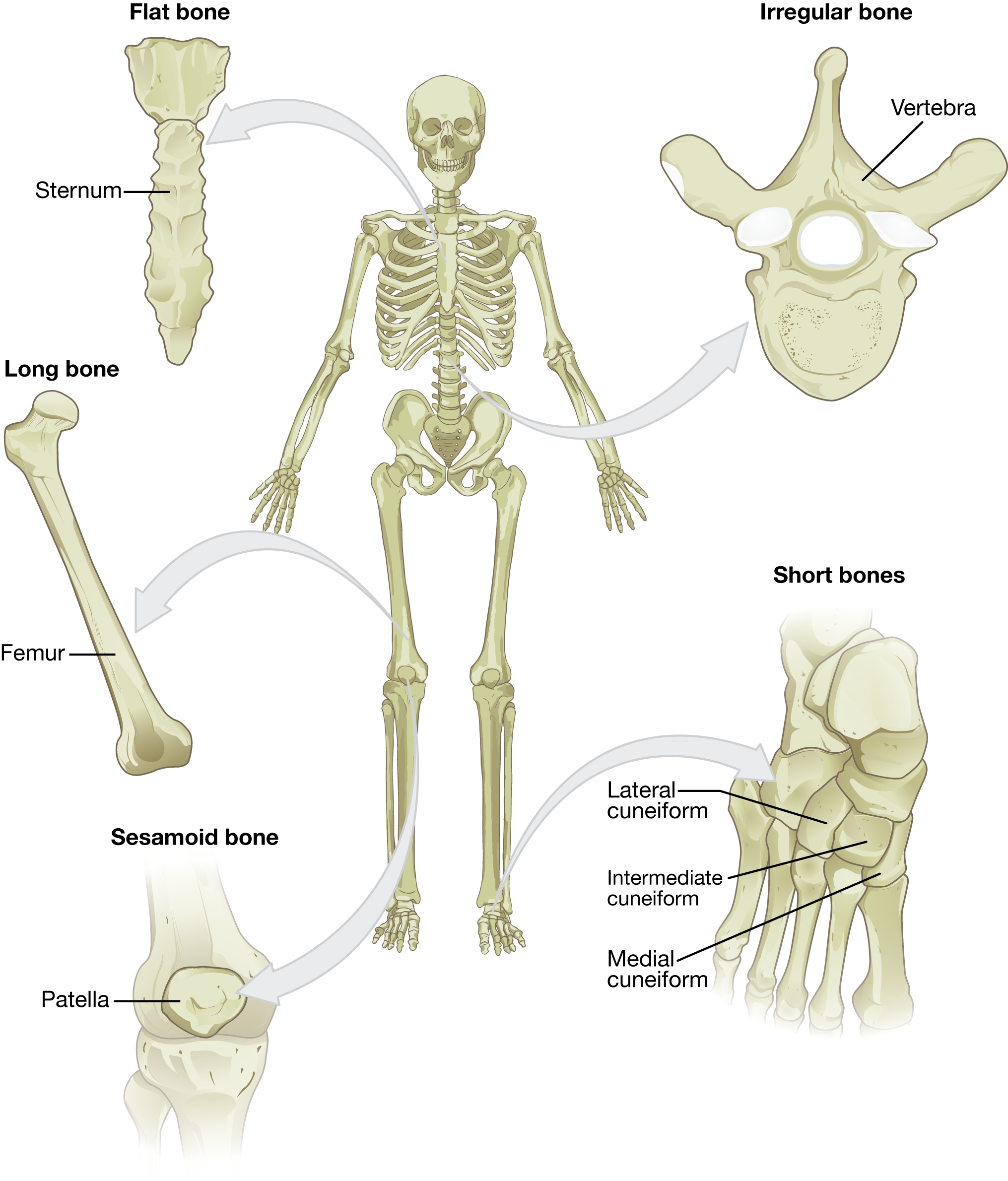
Long bones are longer than they are wide. They are usually found in the limbs and help with movement by acting as levers.
Major examples:
- Humerus: upper arm
- Radius and ulna: forearm
- Femur: thigh
- Tibia and fibula: lower leg
- Metacarpals, metatarsals, and phalanges: hand, foot, fingers, and toes
- Clavicle: collarbone
Almost all long bones are appendicular, because they are in the limbs or limb girdles.
Femur: long bone; appendicular skeleton.
Humerus: long bone; appendicular skeleton.
2. Short bones
Short bones are roughly equal in length and width. They are compact and help provide stability while still allowing small movements.
Major examples:
- Carpals: wrist bones
- Tarsals: ankle and rear-foot bones
Short bones are appendicular because the wrists and ankles are parts of the limbs.
Carpals: short bones; appendicular skeleton.
Tarsals: short bones; appendicular skeleton.
3. Flat bones
Flat bones are thin, broad, and often slightly curved. Their large surface helps protect organs and provides area for muscle attachment.
Major examples:
- Cranium/skull: protects the brain
- Ribs: protect the heart and lungs
- Sternum: breastbone
- Scapula: shoulder blade
Be careful with region:
- Skull, ribs, and sternum are flat, axial bones.
- The scapula is a flat, appendicular bone because it is part of the shoulder girdle.
Sternum: flat bone; axial skeleton.
Scapula: flat bone; appendicular skeleton.
4. Irregular bones
Irregular bones have complex shapes that do not fit the long, short, or flat categories.
Major examples:
- Vertebrae: protect the spinal cord and provide muscle attachment
- Sacrum and coccyx: at the bottom of the vertebral column
- Hip bones/pelvic girdle: complex bones at the hips
Again, location matters:
- Vertebrae, sacrum, and coccyx are irregular, axial bones.
- Hip bones are irregular, appendicular bones.
Vertebra: irregular bone; axial skeleton.
Hip bone: irregular bone; appendicular skeleton.
5. Sesamoid bones
A sesamoid bone develops inside a tendon, usually where the tendon passes over a joint. Its main example is the patella, or kneecap.
The patella is located in the tendon of the quadriceps muscle at the knee. It protects the tendon and helps the muscle pull more effectively when straightening the leg.
Patella: sesamoid bone; appendicular skeleton.
This is an easy one-mark or two-mark test point: patella = sesamoid + appendicular.
GCSE bone-type recap
BBC Bitesize groups the core GCSE types as long, short, flat, and irregular. Read its short table to lock in the standard examples and purposes. Then add the patella as the additional sesamoid example from this lesson.
Read the “Types of bone” section from BBC Bitesize. It gives a compact, test-focused table of the four main GCSE bone categories and their standard examples.
In the “Types of bone” section, begin at the bone-type table. Read all four rows and focus on connecting each type to its anchor example: femur, carpals, ribs, and vertebrae. Note that this table does not include sesamoid bones, so retain patella as your fifth category from this lesson.
The high-value classification grid
You do not need to memorise every bone in the body tonight. Learn this set, because it covers the major names most likely to appear on a Year 10 diagram or test question.
| Named bone/group | Bone type | Skeleton region |
|---|---|---|
| Cranium/skull | Flat | Axial |
| Ribs | Flat | Axial |
| Sternum | Flat | Axial |
| Vertebrae | Irregular | Axial |
| Sacrum/coccyx | Irregular | Axial |
| Clavicle | Long | Appendicular |
| Scapula | Flat | Appendicular |
| Humerus | Long | Appendicular |
| Radius and ulna | Long | Appendicular |
| Carpals | Short | Appendicular |
| Metacarpals and phalanges | Long | Appendicular |
| Hip bones/pelvic girdle | Irregular | Appendicular |
| Femur | Long | Appendicular |
| Patella | Sesamoid | Appendicular |
| Tibia and fibula | Long | Appendicular |
| Tarsals | Short | Appendicular |
| Metatarsals and toe phalanges | Long | Appendicular |
The examples to know perfectly
If time is tight, memorise these five pairings first:
| Bone type | Best example | Region |
|---|---|---|
| Long | Femur | Appendicular |
| Short | Carpals | Appendicular |
| Flat | Ribs or sternum | Axial |
| Irregular | Vertebrae | Axial |
| Sesamoid | Patella | Appendicular |
Avoid these common mistakes
Mistake 1: “Long” means a big bone.
No. A long bone is one that is longer than it is wide. The small bones in fingers and toes, called phalanges, are still long bones.
Mistake 2: The pelvis is entirely axial.
Not quite. The sacrum is axial because it is part of the spine. The hip bones are appendicular because they form the pelvic girdle that attaches the legs.
Mistake 3: All flat bones are axial.
The scapula is flat but appendicular.
Mistake 4: Patella is a short bone.
The patella is a sesamoid bone, embedded in a tendon.
Mistake 5: Giving only one classification.
If a question asks for both type and region, write both: “The vertebra is an irregular bone in the axial skeleton.”
A five-minute cram routine
Cover the classification grid and reproduce it from memory using these anchors:
- Centre of body: skull, ribs, sternum, spine = mainly axial.
- Limb structures: shoulders, hips, arms, hands, legs, feet = appendicular.
- Femur = long.
- Carpals and tarsals = short.
- Ribs, sternum, skull, scapula = flat.
- Vertebrae = irregular.
- Patella = sesamoid.
When you look at a skeleton diagram, classify each labelled bone in two passes: first decide axial or appendicular, then decide its shape type. That prevents the two classifications from becoming muddled.
Key takeaways
Every bone can be given two labels:
- a shape type: long, short, flat, irregular, or sesamoid;
- a skeleton region: axial or appendicular.
The axial skeleton is the body’s central framework: skull, vertebral column, ribs, and sternum. The appendicular skeleton includes the shoulder and pelvic girdles plus the limbs.
Your strongest test examples are:
- femur: long, appendicular
- carpals: short, appendicular
- sternum: flat, axial
- vertebrae: irregular, axial
- patella: sesamoid, appendicular
Next, you will look inside a long bone, learning the key structures and the difference between a child’s growth plate and an adult’s epiphyseal line.
Can't find a good explanation? Sign up and we'll make it for you
Sign up